
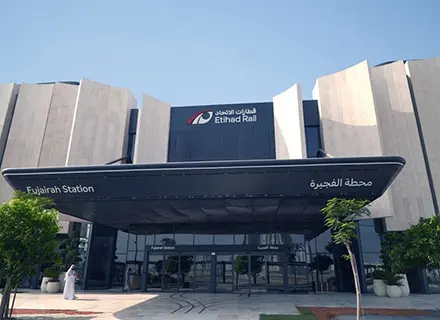

The United Arab Emirates (UAE) has stepped into a new era of domestic travel. On 30th June, Etihad Rail launched the Gulf major’s first passenger train service, running between Abu Dhabi and Fujairah in an introductory operational phase that officials describe as the opening chapter of a much larger national network. For a country that has spent decades building its identity around aviation and motorways, the sight of commuters queuing for a train ticket marks a genuine cultural shift.
The route, the numbers, the moment
The inaugural service connects Abu Dhabi and Fujairah with a journey time of one hour and 45 minutes, a dramatic cut from the roughly two and a half hours the same trip takes by road. The very first train departed Fujairah at 5.34 am, with passengers welcomed at the station with traditional Emirati dance and Arabic coffee, and arrived in Abu Dhabi seven minutes ahead of schedule. His Highness Sheikh Khaled bin Mohamed bin Zayed Al Nahyan, Crown Prince of Abu Dhabi, inaugurated the Mohamed bin Zayed City Passenger Train Station in the capital as part of the launch.
Sheikh Theyab bin Mohamed bin Zayed Al Nahyan, Chairman of Etihad Rail, called the network a defining moment for the country’s transport ecosystem, one built on modern technology to deliver a safe and efficient mobility system. The framing matters. This is not being pitched merely as a convenience for commuters, but as a structural piece of how the UAE wants to be seen, connected, efficient and diversifying beyond oil and aviation.
What the fleet and stations look like
The passenger fleet consists of 13 trains manufactured by the Spanish firm CAF, capable of speeds up to 200km/h and each carrying up to 400 passengers. Fujairah Station, the first to be fully completed in the network, sits within Hilal City, close to the emirate’s key economic hubs and roughly 12 minutes from Fujairah International Airport, with parking and ride hailing pick up points built in. Inside, elevators and escalators serve the platforms, alongside a premium lounge, a help desk, a police hub and real time timetable screens. Abu Dhabi Station in Mohamed Bin Zayed City will operate daily from 5 am to 11 pm, and amenities across stations include prayer rooms, family waiting areas, retail outlets and food and beverage counters.
Tickets, classes and how to book
Fares on the Abu Dhabi to Fujairah route start from Dh55 in Comfort Class and Dh120 in Premium Class, though this reflects a launch period discount of roughly half the regular Dh109 and Dh239 pricing. Within Comfort Class, travellers can choose between Standard, Value and Flex tiers, with the Flex option costing an additional Dh20, offering seat selection and a refundable booking, while the base Standard ticket has automatically assigned seating and no refunds. Children up to 17 travel at Dh28 in Comfort and Dh60 in Premium under the discount, seniors aged 60 and above pay Dh44 and Dh96 respectively, and infants under two travel free on an adult’s lap. Wheelchair users are charged standard adult or child fares, with designated spaces and priority seating subject to availability.
Bookings opened through the Etihad Rail app and website from 23rd June, and uptake has been swift. More than 10,000 tickets were sold in the week following the opening of bookings. Up to six services a day are expected to run between Abu Dhabi’s Mohamed Bin Zayed City station and Fujairah’s Al Hilal City station, spread across morning, afternoon and evening slots.
What the ride actually feels like
This is the part most likely to draw curious first time riders. Premium Class seats recline at the touch of a button and come with generous legroom, while both classes get USB and USB C charging points at every seat along with complimentary Wi-Fi. Retractable tray tables, overhead and under seat luggage storage, wall mounted hooks for bags, and dedicated seating for families and pregnant women feature across the cabins. Etihad Rail has been candid that for many residents, this will be their first experience of rail travel altogether, and station design has been shaped around that, with clear signage and staff on hand to guide first timers.
Interestingly, the cabin interiors also carry a distinctly national touch, featuring portraits of the UAE president and his sons woven into the contemporary design, a small but deliberate detail that ties the infrastructure project to the country’s broader identity building exercise.
The rollout still to come
The Abu Dhabi to Fujairah link is only the opening move. Dubai and Al Dhaid stations open on 30 September, followed by stations across the Al Dhafra region on 30 December, and the initial route will be completed when Sharjah station opens on 30 March 2027. Beyond that, feasibility studies are being conducted to evaluate expanding passenger rail into the remaining emirates and regions of the country. Once complete, the network will connect ten cities stretching from Al Sila in the west to Fujairah in the east, and Abu Dhabi to Dubai is projected to take under an hour, with Dubai to Fujairah around 69 minutes. A separate high speed line between Abu Dhabi and Dubai, expected to eventually cut that leg to just 30 minutes, is also part of the longer term plan.
There is a luxury dimension too. Etihad Rail has signed a deal with the Italian hospitality group Arsenale to develop a premium train experience, one that has drawn comparisons in spirit to the Orient Express, aimed squarely at the tourism market rather than daily commuters.
Why this matters beyond the timetable
The launch arrives less than five years after the UAE first announced its National Railway Programme as part of the “Projects of the 50” initiative in 2021, a pace officials are keen to highlight as proof the country can deliver large infrastructure ahead of schedule. Beyond the novelty factor, the economic logic is straightforward. Faster, cheaper intercity movement lowers the cost of doing business across emirates, opens northern emirates like Fujairah to a wider tourism catchment, and reduces reliance on congested highways. Once the network is fully operational, Etihad Rail expects to carry up to 10 million passengers a year, a figure that would meaningfully reshape domestic travel patterns in a country long defined by private car use.
For now, the practical takeaway for travellers is simple. The Abu Dhabi to Fujairah corridor is open, tickets are discounted for the launch window, and three more legs of the network arrive over the next nine months. Anyone curious about experiencing it first hand will not need to wait long to see the rest of the map fill in.
Image Credit: Etihad Website