
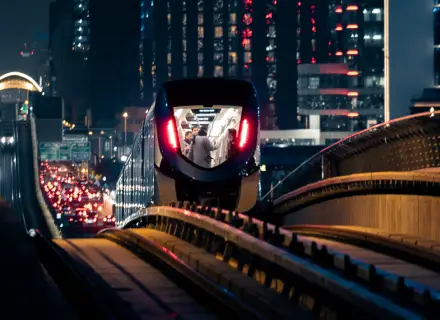

What used to take two hours will now take just 30 minutes. That’s a 75% cut in commuting time. We’re talking about rail lines that hit 250 km/h.
The Qiddiya bullet train is a part of the Vision 2030 strategy to improve connectivity and enhance mobility between important locations so that population growth and urbanisation don’t cause traffic bottlenecks.
The Royal Commission for Riyadh City announced an extension of the Red Line of the Riyadh Metro to Diriyah. It will be a 7.1km tunnel with 1.3km of elevated track, starting from King Saud University and Diriyah. They also planned Line 7, which would connect to the proposed Red Line extension.
There is going to be a huge reduction in daily traffic, with 150,000 cars removed due to the availability of this hyperspeed commuting possibility. Tourists from Bujairi Terrace and Wadi Safar will be able to get around the city much faster.
Vice Chairman Bandar Al-Saudun told Asharq Al-Awsat that the Diriyah development is one of the largest projects under Vision 2030. He also noted additional landmark initiatives in Wadi Safar, such as the Opera House project and the King Salman Grand Mosque.
Real estate is going to boom as the red line is extended along King Abdullah Road to Diriyah. The Vice Chairman especially noted the potential for a boom in the price of land from the King Salman International Airport through KAFD.
There are around 30 projects within Qiddiya, and these are also going to gradually vitalise the real estate sector. Major developments linked by the project include Expo 2030 Riyadh, The Avenues, and New Murabba. Of course, there is also the airport, which is meant to be one of the largest in the world by 2030.
Khaled Almobid, a real estate analyst, noted that the bullet train will improve land value by reshaping market structure over the medium and long term.
Almobid identifies two primary consequences, a redistribution of demand within Riyadh and an authentic market expansion driven by what he identifies as manufactured demand.
The project is expected to attract 70 million visitors and create 325,000 new jobs. Additionally, the areas around the stations are expected to attract a significant population.
It is important to note that, historically, the areas within a one to three-kilometre radius of transfer stations see capital appreciation and significant investment demand. This is particularly true for undeveloped “white land” that is metamorphosed into high-density transit projects.
Land prices also rose almost 40% since 2023, indicating a lot of market anticipation, Khaled said. He also expects sustainable growth as the travel time becomes 30 minutes between the airport and Qiddiya.
Once the local population increases, the real estate value, the next phase will see tourism real estate soaring. This is largely due to the new policy where Saudi Arabia is set to raise homeownership to 70% and its decision to attract 150 million visitors annually by 2030.