
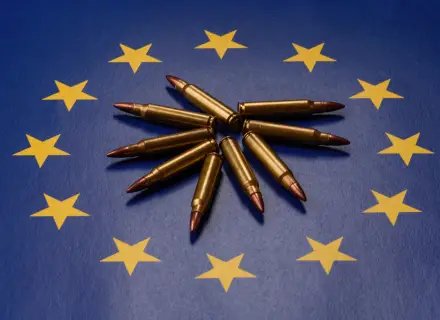

Any student of history would say that one of the most unsettling prospects is the rearmament of Europe, especially Germany. The fear is rooted not only in the atrocities of the Nazi era, including the Holocaust, but also in Germany’s historic industrial capacity for war. During two prolonged wars, Germany proved capable of handling conflicts on multiple fronts.
After World War II and the division into East and West Germany, the country was largely demilitarised and focused on economic reconstruction under the security umbrella of the United States and the Soviet Union, and later under NATO.
With the end of the Cold War, much of Europe came to believe that large-scale continental war was behind them. However, Europeans had a wake-up call, first with the conflicts in the Balkans, followed by the Russian annexation of Crimea in 2014, and the invasion of Ukraine on February 24, 2022. The war in Ukraine is a frozen conflict in its fourth year of devastation.
Europe’s rearmament is being driven by two major forces. Firstly, fear of an expansionist Russia and, secondly, growing doubts about whether the United States, under Donald Trump’s more isolationist approach, would fight on Europe’s behalf.
The age of European pacifism is ending. Germany, Poland, and other states are rearming, while France and the UK remain active military powers. Ukraine, forged by years of war, has become the continent’s most experienced military and a testing ground for 21st-century warfare.
ALSO READ | Can Britain’s 298 billion pound ‘Defence Investment Plan’ keep the country safe?
With the US-Israel’s war with Iran, and the closing of the Strait of Hormuz, the great powers of Europe hesitantly find themselves in the Indian Ocean with fleets and submarines.
Great Shadow Of The Military Industrial Complex
The world seems to be in a security crisis. Heads of state are being abducted or assassinated (Venezuela and Iran). The sovereign territory of one nation is being invaded and annexed by another (the Ukraine war). There are accusations of genocide or ethnic cleansing (Israel-Palestine). And, the fight for resources, especially energy, is entering a new phase. Global economies are bracing for $200 a barrel. But even in war, there is money to be made.
Defence spending in EU member states has risen from €218 billion in 2021 to €381 billion in 2025. According to the International Institute for Strategic Studies (IISS), Europe accounts for around 21% of global military spending, which means more than one-fifth of the global military budget is now in Europe (a region that America took great care to ensure doesn’t rearm or militarise for the longest time).
It began as an emergency response to what was happening in Ukraine, a reaction to perceived Russian aggression. It quickly turned into structural rearmament as European governments grew more doubtful about the durability of US security guarantees.
Ursula Von Der Leyen, President of EU Commission, introduced REarm Europe on March 2, 2025, to EU member states. The new REarm Europe/ Readiness 2030 plan is an €800 billion framework in which members will push defence spending from 1.9% of their GDP in 2024 to 3.5% by 2030. The EU initiated a €150 billion loan programme titled ’SAFE’ (Security Action for Europe) to support joint weapons procurement, with projects generally requiring that no more than 35% of component costs come from outside the EU, the EEA-EFTA states, or Ukraine.
Additionally, €1 billion will be allocated to the European Defence Fund in 2026 for research and development, primarily for hypersonic missile defences, drone swarms, and next-generation tanks.
Rheinmetall CEO Armin Papperger told Reuters: “A new era of rearmament has commenced in Europe,” and that it brings “unprecedented growth opportunities” for the company.
Not too long ago, defence contractors in Europe struggled to convince governments to increase the budget and procurement. Now, supply chains and even politics can’t seem to keep up with the demand.
The Doves Slowly Turn into Hawks
The EU Parliament and think tanks believe that the EU’s defence budget has risen 63% since 2020. The estimate for 2025 was €381 billion, amounting to about 2% of the bloc’s GDP.
The EU spent around €88 billion in 2024 on equipment procurement. This number was at €130 billion in 2025, while R&D is said to have risen from €13 billion to €17 billion at the same time.
There have been accusations about Germany underspending for many years. Understandably so, because German militarisation was more frightening than a stingy defence budget for most of the world. However, Germany is now the biggest spender in Europe, and has answered its critics by sharply expanding its defence budget, with spending projected to rise to €162 billion by 2029. This would represent approximately 3.5% of GDP.
The Baltic and Scandinavian states are also splurging money to harden NATO’s eastern flank. They are especially energised because they share land borders with Russia.
On February 15, Ursula Von Der Leyen tweeted: “We need a surge in defence spending. Europe must bring more to the table. I will propose to activate the escape clause for defence investments. It will allow member states to substantially increase their defence expenditure, in a controlled and conditional way.”
There is a ’national escape clause’ in the bloc’s fiscal rules, which allows for an additional 1.5% of GDP to be spent on defence without budgetary constraints. Furthermore, the SAFE facility enables €150 billion in joint borrowing to finance cross-border projects and encourage European governments to purchase European weapons rather than ammunitions, drones, tanks, and missiles from the United States, Israel, or Japan.
The bond markets and investors are happy. Not so long ago, environmental, social, and governance (ESG) portfolios did not include defence. But now, because of hard security shocks, defence has been rebranded as a public good on par with environmental conservation.
Europeans, once again, are beginning to see war as an inconvenient necessity rather than an evil to be avoided.
War Is Good Business
Armin Papperger wrote on the company’s official X account: “Defence is now by far the most dynamic sector of German industry.”
Europe’s Aerospace and Defence Index has surged over the past year, reflecting investor enthusiasm for the sector. Fitch Ratings estimates that the eight largest defence companies are seeing at least a 15% increase in demand from 2024, and their combined cash flow is at a record-breaking €8 billion.
Germany’s Rheinmetall is acquiring US-based Loc Performance Products for $950 million. In France, Safran is buying the AI defence firm Preligens for around €220 million so that it can have better surveillance and data analysis capabilities.
Even startups like the Europe-based Helsing is raising €600 million in a Series D round for their state-of-the-art drone and electronic warfare systems, which are AI-operated.
Investment managers and law firms are jubilant as SAFE brings cheap credit to the European military-industrial complex, with experts expecting increased funding for missiles, armoured vehicles, and aircraft. Resources will also be allocated to neotechnologies, such as quantum secure communication, space-based surveillance, and autonomy.
This trend is projected to drive countless cross-border mergers and joint ventures well into the 2030s.
Too Slow To Make Bombs
Europe is throwing money at the problem, hoping to be prepared for an inevitable showdown with Russia. But money can’t make missiles, shells, and drones by itself. European factories are ramping up production, but there are bottlenecks and serious limitations to output capacity.
Economists at BNP Paribas believe that the bloc can transform its underutilised industrial capacity, which was once used for automotive and adjacent sectors, for defence production. The defence output would be raised by 0.5 percentage points to annual GDP growth in the mid-2020s. That growth is not just going to come from weapons, but also from metals, electronics, and machinery required to make them.
Additionally, the SAFE initiative, which demands procurement from within Europe, and investor enthusiasm might revitalise factories that were once closed for defence manufacturing.
The European Defence Fund has grand plans, but full-scale production won’t start until early 2030, even though Ukraine is running out of ammunition and drones at an unprecedented rate.
Europe is trying to buy off-the-shelf systems while setting up its own, while also scaling up its existing lines.
The Side Effects Of Defence Spending
There are conflicting opinions from economists on how increased defence spending will affect the economy.
Filippo Taddei, senior European economist at Goldman Sachs, told Reuters that extra defence spending will support European growth, in particular, support European industry at a time when they are particularly struggling.
Carsten Brzeski, ING’s global macro head, said: ’increased defence expenditure results in a negative multiplier effect on growth’ in the short term.
Klaas Knot, head of the Dutch central bank, said, “A temporary fiscal exemption for higher defence spending is justifiable, but warned that public debt in the EU remained excessively high.”
If you focus too much on war, you risk deprioritising other sectors (essential sectors such as education and healthcare). There is also the risk of inflation and higher interest rates.
Europe is infamous for its expensive welfare system and green transition programmes. If they pile up military outlays on top of that, the continent could see a backlash from voters who struggle to make ends meet.
There is also a lot of debate about the inequality within the bloc. Bruegel and other think tanks analysed ’Rearm Europe’, and believe that the move would largely benefit national governments instead of the EU as a whole. For example, rich nations like Germany and the Netherlands will borrow cheaply and aggressively invest in weapons manufacturing, while Eastern and Southern Europe will find themselves in unsustainable debts, or incapable of militarising at a pace on par with their wealthy counterparts.
Europe’s political and cultural rebranding of making defence an ESG-compatible investment is still on the debate floor.
Institutional investors are arguing that supplying democracies with weapons to defend against tyranny is ethical and consistent with the EU’s vision.
But, many are afraid of dual-use technologies that will later be exported to poor countries with questionable human rights records. There is already a lot of uproar towards sending weapons to Saudi Arabia and Israel.
The ethical complexity of the issue is likely to affect industrial growth, even though the weapons manufacturing sector is seeing a boom.
An End To Reliance On External Security Umbrellas
Europe is beginning to understand that pacifism and reliance on external security umbrellas might not cut it. True safety and security come from self-reliance. The wars in Ukraine and Russia are stark reminders of a return to armament.
Despite throwing money at the problem and having the potential to have outstanding armies by the end of the decade, there are still several challenges that governments must navigate.
For starters, there are the industrial bottlenecks. Not all the money in the world can create missiles, artillery, and drones instantly. There are supply chain problems and production limits that are to be overcome gradually.
There is also the economic inequality and in-bloc politics that might arise because of a re-armed Europe, as Eastern and Southern states might find themselves drowning in debt, while nations like Germany and the Netherlands might make a profit through the rapid militarisation race.
Europe has long positioned itself as the most ethical society on earth. Making defence an ESG-compatible public good is highly controversial in European societies, and many see it as a means to pour government funds into the military-industrial complex.
Regardless, money is being poured into the military establishment, factories are reopening, and war looms on the horizon.