

War risk insurance (WRI), as an emerging industry vertical, provides financial protection to policyholders against losses stemming from geopolitical conflicts. The concept has been under the spotlight since 2022, but it is gaining traction as the world simultaneously deals with two large-scale geopolitical conflicts: the Ukraine war and the Middle East conflict.
While 21st century businesses have no other option but to take the volatile geopolitics into consideration while expanding their operations, the insurance sector faces the challenge of accurately assessing the possible outcome of damages and calculating appropriate premiums to charge.
As of 2026, war insurance remains an unknown quantity for insurance companies, with a high risk that a policy issued in this domain could lead to insolvency.
While industries like aviation and maritime trade still get specific war insurance options tailored to their needs, International Finance, using the ongoing Middle East conflict as a case study, examines how the broader War risk insurance industry has come under tremendous stress.
In Dire “Straits at Hormuz”
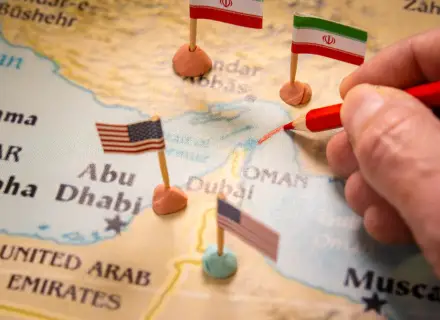
On February 28, 2026, the coalition of the US and Israel launched targeted air raids against Iran’s military and missile infrastructures, along with its decision-makers, repeating a similar act from 2025, killing the Western Asian nation’s Supreme Leader Ali Khamenei and many senior government and military officials.
Since then, Iran’s retaliatory missile and drone attacks across the Middle East have introduced chaos in the entire region. Apart from the American bases located in the region, energy production facilities are being attacked, while maritime trade through the Strait of Hormuz (one of the important shipping lanes) faces severe disruption.
While aviation and maritime trade are known for getting specific war insurance options, immediately after the conflict’s beginning, marine insurers started cancelling war risk coverage for vessels, as three tankers were damaged in the first week.
Through the Strait, oil equal to about one-fifth of global demand is moved by Saudi Arabia, the United Arab Emirates (UAE), Iraq, Iran, and Kuwait, with tankers hauling diesel, jet fuel, gasoline and other products. While maritime insurance majors, including Gard, Skuld, NorthStandard, the London P&I Club, and the American Club, excluded Iranian waters, Gulf and adjacent waters from their War risk insurance commitments, Skuld is reportedly working on a buy-back option to reinstate cover.
This move has led to a situation where the costs of shipping oil from the Middle East to Asia, already at six-year highs, could put the global energy trade under tremendous financial stress.
By March 13, the rates for a weekly coverage reportedly stood around ten times higher than before the beginning of the conflict, raising the transportation cost in the shipping corridor as well.

Nick Francis, Partner with Kennedys Legal Solutions in Singapore and Hong Kong, told International Finance that the coverage rise should be viewed using the parameter called additional war risks premiums (AWRP).
“AWRP, as the name suggests, is driven by risk. The risk in the Persian Gulf and surrounding areas has obviously escalated dramatically since the Iran conflict began. As a sidenote, while AWRP has exponentially increased, so have charter rates for these vessels – particularly tankers – so owners/operators are willing to pay the AWRP (which is usually passed on to charterers of vessels under charterparties in any event),” said Nick.
According to the marine journal Lloyd’s List, as of March 13, high-risk voyages were being quoted at approximately 7.5% of the ship’s value. This ratio may rise to 10% or more. Before the war onset, additional premiums (AP) for voyages through the Middle East Gulf (MEG) typically ranged from 0.15% to 0.25%.
The geopolitical developments in the last three to four years (including those in Ukraine and the Suez Canal) have made one thing clear: the choking of shipping lanes will be the new normal. In that case, will it add pressure to the WRI industry?
Nick, a leading shipping and international trade lawyer, told International Finance, “The insurance industry is built on an ability to price risk. I think the market is well steeled for the current conflict, given the recent experiences with the Black Sea/Sea of Azov following the Russian invasion of Ukraine, and the Houthi attacks in the Red Sea.”
Could the insurers have handled the Hormuz situation in a better manner?
Nick said, “The insurance industry is there to provide cover for various risks, which it does. It doesn’t create the risk.”
Shipping sector in a tight spot
Discussing risks, things are getting uncertain within the commercial marine industry itself, with a strong probability of hull rates rising. Dylan Mortimer, Vice-President of New York-based insurance player Marsh, told the Reinsurance News that there could be near-term rate increases for the Marine Hull line of businesses operating in the Gulf region by 25%-50%, with underwriters swiftly cancelling certain annual hull war policies under standard seven-day war clauses.
Stephen Rudman, head of marine for Asia at Aon, told Modern Diplomacy that the increase in hull war market rates should be seen as a quick response to the risk of significant losses if multiple vessels are attacked at the Strait of Hormuz. According to Rudman, there will be heightened underwriting scrutiny for voyages into or near sensitive (conflict) zones, including a potential requirement for prior approval.
Estimates by global investment giant Jefferies suggests that damages from seven reported vessels at the Strait (figures as of March 6) could lead to industry losses of up to USD 1.75 billion. Tankers valued at USD 200-USD $300 million could face new insurance rates of approximately 3%, translating to about USD 7.5 million in premiums, a significant rise from roughly USD 625,000 before the conflict.
Shedding further light upon the crisis, Nick noted, “When costs rise for the owner and operators of vessels, they will inevitably be priced into charter rates. Increased cargo premiums will obviously affect the landed value of goods – and will eventually be passed on to the end consumer.”
According to Sheila Cameron from the Lloyd’s Market Association, by March 6, about 1,000 vessels (mostly oil and gas tankers), with a total hull value exceeding USD 25 billion were in the Persian/Arabian Gulf region.
Stating that while most of these vessels are insured within the London market, she told Modern Diplomacy, “Reinsurers may respond to increased risks by adjusting the conditions under which their liability begins, potentially leaving main insurers with more risk and stress on their solvency levels.”
Also, the International Group of P&I Clubs has ceased coverage for vessels operating in and around Iran. Without it, shipowners will face open-ended liabilities, often halting voyages in high-risk areas. Industry reports reveal that such war-risk exclusions in the past led to reduced traffic and higher freight costs, and the same pattern can now re-emerge in the Persian Gulf as well.
According to London-headquartered GlobalData, reinsurers are repricing exposures across sectors such as marine, aviation and energy, while maintaining coverage continuity wherever possible. The conflict is affecting the sector through both direct exposure to loss events and indirect pressures, including higher reinsurance costs, capital flows, and inflation.
If anything, the changing geopolitics have taught the 21st century global socio-economic order that businesses need to engage with insurers to address disruptions and risks tied to war-like events, without any laxity.
Expressing confidence in the sector’s resilience, Nick concluded, “War is not new. War risk insurers have been recently dealing with the events in the Black Sea/Sea of Azov, involving missile strikes on vessels and, later, numerous constructive total losses (following a 12-month deprivation period), and missile attacks by Houthis in the Red Sea – so they are well- prepared to deal with the current events in the Persian Gulf.”