
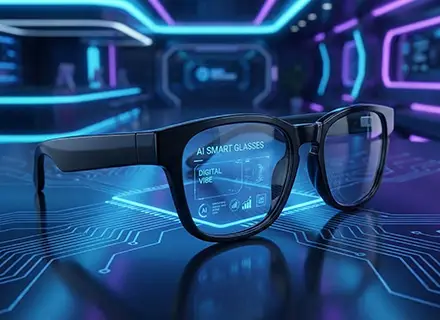

Smart glasses, known for their abilities to pack wearable tech into regular-looking frames, act as an extension of smartphones. The users can capture photos and videos hands-free, listen to podcasts via open-ear speakers, take calls, and use built-in AI assistants for real-time translation and object recognition, all while keeping their handsets in their pockets. And this is the same technology, which has emerged as the next big bet for Big Tech, with AI coming into the mix.
While the Mark Zuckerberg-led Meta has been selling AI-enabled Ray-Ban glasses since 2023, Google is building Android XR, and Apple will be entering the niche market as well. Samsung, along with eyewear biggie Gentle Monster, is working on its first AI-capable smart glasses. China’s Huawei, Alibaba, and Xiaomi are not behind either.
The shipments of smart glasses, in 2025, stood at 8.7 million units, up by over 300% from 2024. As per the analysts, the sales data will cross the 15 million mark in 2026. And that’s where the South Korean start-up LetinAR, which has spent the last decade building the optical technology, the technology that powers the wearables, is looking to lead the ecosystem of suppliers and component makers of the niche technology.
The LG Electronics-backed start-up hit the headlines recently by securing funding worth USD 18.5 million from a consortium consisting of the likes of the Korea Development Bank and Lotte Ventures. LetinAR is also eyeing filing an IPO in South Korea by 2027.
In today’s episode of the “Start-up of the Week,” International Finance will talk in detail about LetinAR, whose CEO Jae-hyeok Kim and CTO Jeonghun Ha, also high school friends, are looking to redefine the innovation game at the smart glasses segment.
Powering the heart behind smart glasses
LetinAR’s expertise lies in making the optical module that makes the smart glasses work. The module, which has an appearance like a tiny lens component, projects images into the smart glass user’s field of vision. The lighter, thinner, and more power-efficient the optical module is, the better it becomes in terms of delivering a sharp and clear image.
So, the critical engineering task here is to get that particular single component right by making it small enough to fit inside a normal-looking frame. Kim, while interacting with TechCrunch, stated that his start-up’s specialization lies in executing the tough engineering challenge perfectly.
“We see AI glasses as that next platform. And the optical module is the hardest part to get right, as AI glasses makers will need a lens that is thinner, lighter, and more power-efficient than what exists today,” he said further.
If AI is going to redefine how the next generation of smart glasses is going to work, then LetinAR’s goal is simple here: be the company that the glass makers will rush to during the R&D phase.
Talking about the company’s key technology, we have PinTILT. The start-up defines the technology through these following words: “The hybrid structure consisting of advantages of both waveguide and birdbath AR optics provides better form factor, power consumption, and image quality, enabling next-level AR smart glass experiences.”
To remain useful throughout the day, an augmented reality (AR) device must possess specific characteristics, such as being lightweight, having a long battery life, providing a clear exterior view when not in use, and displaying a wide and clear virtual image that draws users in.
The PinTILT technology, as per LetinAR, has been tailored to meet exactly those requirements. The technology offers high light efficiency, resulting in lower power consumption for the display. This significantly reduces the battery’s weight, making the smart glasses lighter and allowing for longer wear.
PinTILT’s structure prevents information from leaking to external observers. At the same time, its high transmittance allows users to maintain eye contact naturally. Another plus point of PinTILT is the simplicity in its design. In AR optical lenses, enhancing one key specification often means a reduction in another. To increase the FOV (Field of View) or eye box, birdbath designs grow in form factor.
“EPE (Exit Pupil Expander) designs, on the other hand, can suffer from reduced optical efficiency, leading to dimmer displays or requiring larger batteries. However, our B-Type PinTILT technology stands apart. Beyond the minimal thickness required by the display’s vertical dimension, it presents virtually no other significant trade-offs,” the start-up remarked.
EPE (Exit Pupil Expander) technology also requires high-refractive-index materials for expanded FOV, leading to higher production costs and manufacturing challenges that impact the end product’s pricing aspects. PinTILT has reportedly solved the issue by utilizing a “Wide Total Internal Reflection Angle,” enabling a large FOV using only conventional refractive indices. The B-type PinTILT structure has further been tailored for eyeglass forms so that the end product scores significantly on the wearability front, making it ideal for everyday AR and AI glasses.
“PinTILT lenses are produced using a high-efficiency injection moulding process. Unlike birdbath and waveguide designs, which require precise assembly of multiple components, PinTILT lenses are assembled with minimal parts, offering high manufacturability. These lenses are made with an injection-moulded plastic structure that is solid inside, offering strong durability. As a result, there is no need for additional protective covers or rigid frames. The outer shaping is simple, making it easy to adapt to various designs depending on the desired eyeglass form,” the start-up continued further.
By making the technology available through A-Type and B-Type, LetinAR has unlocked state-of-the-art performance across a wide range of displays and application fields. The A-Type PinTILT for Maximum FOV has emerged as suitable for wide FOV applications by providing two to four times the field of view compared to the same size and same components.
“While birdbath designs increase in volume to achieve a wide FOV, waveguides are limited to using only the area below half of the total internal reflection angle for multiple internal reflections. PinTILT offers a wider total internal reflection angle, allowing for a significantly larger FOV,” the start-up said.
The PinTILT structure has been specifically designed to cater to the large set of consumer demands. These include the basic type (suitable for car HUDs), the A-type (perfect for goggles), and the B-type (well-matched for glasses).
Through PinTILT, LetinAR has focused only on the light that can actually enter the eye. The technology has been carefully engineered, keeping in mind the angle of tiny elements inside the lens. The start-up wants to ensure that the AR device using the PinTILT technology can produce a brighter image in a thinner, lighter form factor, using less power.
Backing PinTILT, we have Pin Mirror, a device smaller than a pupil, that makes things increasingly transparent for AR as it approaches the eye, much like how eyelashes do not obstruct vision. Additionally, adjusting the size, spacing, transparency, and other factors of Pin Mirrors can offer users a sharper and more precise view.
Rewriting the AR playbook
Using PinTILT and Pin Mirror, LetinAR has developed Letinus (formerly B30), a compact lens module that features a lightweight design and is ideal for the development of smart glasses that can be worn for extended periods of time, thanks to its 22-degree field of view (FOV) and low power consumption.
T-Glasses, on the other hand, is an EV-Kit in the form of glasses that utilizes the Letinus lens module produced through standardized processes. Then we have FrontiAR, the module, Letinus’ successor, that has been customized for developing wide-angle smart glasses with a wide field of view of 45 degrees, low power consumption, and a lightweight design.
Last but not least, KeplAR is an EV kit in the form of glasses that incorporates the FrontiAR, offering a wide field of view of 45 degrees. With low power consumption and a lightweight design, FrontiAR is suitable for developing applications in everyday and industrial environments.
Talking about the commercial success of LetinAR’s products, Japan’s NTT QONOQ Devices and Dynabook, formerly known as Toshiba Client Solutions, have emerged as the start-up’s customers, giving the company real manufacturing experience at scale. However, it is the deal with Aegis Rider, a Swiss deep tech company spun out of ETH Zurich’s Computer Vision Lab, that has presented the deep tech company its “make-or-break” moment.
Aegis Rider is building an AI-powered AR helmet that displays navigation, speed, and safety alerts directly in a motorcycle rider’s field of vision, not floating on the visor but anchored to the road itself. Using LetinAR’s module inside the helmet, Aegis Rider is targeting a 2026 launch date for the European Union and Swiss markets.