
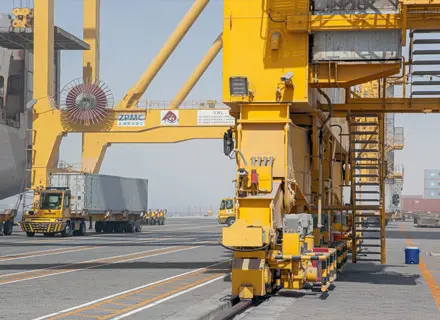

Despite its LNG trade taking a brute hit from the ongoing Iran war, there were green shoots in Qatar’s economy in May, as the Gulf major’s maritime sector continued its upward course, with significant increases in container handling, cargo throughput, livestock imports, and vessel arrivals across the country’s main ports.
According to data released by Mwani Qatar, the country’s ports handled more than 73,173 TEUs (twenty-foot equivalent units) in May, representing a remarkable 44% month-on-month increase. The strong rise in container traffic also reflects growing import and export activity, increased transshipment operations, and the continued expansion of maritime trade through the Middle East nation’s strategic gateways.
Qatar’s three main ports—Hamad Port, Doha Port, and Al-Ruwais Port—stepped up in terms of supporting the maritime sector’s operational resilience. Through these critical hubs, Qatar has been connected with major international shipping routes and more than 100 global destinations.
While bulk cargo volumes exceeded 48,077 tonnes, highlighting increased demand for raw materials and industrial commodities required to support Qatar’s economic and infrastructure activities, general cargo handling reached 2,488 tonnes, reflecting the steady movement of diverse commercial goods through the nation’s maritime gateways.
“Qatar’s ports processed around 20,070 heads of livestock during the same period. Such a constant flow of livestock imports has been playing a vital role in strengthening the nation’s food security strategy and ensuring stable supplies to the local market, particularly amid growing consumer demand, especially during the recent Eid holidays,” Mwani noted.
Vessel traffic too demonstrated positive momentum, as a total of 100 ships called at Qatar’s ports in May, marking an 8% increase compared with April 2026, indicating a growing confidence among international shipping lines in Qatar’s port infrastructure, operational efficiency, and logistics capabilities.
“May’s results represent a significant improvement over the previous month’s performance, when Qatar’s ports handled 50,738 TEUs, 8,600 tonnes of bulk cargo, 9,379 heads of livestock, and 93 vessels. The month-on-month gains clearly show accelerating trade activity and stronger cargo flows across multiple sectors,” Mwani stated further.
Talking about Qatar’s maritime sector, it has been the steady beneficiary of sustained investments in arenas like advanced port infrastructure, digital logistics solutions, and expanded shipping connectivity. Hamad Port, for example, has strengthened its position as one of the region’s leading maritime hubs, handling approximately 1.44 million TEUs during 2025, apart from serving as a key transshipment center for regional and international trade.
In Q1 2026, Qatar’s ports handled more than 291,000 TEUs, over 237,000 tonnes of general cargo, and around 200,000 tonnes of bulk cargo. The latest data only confirms the sector’s preparedness for another year of sustained capacity expansion. Linking Asia, Europe, Africa, and the wider Gulf region, Qatar’s strategic geographical position has made it a candidate for becoming the next logistics and maritime gateway.