


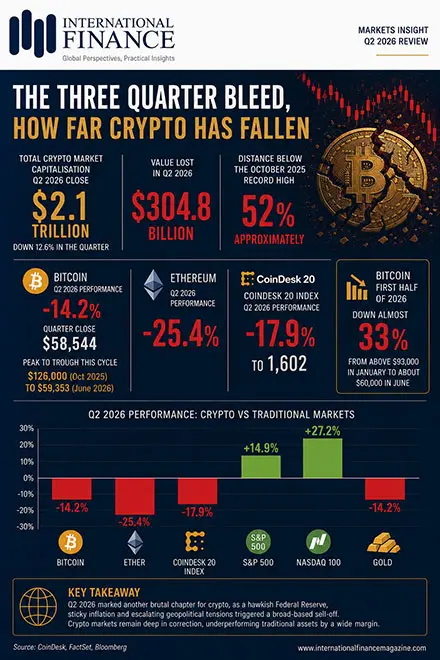
Digital assets have just closed their third consecutive quarter of decline, the longest losing run since the bear market of 2022. Total crypto market capitalisation fell 12.6% in the second quarter of 2026, shedding roughly USD 304.8 billion to end June at USD 2.1 trillion.
That is the lowest reading since September 2024 and about 52% below the record high set in October 2025, when bitcoin traded at USD 126,000.
What makes this decline unusual is what did not cause it. No major exchange collapsed. No large stablecoin lost its peg. There was no fraud at the centre of it and no single villain to name.
The damage came instead from two forces that sit entirely outside the industry, a war in the Middle East that rewrote the inflation outlook, and a Federal Reserve that responded by taking rate cuts off the table.
The war that moved the oil price
The chain of events began in late February, when the United States and Israel carried out a joint military operation against Iran that killed Supreme Leader Ali Khamenei and several senior officials.
Iran retaliated with missile strikes on American bases across Jordan, the United Arab Emirates (UAE) and Qatar, and moved to disrupt shipping through the Strait of Hormuz.
The energy market did the rest. Brent crude surged around 64% from roughly USD 73.50 before the conflict to a peak near USD 120 in early March. A ceasefire in mid-April pulled prices back below USD 100, but the truce never fully held.
 Through May and June, tanker seizures, naval build-ups and on-again, off-again negotiations kept a heavy risk premium in the price of oil, and kept markets guessing.
For crypto, the transmission was fast and mechanical. Institutional investors cut their most volatile positions first when geopolitical stress spikes, and digital assets sit at the top of that volatility ladder.
Bitcoin fell on the oil headlines in April, and again in early June when tensions flared once more. Altcoins fell harder, as they always do.
The quarter did not start badly. April was one of the strongest months of the year, and bitcoin recovered towards USD 80,000 in early May as ceasefire talks progressed.
The collapse came later. A single day in early June saw USD 1.8 billion of forced liquidations, the heaviest since February.
How a shipping lane became a monetary problem
The deeper damage was slower and more consequential. Sustained expensive energy feeds directly into headline inflation, and by March the tone at the Federal Reserve had turned.
Governor Christopher Waller, who had supported easing after weak February labour data, publicly reversed course and pointed to the prolonged Hormuz disruption as the reason. Rate cuts that markets had already priced in for 2026 began to be priced out.
Then the leadership changed. Kevin Warsh was confirmed as Fed chair by a 54 to 45 Senate vote, the narrowest in modern history, and brought a markedly different communication style.
His first meeting in June this year delivered a unanimous hold, a shortened statement stripped of its easing bias, and a dot plot showing nine of eighteen officials penned in at least one rate rise for 2026. The median year end rate expectation jumped to 3.8% from 3.4% in March.
On July 29, the committee held again at 3.50% to 3.75%, but the vote split 9:3, with the Cleveland, Minneapolis and Dallas presidents all dissenting in favour of an immediate quarter point rise. It was the sharpest split since 2016.
Warsh told reporters there is no soft inflation target on his watch. Futures markets now put the odds of a September rise above 60%.
This matters more to bitcoin than any protocol upgrade. In its current form bitcoin trades as a high beta risk asset.
When safe assets pay more, the cost of holding something that yields nothing goes up, and capital rotates out of the riskiest holdings first.
 The ETF machine ran in reverse
The clearest evidence sits in fund flows. Spot bitcoin exchange traded funds were the marginal buyer that carried the market to its 2025 high. In the second quarter they became the marginal seller.
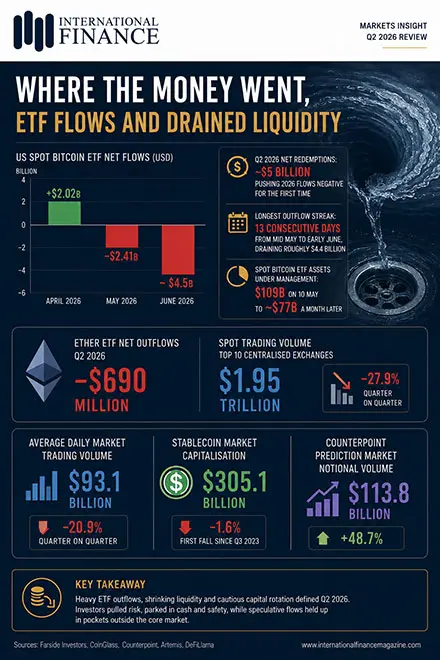
April was strong, with USD 2.02 billion in net inflows. May reversed to USD 2.41 billion of redemptions.
June was carnage, with about USD 4.5 billion pulled out according to SoSoValue, the worst month since the products launched in January 2024 and comfortably past the previous record of USD 3.56 billion set in February 2025.
That took net redemptions for the quarter to nearly USD 5 billion and pushed the year’s flows negative for the first time.
Between mid May and early June the funds recorded thirteen consecutive days of outflows, the longest such streak on record, draining roughly USD 4.4 billion on its own. Ether products lost a further USD 690 million over the quarter.
Total assets in the US spot bitcoin complex fell from roughly USD 109 billion on 10 May to about $77 billion a month later, tracking bitcoin’s 27% slide from a May peak of USD 81,443 to a low near USD 59,353. The funds’ bitcoin holdings are now around 7.2% below their October 2025 level.
A symbolic corporate sale added to the mood. On 1 June, Strategy, the listed company that has bought bitcoin consistently since 2020, disclosed that it had sold 32 coins for roughly USD 2.5 million to fund dividends on its preferred stock. In money terms it was nothing.
As a signal it was considerable, being the firm’s first disclosed net disposal since December 2022. A far larger sale followed, 3,588 coins for about USD 216 million between June 29 and July 5, at prices well below its average cost of about USD 75,476 a coin.
The decoupling nobody expected
The defining feature of the quarter was not the fall itself but the company crypto failed to keep. While bitcoin dropped 14.2% and ether 25.4%, the S&P 500 rose 14.9% and the Nasdaq 100 gained 27.2%, both lifted by a violent rotation into artificial intelligence equities. Gold also fell 14.2%.
For a decade the sector’s pitch has rested on two claims, that bitcoin is a hedge against monetary debasement and that it belongs in a diversified portfolio. A quarter in which equities rallied hard and crypto did not undermines both. Institutional money did not leave the risk trade. It simply found a better one.
Underneath the price action, liquidity drained away. Spot trading volume across the top ten centralised exchanges fell 27.9% to USD 1.95 trillion, with May setting a monthly low of USD 619 billion.
Average daily volume across the market dropped 20.9% to USD 93.1 billion. Most tellingly, stablecoin market capitalisation slipped 1.6% to USD 305.1 billion, the first quarterly decline since the third quarter of 2023 and the surest sign that capital is leaving the industry rather than rotating within it.
Not everything shrank. Prediction market notional volume grew 48.7% to USD 113.8 billion, with June setting an all time high on the back of the World Cup and other sporting events. Hyperliquid’s HYPE token broke into the top ten. Speculative appetite has not vanished, it has narrowed.
What the rest of 2026 looks like
July offered relief. Bitcoin rose roughly 9.8% to close the month near USD 63,000, ETF flows turned briefly positive, and the market steadied in the low sixties.
Three things will decide whether that holds.
The first is the Federal Reserve. The September meeting on the fifteenth and sixteenth is the next scheduled test, with Warsh’s Jackson Hole appearance in August ahead of it. A rate rise would likely push bitcoin towards the USD 50,000 to USD 55,000 zone that several banks now flag as downside risk.
The second is regulation. The CLARITY Act, the bill meant to give institutions the legal certainty to allocate to digital assets, is still fighting the Senate calendar.
Citigroup has already cut its twelve month bitcoin target from USD 112,000 to USD 82,000 and now forecasts zero net ETF inflows over the coming year, partly because it no longer expects the bill to arrive on time.
The third is the oil price, which remains hostage to whether the Iran ceasefire holds.
Analyst forecasts for year end run from a USD 53,000 floor to USD 150,000, a spread wide enough to be honest about how little anyone knows.
The realistic base case is a market that grinds sideways in the high fifties to mid sixties, with a possible deeper flush in the autumn before any recovery.
The industry spent 2025 arguing that institutional adoption had made crypto less volatile.
What 2026 has shown is that institutional adoption made crypto more sensitive to interest rates instead.