

AT&T put out a short press release on July 28. Two bullet points, four paragraphs of copy, no executive quotes, no fanfare. Read on its own it looks like routine housekeeping, the tidying up of a transaction the market had already priced in. It is nothing of the sort.
The closing of AT&T’s roughly USD 23 billion purchase of wireless spectrum licences from EchoStar ends a 15-year attempt to build a fourth national mobile network in the United States, hands the American regulator a powerful new precedent, and resets the competitive arithmetic in the world’s most profitable wireless market.
 What actually changed hands
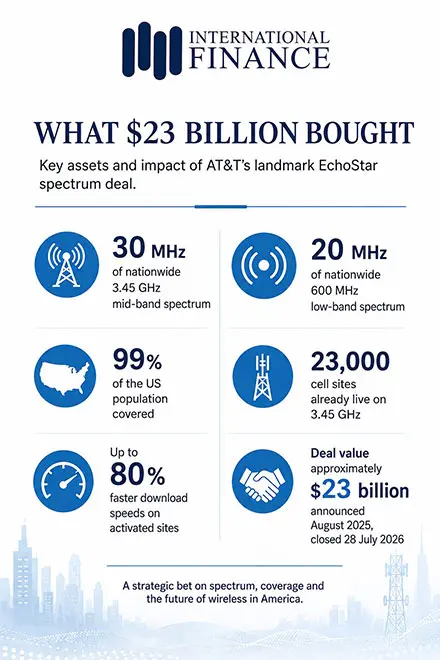
AT&T has acquired around 30 MHz of nationwide 3.45 GHz mid-band spectrum and around 20 MHz of nationwide 600 MHz low-band spectrum. Together the licences cover close to 99% of the American population. The deal was announced in August 2025, cleared by the Federal Communications Commission in May 2026 and completed last week.
Mid-band is the part that matters commercially. It carries far more traffic than low-band while still travelling reasonably well through walls, which is why engineers call it the sweet spot for 5G.
AT&T had been deploying the 3.45 GHz airwaves under a leasing arrangement since late 2025 and already has them live on roughly 23,000 cell sites, where download speeds have risen by as much as 80%.
The 600 MHz holdings are a slower story. Network and device work means customers are unlikely to feel much benefit for more than a year, and the FCC has told AT&T to move faster on that build than it had originally planned.
The end of the fourth carrier
The bigger story is what EchoStar has given up. Charlie Ergen spent well over a decade assembling spectrum with the stated aim of turning Dish into a facilities-based rival to AT&T, Verizon and T-Mobile.
Project Genesis, the USD 30 a month unlimited offer built on Dish’s own 5G core, was the visible end of that ambition. It stops serving customers on August 31. Dish filed for Chapter 11 protection on June 30, its finances squeezed in part by the delay in closing this very transaction.
What survives is Boost Mobile, which now runs as a hybrid mobile virtual network operator on AT&T’s physical network under a long-term wholesale deal that the FCC made a condition of approval. Boost keeps its cloud-native core and its brand, and AT&T charges it favourable rates.
But a reseller with a good wholesale contract is not a fourth network. The United States is back to three infrastructure competitors, and analysts have been open about what that means.
 T-Mobile’s shares climbed sharply after the Dish bankruptcy filing, on the straightforward logic that nobody is left to undercut the big three on price.
For anyone covering telecoms outside America, this is the point worth dwelling on. Regulators in Europe and Asia have spent years arguing about whether four networks are necessary for healthy competition.
The American experiment in manufacturing a fourth player through merger conditions and spectrum set-asides has now formally failed. That will be quoted in consolidation arguments from Brussels to Delhi for years.
A regulator that got exactly what it wanted
EchoStar did not sell willingly. The chain of events began when FCC chairman Brendan Carr opened an investigation into whether the company was meeting its 5G build-out obligations.
EchoStar has argued since that the inquiry created a force majeure event, which it used to justify halting payments to tower companies and contractors. American Tower, Crown Castle and SBA Communications all ended up in litigation.
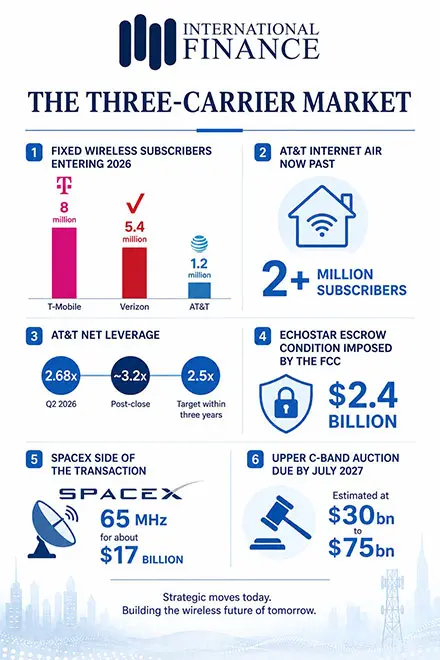
The regulator’s approval in May came with an unusual string attached. EchoStar was required to establish a USD 2.4 billion escrow account to cover claims from the vendors and infrastructure partners left unpaid when the Dish build was abandoned. EchoStar publicly called the condition unprecedented and involuntary while accepting the approvals themselves.
Strip away the detail and a use-it-or-sell-it doctrine has been enforced successfully against a major licence holder for the first time at this scale.
Carr’s team has framed it as part of a plan to move roughly 300 MHz of low and mid-band spectrum into active use by the end of 2027. Every regulator sitting on a hoarder’s portfolio has now seen a working template.
The competitive reset
AT&T needed this spectrum for a specific reason. Its fixed wireless business was capacity constrained in a way its rivals’ were not, because mobile and home broadband customers share the same mid-band capacity.
AT&T entered 2026 with about 1.2 million fixed wireless subscribers against roughly eight million at T-Mobile and 5.4 million at Verizon.
It has since said AT&T Internet Air has passed two million, doubling its base in about half the time it took to reach the first million. The EchoStar spectrum is what allows that growth to continue without degrading the mobile network.
The timing is pointed. Ookla and Opensignal both recently confirmed T-Mobile as the American speed leader.
AT&T has bought itself a serious shot at closing that gap, and the alternative route was waiting for the upper C-band auction due by July 2027, an event with price estimates running anywhere from USD 30 billion to USD 75 billion and no certainty about when cleared spectrum would actually be usable.
The balance sheet question
AT&T reiterated the financial outlook and capital allocation plan it gave with its second-quarter results, which is the sentence institutional investors were reading for.
Net leverage stood at 2.68 times adjusted earnings at the end of the second quarter and is expected to rise to around 3.2 times following the close, before returning to the roughly 2.5 times target within three years.
That is a substantial temporary stretch for a company that spent years rebuilding credibility on debt reduction, and management is signalling it does not consider the dividend or the fibre build at risk.
What to watch next
Three threads remain live. EchoStar is still evaluating its response to the escrow condition. Its Hughes Network Systems unit was reported to be preparing a Chapter 11 filing ahead of a USD 1.5 billion maturity due on August 1, and receipt of the AT&T cash may or may not change that calculation.
And SpaceX, which is paying about USD 17 billion for 65 MHz of EchoStar’s satellite-adjacent spectrum, now holds exclusive nationwide airwaves for direct-to-device Starlink service, with FCC waivers allowing terrestrial, space-based or hybrid use.
That last point deserves its own article. A satellite operator outbidding terrestrial carriers for licensed spectrum, and winning permission to use it either way, is a genuinely new fact about how this industry will be structured.