
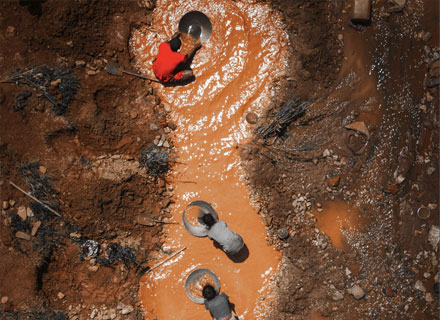

Beneath the Saharan dust, across a vast stretch of West Africa that most people could not place on a map, a gold rush is underway. It is not the romantic kind. In the three neighbouring nations of Burkina Faso, Mali, and Niger, roughly 230 tonnes of gold are dug out of the earth every year. At today’s prices, that amounts to about $15 billion annually. It is more gold than any other cluster of African nations produces.
This mineral wealth has become the financial engine of one of the world’s most violent and complex crises. It pays the wages of military rulers who seized power in a wave of coups. It funds Russian mercenaries operating thousands of kilometres from home. It fills the war chests of jihadist groups who have turned large parts of the three countries into ungovernable territory.
Understanding how this works, and why the world has struggled to stop it, requires looking at history, geography, and the mechanics of how gold moves from a hole in the ground to a vault in Dubai.
How It Got This Bad
The three countries at the centre of this story share more than borders. They are among the poorest nations on Earth. Niger, for instance, had an average income of just $560 per person in 2023. Nearly half its population lives below the international poverty line. The average person there can expect to live to 61. They describe lives shaped by hunger, illness, and a near-total absence of the public services most people take for granted.
Yet, for decades, these same countries sat on vast mineral wealth, and a great deal of that wealth left without benefiting the people living above it. France, the former colonial power in all three nations, maintained a deeply influential role long after formal independence. One of the most resented symbols of this was the CFA franc, a shared currency tied to the euro and historically managed with French oversight. Local governments were required to park a large portion of their foreign reserves in accounts at the Bank of France, which limited how freely they could manage their own economies. Meanwhile, Western mining companies operated under generous tax arrangements that critics argued left very little behind for the host countries.
This frustration eventually boiled over. Between 2020 and 2023, military officers staged coups in all three countries, ousting elected governments that large parts of their populations had come to see as corrupt and subservient to foreign interests. The new leaders expelled French troops, tore up defence agreements with the United States and the European Union, and withdrew from ECOWAS, the regional bloc that groups 15 West African nations. In September 2023, they formalised their break by forming the Alliance of Sahel States, known by its French initials AES, and agreed that an attack on any one of them would be treated as an attack on all three.
The problem they immediately faced was money. International aid dried up. Regional sanctions bit hard. Yet, these juntas had armies to pay, insurgencies to fight, and Russian paramilitary forces arriving to help prop up their regimes. The answer, as it turned out, was sitting right beneath their feet.
Squeezing the Mining Giants
Industrial gold mining in this part of Africa had for years been dominated by large foreign corporations, mostly from Australia, Canada, and the United Kingdom. They ran sophisticated operations, employed thousands of people, and paid taxes, though the new governments were convinced they had not been paying nearly enough.
Mali moved first and most aggressively. After an audit suggested the government had lost somewhere between $500 million and $1 billion in revenue it was owed, the authorities rewrote the mining rule book. Under the new code, introduced in 2023, the state gets an automatic 10% stake in any mine for free, with the option to buy an additional 20%. Foreign companies must sell a portion of their shares to Malian investors. Old tax exemptions were abolished. The message was clear: the terms of the old relationship were no longer acceptable.
What followed was less a legal process than a corporate shakedown. The Malian government simply summoned executives, detained them if necessary, and demanded settlements. In November 2024, the CEO of Australian miner Resolute and two colleagues were arrested in the capital Bamako. They were held for over a week before the company agreed to pay $160 million to settle alleged unpaid taxes. Resolute had little choice; the mine in question, at Syama in southern Mali, accounts for more than 60% of everything the company produces.
The biggest confrontation was with Barrick Gold, the world’s second-largest gold miner, over its Loulo-Gounkoto complex in western Mali. This single site represents roughly 14% of Barrick’s revenues worldwide, and about a third of Mali’s total gold output. The government claimed the company owed $5.5 billion in back taxes. It issued an arrest warrant for Barrick’s CEO, detained local employees, and in mid-2025, had a court hand operational control of the mine to a state-appointed administrator. After Barrick pursued international arbitration, a settlement was eventually reached in November 2025. The company agreed to pay $437 million, drop its legal case, and operate under the new framework. Several employees were released and operational control was to be returned in 2026.
Other companies settled too. UK-based Hummingbird Resources paid around $31 million. Canada’s B2Gold restructured its ownership arrangement at the large Fekola mine, converting the government’s share into a preferred stake that earns guaranteed dividends, in exchange for approvals to expand underground operations worth up to 100,000 extra ounces per year.
These settlements handed the juntas a significant short-term windfall. Mali alone confirmed in late 2024 that it had secured nearly $800 million from mining companies, with more payments due. But the longer-term picture is troubling. Industrial mining requires massive upfront investment that takes years to recoup. When governments detain executives and seize assets, future investors take notice. The pipeline of new projects that would sustain these revenues over the coming decades is unlikely to materialise if companies believe their assets can be arbitrarily taken away.
The Refinery Question
The more strategically significant development is what the AES governments are building now. Both Mali and Burkina Faso have begun constructing their first domestic gold refineries.
On the surface, this sounds entirely reasonable. At present, gold extracted in these countries is mostly exported as raw ore to be refined in Switzerland or South Africa. The refining process, which turns raw material into standardised gold bars ready for the global market, adds significant economic value. Why should that value be captured abroad? Building refineries at home means jobs, income, and a bigger slice of the value chain.
Mali’s refinery, being built near the capital Bamako, is designed to process up to 200 tonnes of gold per year. Its partner in the project is Yadran, a Russian conglomerate. Burkina Faso’s facility, launched by President Ibrahim Traoré in late 2023, is projected to handle 150 tonnes annually. The governments speak enthusiastically about the employment these facilities will create, citing hundreds of direct jobs and thousands of indirect ones.
But analysts who track illicit financial flows see something else entirely. The problem is not refineries per se; it is what a refinery does to the traceability of gold. Once ore from different sources is melted down together and cast into standardised bars, it is impossible to tell where the gold originally came from. A bar that comes out of the Bamako refinery might contain gold from a legitimate industrial mine, gold extracted by Russian mercenaries from a site they seized by force, and gold that jihadist groups taxed from informal miners in territory they control. The bar looks the same regardless.
This matters enormously because the global gold market operates on the principle that you can trace where bullion came from. The London Bullion Market Association, which sets the standards for gold traded internationally, requires strict checks on provenance. Gold that fails those checks cannot legally enter the mainstream market. A Russian-backed refinery in Mali, however, can export its bars directly to the United Arab Emirates or to Russia itself, bypassing European compliance checks entirely. From Dubai, the gold enters the global supply chain, and at that point, it is virtually untraceable. European jewellers, electronics manufacturers, and banks may unknowingly be buying what researchers call ‘blood gold’.
The Artisanal Sector and the Jihadist Tax
The industrial mines run by multinational corporations are only part of the picture. Across the Sahel, hundreds of informal digging sites operate with almost no regulation. In Burkina Faso alone, an estimated 430,000 people work in this artisanal sector, supporting over a million dependents. These are people digging by hand, often using mercury and other hazardous materials, in sites that may be little more than pits in the desert. Child labour is common. The work is dangerous and the rewards are small.
These sites are also deeply vulnerable to exploitation by armed groups. Jihadist organisations, principally a network called JNIM and a local affiliate of the Islamic State, have steadily taken over large parts of the rural Sahel. As they did so, they imposed themselves on the artisanal mining economy. They do not typically dig for gold themselves. Instead, they run protection rackets. Miners who want to keep working must pay fees. Transporters moving raw gold along roads pay tolls at checkpoints. These groups levy a form of taxation on the entire informal economy of the areas they control, and the gold sector is one of their most lucrative targets.
The revenue funds their operations directly. JNIM and allied groups have used this money to blockade towns, cutting off food and supplies to force civilian compliance, and to sustain sieges of military outposts. They pay fighters, buy weapons, and recruit from communities that have been terrorised, or economically marginalised.
Once this gold has been taxed, it enters a smuggling network that stretches from the Saharan interior to the coast. Criminal middlemen aggregate illicit gold with material from legitimate sources. It crosses borders, often through Togo or Benin, and then flies out of airports in Accra, Lomé, or Bamako, frequently destined for gold markets in Dubai. The UAE has become a critical node in this system, a place where gold of uncertain origin is absorbed into the global supply chain with relatively few questions asked. Burkina Faso alone is estimated to have lost over $490 million in a single year to gold smuggling and the under-declaration of exports.
Russia’s Cut
No account of the Sahel’s gold economy is complete without examining Russia’s role. After France’s decade-long military presence in the region failed to contain the jihadist insurgency, the AES governments turned to an alternative partner. The Wagner Group, a Russian paramilitary organisation, began deploying to Mali and then Burkina Faso. After Wagner’s founder Yevgeny Prigozhin died in a plane crash in 2023 following his brief mutiny against the Kremlin, the force was reorganised and rebranded as the Africa Corps, operating under the direct command of the Russian defence ministry.
Russia’s pitch was simple. It offered security with no conditions attached, no lectures about democracy or human rights, no awkward press conferences after civilian casualties. In exchange, the Africa Corps received access to mining sites.
Since Russia’s full-scale invasion of Ukraine in 2022, the Kremlin has reportedly earned over $2.5 billion from gold operations across Mali, Sudan, and the Central African Republic. This money helps offset the impact of Western sanctions on Russia’s economy and, according to researchers, effectively subsidises the war in Ukraine.
The Africa Corps’ tactics on the ground are instructive. In February 2024, Russian mercenaries arrived by helicopter at an artisanal site called Intahaka in eastern Mali, one of the largest informal gold sites in the country, capable of hosting up to 4,000 miners. They drove out the armed group previously controlling the area and immediately began charging miners for access. They had turned a humanitarian landscape into a revenue stream.
This strategy, critics argue, is inherently self-defeating as a counterinsurgency tool. When Russian forces raze villages, kill civilians suspected of sympathising with jihadists, and displace entire communities, they hand JNIM and its allies their most powerful recruitment pitch imaginable. Researchers tracking conflict data have found that civilian deaths attributable to Russian mercenaries in Mali are significantly higher than those caused by either the Malian military or rebel groups. The Africa Corps has been linked to mass executions. The result is a cycle in which Russian brutality generates the very instability that justifies the continued presence of Russian mercenaries.
Uranium and a Nuclear Footnote
While gold dominates the Sahel’s shadow economy, Niger’s crisis has added a genuinely alarming dimension. Niger holds some of the world’s largest untapped uranium reserves, and the French nuclear energy company Orano has operated there for decades. France has historically sourced around a fifth of its reactor fuel from Niger, a fact that sits uncomfortably alongside Niger’s near-complete lack of domestic electricity access.
After the 2023 coup, the Nigerien junta revoked Orano’s operating rights and eventually seized physical control of the company’s main mine. Most alarming of all, the government took custody of approximately 95,000 tonnes of concentrated uranium powder, an act that violated an international arbitration ruling. That this highly radioactive material was then being transported through regions contested by jihadist groups gave nuclear security experts serious pause. The incident illustrated how resource nationalism, when pursued recklessly, can create risks that go far beyond corporate disputes.
The Wider Contagion
The World Economic Forum has described the Sahel as one of the most dangerous potential sources of global instability. The concern is not just what is happening inside Mali, Burkina Faso, and Niger. It is what is coming next.
Jihadist groups, funded partly by the gold economy and partly by the chaos that Russian mercenaries have deepened rather than resolved, are moving south. They have already conducted attacks in the northern regions of Benin, Togo, and are edging toward Ghana and Cote d’Ivoire. These coastal nations are more stable and more economically developed, but they are not immune. Analysts estimate that sustained spillover of violence could reduce the GDP of some coastal states by up to 5%.
Meanwhile, the AES withdrawal from ECOWAS has shattered the regional security framework that existed to manage exactly these kinds of cross-border threats. The replacement mechanisms being assembled are underfunded and slow.
What It All Means
The Sahel’s $15 billion gold economy is not simply a story about a distant conflict. It is a story about how illicit money moves through the global financial system, how Russian geopolitical ambitions are partly bankrolled by West African soil, and how everyday consumers in wealthy countries may be inadvertently connected to all of it.
Breaking this cycle would require the global gold market to take provenance far more seriously, and for intermediary hubs like Dubai to face real consequences for absorbing material of uncertain origin. It would require the international community to engage coastal West African governments with genuine economic support rather than leaving them to absorb a crisis they did not create.
Until then, the gold keeps moving, the violence keeps spreading, and the war chest keeps filling.