
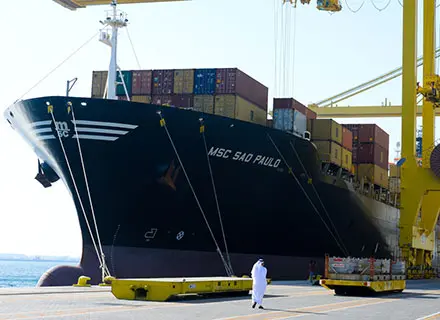

All of Qatar’s main ports, Hamad, Ruwais, and Doha, witnessed an increase in handling of container volumes, cargoes (general and bulk), and vessels in June 2026 compared to the month of May.
Mwani Qatar, the integrated logistics services provider responsible for managing the Gulf nation’s seaports and shipping terminals, stated, “Qatar ports welcomed 121 vessels in June 2026, marking a 21% growth compared to last May. Additionally, the ports handled over 78,000 TEUs, up 13%, nearly 23,000 tons of general cargo, and over 67,000 tons of bulk cargo, a 40% increase from the previous month.”
“The three ports handled 78,002 twenty-foot equivalent units (TEU) containers, 23,092 tonnes of general cargo, 67,371 tonnes of bulk cargo, and 7,264 heads of livestock. Positioned strategically and supported by a rapidly expanding shipping network, the ports enable seamless and secure cargo flow and transshipment operations,” it added further.
The latest figures augur well for Qatar’s economy, which took a solid hit from the recently concluded Iran war, with the facilities producing LNG, the Gulf major’s key economic driver, receiving severe hits from Iranian missiles and drones. By boosting customer experience, Mwani Qatar is consolidating its role as the main growth engine of the nation’s integrated logistics sector.
“Advanced technology and modern operational capabilities have enabled Mwani Qatar to further strengthen marine safety and streamline port operations, with the organization delivering a comprehensive range of services designed to ensure the safe and efficient movement of vessels throughout Qatar’s maritime network,” the organization remarked.
Until the lead-up to the Iran war, Mwani Qatar had solidified its position as a fundamental pillar of economic diversification in Qatar and a vital link in the global supply chain. The year 2025 was characterized by the organization as the one where it showed steadfast commitment to operational efficiency, digital innovation, and sustainable growth, in alignment with the goals of the “Qatar National Vision 2030.”
“By achieving record handling rates and increasing Hamad Port’s share of regional trade, Mwani continues to fulfill the Ministry of Transport’s strategic plan to transform Qatar into a vital commercial and logistical hub in the region. By providing world-class competitive services, it supports the non-oil sector and contributes to turning the country’s national vision into a tangible reality,” the authority reiterated.
Recently, in a strong validation of Mwani’s industry-defining leadership, Hamad Port, Qatar’s main gateway to world trade, climbed three spots to rank eighth globally and second in the Gulf region in the 2025 Container Port Performance Index (CPPI), developed by the World Bank and S&P Global Market Intelligence.
This achievement reflects the port’s high operational efficiency and its capacity to maintain superior performance and resilience despite geopolitical disruptions and shifts in global trade and supply chains. The upbeat ranking also validates Qatar’s position as the Gulf region’s principal maritime gateway, with the country’s ports quickly emerging as upcoming integrated trade and logistical hubs.
“The CPPI is widely regarded as one of the most comprehensive assessments of container port performance worldwide. Developed using extensive operational data, the index evaluates ports primarily on vessel turnaround times, the time required for ships to complete loading and unloading operations. The metric serves as a key indicator of efficiency, reliability, and the overall quality of port services. Hamad Port’s improved standing demonstrates its capacity to sustain superior operational performance in an increasingly challenging global environment. The ranking also underscores the port’s emergence as a major regional logistics hub,” Mwani said.
While Qatar’s key trade hubs and integrated logistics ecosystem remain resilient against the fallouts of the Iran war, the country is looking to resume its usual levels of LNG production “within a few weeks,” said Prime Minister Mohammed bin Abdulrahman Al Thani while interacting with the Financial Times (FT).
For the government, restoring output has emerged as a top priority following months of disruption caused by the volatile geopolitics. The blast at QatarEnergy’s Barzan gas processing facility, which happened due to a technical malfunction and ended up killing 13 people and injuring 66, has raised fresh questions over both the pace of the country’s energy sector recovery and safety.
Iranian missile and drone attacks knocked out 17% of Qatar’s LNG export capacity in March. Two of the country’s 14 LNG trains and one of its two gas-to-liquids facilities were severely damaged. QatarEnergy had already suspended LNG production at Ras Laffan on 28th February after the outbreak of hostilities between the US, Israel, and Iran, following a drone attack on the industrial complex.
The disruption tightened helium markets after LNG production was halted at Ras Laffan, a key source of crude helium supply. The Gulf major accounts for around 30% of the world’s helium production capacity, with more than 80% of its output recovered as a by-product of LNG processing at the Helium 1 and Helium 2 facilities in Ras Laffan Industrial City.
The closure of the Strait of Hormuz, the strategic waterway that accounts for around 20% of global LNG trade and serves as the export route for almost all of Qatar’s LNG shipments, hurt the country’s economy further.
While LNG tankers have begun transiting the strait again following an interim US-Iran peace agreement, reached on 15th June, shipping activity has remained below pre-conflict levels.