


After three years and two abandoned attempts, Shein is close to a stock market debut. The online fast fashion group won approval from the China Securities Regulatory Commission on July 10 2026, cleared the Hong Kong exchange’s listing committee a week later and published its post-hearing information pack on July 26.
A float in September or October is the widely reported working assumption, although the pace of the past fortnight has put an August debut within reach. Goldman Sachs, Morgan Stanley and JPMorgan are joint sponsors.
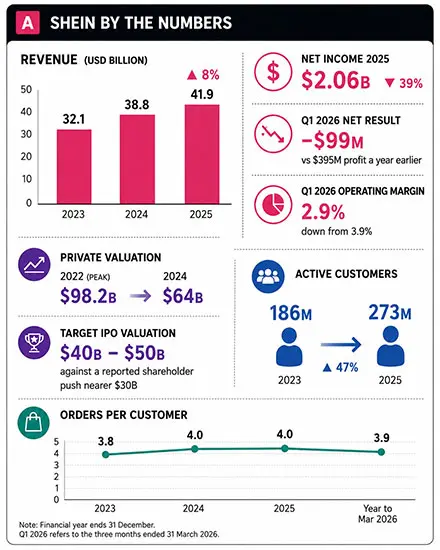
The number that stands out is the valuation. Shein was worth USD 98.2 billion after a private round in 2022 and USD 64 billion after another in 2024.
It is now seeking USD 40 billion to USD 50 billion, and some shareholders have reportedly pushed for a figure closer to USD 30 billion. A draft prospectus published in late July explains the argument.
What Shein actually does
Shein sells very cheap clothing, and a great deal else, straight to shoppers through an app and website. It was founded in China in 2012 by Sky Yangtian Xu, who remains chairman and chief executive, and is now headquartered in Singapore.
It owns almost no factories. Instead it runs a network of mostly Chinese suppliers, feeds them live demand data and orders tiny production runs.
The listing document calls the system large-scale automated test and reorder, or LATR. New products typically launch in batches of 100 to 200 units, response is tracked in real time, and anything that sells can be restocked in as little as five days. Anything that does not is quietly dropped.
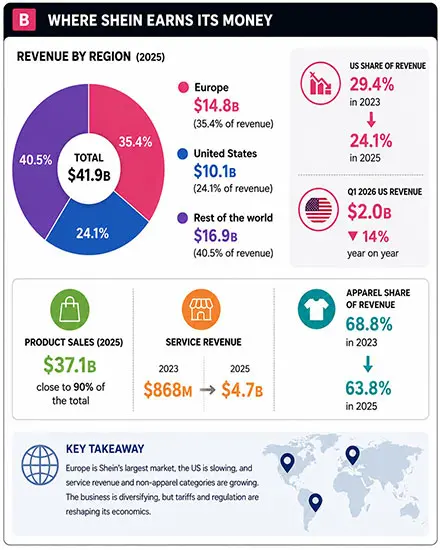
That machinery served about 273 million active customers across roughly 160 markets in 2025, up from 186 million in 2023. Clothing remains the core, although its share of revenue has slipped from 68.8% in 2023 to 63.8% in 2025 as beauty, homeware and small electronics have grown.
A third-party marketplace now sits alongside Shein’s own label, and service revenue from those sellers has jumped from USD 868 million in 2023 to USD 4.7 billion in 2025.
 Growth that ran into a wall
The growth was real. Revenue climbed from USD 32.1 billion in 2023 to USD 38.8 billion in 2024 and USD 41.9 billion in 2025, a compound annual rate of 14.2%. Shein overtook H&M on revenue and closed in on Inditex, the owner of Zara, in barely a decade.
Then the rules changed. In May 2025 Washington scrapped the de minimis exemption for parcels from China and Hong Kong, and by that August had removed the waiver for every country.
Shipments worth under USD 800 had for nearly a decade entered the United States duty free with light customs scrutiny. A 2023 congressional report estimated Shein and Temu were together behind more than 30% of all such packages arriving daily. The exemption was not a bonus. It was part of the model.
Europe followed. From 1 July 2026 the European Union scrapped its own €150 duty waiver, replacing it with a flat 3 euro charge per item type, an interim measure running to 2028 while a permanent system is built. Nearly 5.9 billion low-value items entered the bloc duty free in 2025, more than four times the 2022 figure.
The financials investors will pick over
Growth has now stalled. First-quarter revenue in 2026 rose just 1.1% to USD 9 billion. Operating profit fell 26% to USD 258 million as marketing and fulfilment costs climbed against flat sales, dragging the operating margin to 2.9% from 3.9%. Net income for 2025 had already fallen 39% to USD 2.06 billion.
The headline USD 99 million quarterly loss is less alarming than it looks in isolation. Most of it stems from a USD 328 million non-cash fair-value charge on convertible redeemable preferred shares, which convert to ordinary stock at listing. Strip that out and the company is still profitable.
The harder problem is the underlying trend, a business earning under three cents of operating profit on every dollar of sales while its two largest markets tighten import rules simultaneously.
There is a second signal. Customer numbers keep climbing, but each shopper still places about four orders a year, as in 2023, slipping to 3.9 in the twelve months to March 2026. Shein is recruiting customers, not getting more out of them.
 Europe is now the biggest market
The geographic shift is the filing’s most consequential detail. Europe overtook the United States as Shein’s largest market in 2024, with revenue rising from USD 10.2 billion in 2023 to USD 14.8 billion in 2025, or 35.4% of the total. American revenue fell to 24.1% in 2025 and dropped a further 14% to USD 2 billion in the first quarter of 2026.
Europe is not simply a fallback. Shein reported 155.7 million average monthly users across the bloc for the six months to January 2026, comfortably ahead of Temu, with France, Spain and Italy supplying the largest user bases and Germany the most revenue.
Even here the pace has eased, with user growth slowing to 6.9%. The awkward part is that Europe is now the market applying the tightest regulatory pressure, and the euro 3 duty landed weeks before the prospectus.
The rest of the world now accounts for the largest slice of all at 40.5%, or USD 16.9 billion. Brazil is the standout, although the local manufacturing programme Shein began there in 2023 has been bumpier than planned, with many factories walking away over pricing and turnaround demands.
What Shein has that its rivals do not
Against Temu, the advantage is depth rather than breadth. Temu runs a managed marketplace matching existing inventory to buyers. Shein sits inside the production process itself, which tightens control over design, cost and restocking, and locks suppliers in.
Against Zara, H&M and Primark, the advantage is inventory risk. Traditional retailers commit to seasons months ahead. Shein commits to a few hundred pieces.
Both advantages are built on the Guangdong supplier cluster, and both are harder to replicate abroad, as Brazil has shown. The field is crowding regardless, with AliExpress, Amazon’s discount tier and TikTok Shop chasing the same young, mobile-first shopper. What still separates Shein is that it is a fashion platform first.
Five things to watch in the IPO
It’s important to look at margins over revenue. At 2.9%, the operating margin leaves almost no cushion for further duty increases.
Pricing discipline in the book. Analysts widely doubt Shein will secure much uplift on its 2024 private valuation of USD 64 billion.
IDG Capital and HSG, the rebranded Sequoia Capital China, are the two largest institutional holders at 7.9% and 5.8%, ahead of Tiger Global, General Atlantic, Boyu, Coatue and DST. A soft debut would sting all of them.
Governance is also worth keeping an eye on. Donald Tang, previously executive chairman and the public face of the company in Washington and London, does not appear among directors or senior management.
Regulators in Europe are another hurdle. The European Commission opened Digital Services Act proceedings against Shein in February 2026 over illegal product listings and addictive design. France moved to suspend the platform in late 2025. Mandatory product identifiers arrive in November 2026.
Whether growth outside the West holds is also a big question. Europe and the United States together make up more than half of revenue and both are slowing, leaving the near-term story to Latin America, the Middle East and Asia.
Will US-China tensions derail it
Not the listing itself. That is the point of Hong Kong. New York and London proved impossible precisely because of political scrutiny, and a Hong Kong float sidesteps the American disclosure regime entirely. The trade-off is a narrower investor base and a valuation that reflects it.
The business is a different matter, and the exposure is severe. Shein does not control the rules that set its cost base. The current US-China truce, which cut the effective tariff rate on Chinese goods from around 41% to 31%, runs only to November 10 2026, weeks after Shein expects to list.
Both sides have been working to preserve it, including talks on agricultural tariffs in July, but a lapse would hit Shein’s American unit economics immediately.
The deeper risk is that de minimis repeal is not a US-China issue at all. Europe has done the same thing for its own reasons, and Britain follows in 2028. Shein’s answer is to push more inventory into local warehouses, expand its marketplace and lean on markets where tariffs are not yet the binding constraint.
Investors will decide within weeks whether that answer is worth USD 40 billion.