
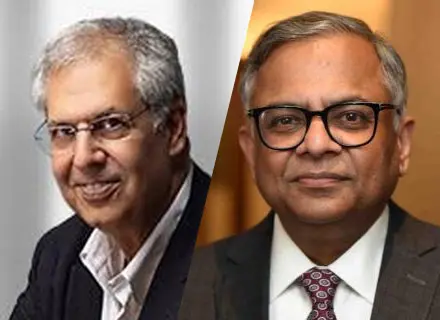

For a company that prizes discretion, Tata Sons has spent September arguing in public. Letters between Bombay House and the Tata Trusts leak within hours, India’s best-known lawyers are giving television interviews, and a question that should have been settled in a boardroom now looks headed for a tribunal.
The question sounds simple. Has N Chandrasekaran been validly reappointed as executive chairman of Tata Sons for a third five-year term? Tata Sons says yes.
Noel Tata, who chairs the Tata Trusts that own about 66% of the holding company, says the decision is void from the start.
Behind that sits a bigger fight over whether Tata Sons should list on the stock market, and who gets to steer a group with 26 listed companies and annual revenue of about USD 170 billion.
How a retirement became a reappointment
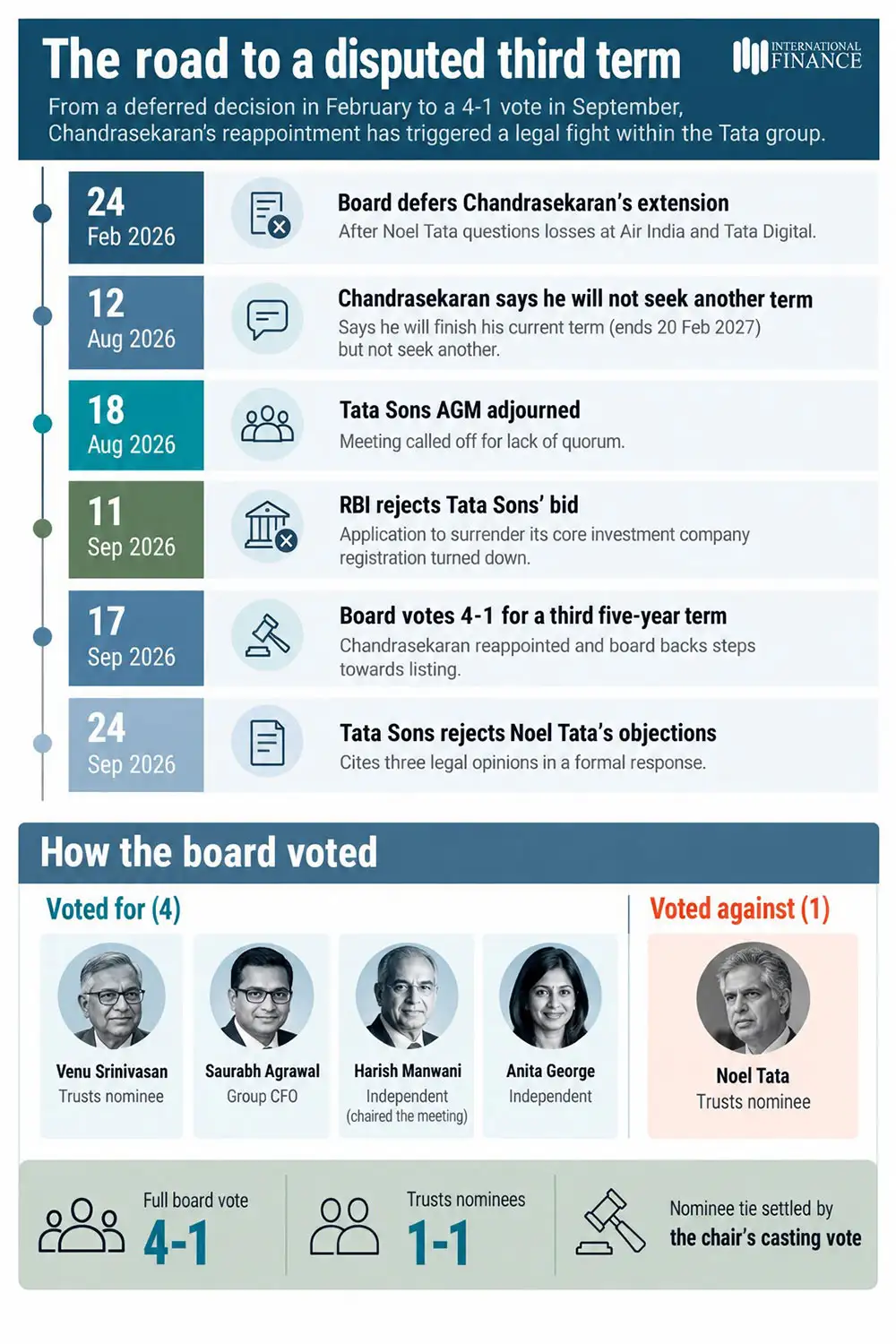
The clash did not start this month. On February 24 2026, the Tata Sons board deferred a decision on extending Chandrasekaran’s term after Noel Tata questioned continuing losses at unlisted businesses, particularly Air India and Tata Digital.
Reports at the time said he also wanted an assurance that Tata Sons would stay private, which Chandrasekaran would not give.
The proposal sat unresolved for six months. On August 12, Chandrasekaran wrote to the board saying he would complete his current term, which ends on February 20 2027, but would not seek another, noting that the extension had stalled because one director did not support it.
Tata stocks fell, led by TCS, and the Trusts began moving towards a search for a successor.
Then the ground shifted. On September 11, the Reserve Bank of India rejected Tata Sons’ application to give up its registration as a core investment company, the group’s main route to staying unlisted.
Since September 2022, the RBI has classed Tata Sons as an upper layer non-banking financial company, a category that must list, and the original three-year deadline has already passed.
Six days later, the board met at Bombay House for nearly four hours. It asked Chandrasekaran to reconsider, he agreed, and directors voted 4-1 to give him another five years from February 2027.
The same meeting backed steps towards a listing. Noel Tata was the only director to vote against both.
The arithmetic of a 4-1 vote
On paper, 4-1 looks decisive. The four in favour were Venu Srinivasan, chairman emeritus of TVS Motor and vice-chairman of the Tata Trusts, group chief financial officer Saurabh Agrawal, and independent directors Harish Manwani and Anita George.
The problem is who dissented. Tata Sons’ Articles of Association, the rulebook that governs the company, give the Trusts special powers because of their controlling stake. Article 104B lets them nominate one-third of the board.
Article 121 says board decisions also need the affirmative vote of a majority of the Trusts’ nominee directors present.
The Trusts have two nominees on the board, Noel Tata and Srinivasan. One voted for, one against. So while the board split 4-1, the nominees split 1-1. Manwani, who chaired the meeting, used a casting vote to settle that tie in Chandrasekaran’s favour.
The Trusts reject that outright. Article 121, they argue, sets two separate tests, a board majority and a majority of nominees, and a casting vote cannot manufacture the second where it does not exist.
In a statement, the Trusts said a casting vote cannot revive “a stillborn resolution”.
Former solicitor general Harish Salve, advising Chandrasekaran, reads the clause differently. Article 121 itself provides for a casting vote when votes are equal.
The rule once required every Trusts nominee to agree and was later softened to a majority. On that reading, a 1-1 split is exactly the deadlock the casting vote exists to break.
Article 118 and the 2022 precedent
The second front is Article 118, which sets out a selection committee process for choosing the chairman.
Noel Tata argues that another five-year term is in effect a fresh appointment and must go through that committee.
He has produced minutes of an February 11 2022 board meeting which, he says, show Chandrasekaran’s second term was approved under Article 118, and complained that they were not placed before directors ahead of the vote.
Tata Sons disagrees. In a letter dated September 24, it told Noel Tata that the committee route applies only to the first appointment of a new chairman, not to reappointing an incumbent.
It attached supporting opinions from senior advocate Sudipto Sarkar, former Chief Justice of India Uday Lalit and former Supreme Court judge BN Srikrishna.
Noel Tata had earlier put an opinion from another former Chief Justice, DY Chandrachud, before the board, arguing that only a majority of Trusts nominees can pick the chairman.
There is also a dispute about what was agreed in the room. Noel Tata says directors understood the decision would stay confidential until a legal opinion was obtained and shareholders had approved Chandrasekaran’s continuation as a director.
Tata Sons announced the reappointment the same day. Noel Tata called that irresponsible and potentially misleading to shareholders, employees and lenders, and asked the company to preserve all records of the meeting.
The Mistry case returns
Both sides are leaning on the last great Tata boardroom war. When Cyrus Mistry was removed as chairman in October 2016, the Shapoorji Pallonji group challenged the very powers the Trusts now invoke, including Articles 104B and 121.
Tata Sons defended them all the way to the Supreme Court, which upheld them in 2021.
The Trusts, represented by senior advocate Abhishek Manu Singhvi, argue that Tata Sons cannot defend those rights when they suit it and ignore them when they do not. But the Mistry judgment does not answer today’s question.
In 2016 the nominees were united.
This time they are split down the middle.
That split raises its own issue. An April 2025 opinion by former Supreme Court judge RF Nariman, which has resurfaced this week, said nominee directors must use independent judgment rather than follow instructions from whoever nominated them.
The day before the September meeting, the Sir Dorabji Tata Trust tried to stop Srinivasan voting on listing matters. He refused, saying his duty as a director was to the company, not to one shareholder.
The TVS question
Another complication surfaced after the vote. Corporate filings reported by Mint show that Chandrasekaran’s wife and son are directors of Hanno One Warehousing, a company set up in March 2025.
Months later TVS Motor, chaired by Srinivasan, leased it about 17 acres in Tamil Nadu’s Krishnagiri district for a warehouse on a 29-year term.
Srinivasan also sits on the Tata Sons committee that reviews the chairman’s performance.
It is not publicly known whether either man disclosed the arrangement to the board.
If it was not disclosed, critics say it could breach the Tata Sons code of conduct and hand the Trusts another ground for challenge.
The listing is the real prize
Salve argues that the reappointment cannot be separated from the listing fight.
Noel Tata has consistently opposed a listing, saying it would weaken the Trusts’ rights as majority shareholder and change the character of a group built around philanthropy.
Others want the opposite. The Shapoorji Pallonji group owns roughly 18% of Tata Sons and has long sought to monetise that stake to reduce its debt.
A listing would give it a route. Adding a family twist, Noel Tata is the brother-in-law of SP Group chairman Shapoor Mistry.
Singhvi calls the listing a red herring as far as the chairmanship is concerned.
Either way, the RBI’s rejection has made the question urgent, and the board that backed Chandrasekaran also backed listing.
What Chandrasekaran’s record says
Noel Tata’s challenge rests on performance as much as procedure.
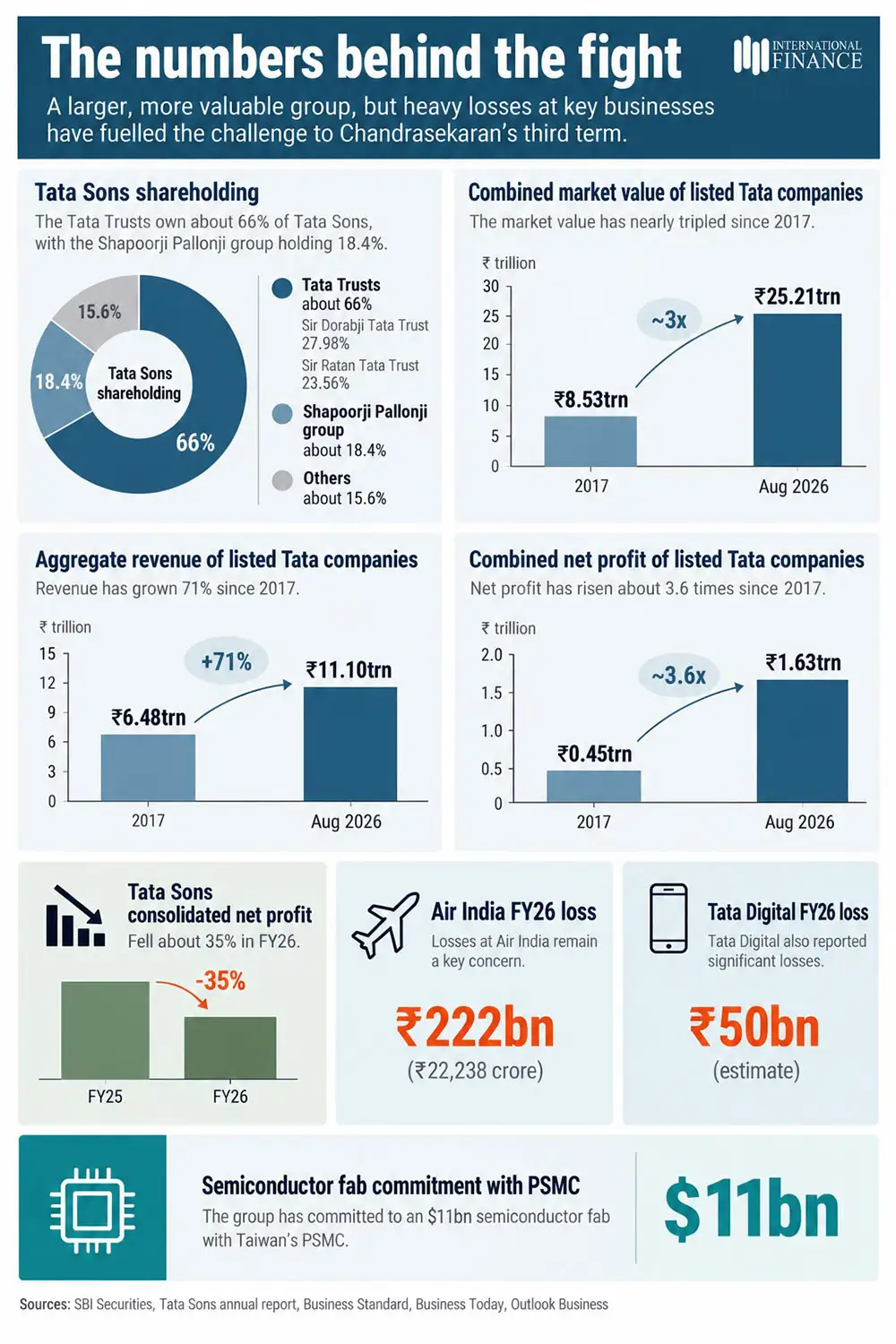
Chandrasekaran’s supporters point to headline numbers. According to SBI Securities, the combined market value of listed Tata companies rose from 8.53 trillion rupees at the start of his tenure to 25.21 trillion rupees by August 2026, aggregate revenue grew 71% and combined net profit rose about 3.6 times.
His critics point to the cost of his big bets.
Tata Sons’ consolidated net profit fell about 35% in the year to March 2026 as losses at Air India, Tata Digital and Tata Electronics piled up.
The group has committed heavily to an USD 11 billion semiconductor fab with Taiwan’s PSMC, iPhone assembly and the Air India turnaround. TCS, whose dividends keep Tata Sons funded, has been hit by fears that artificial intelligence (AI) will erode its outsourcing model.
This is the substance beneath the legal wrangling. The Trusts are asking whether the holding company should keep pouring capital into long-gestation businesses.
Chandrasekaran has described those investments as building blocks for India’s growth.
What happens next
Two tracks now run in parallel. The first is the annual general meeting, which must approve Chandrasekaran’s continuation as a director.
The August meeting collapsed without a quorum because the Articles require a representative jointly nominated by the Sir Dorabji Tata Trust and the Sir Ratan Tata Trust, and restrictions placed on the latter by the Maharashtra Charity Commissioner have blocked that.
Tata Sons has an extension from the Registrar of Companies and is reported to be weighing an approach to the National Company Law Tribunal on how the meeting can proceed. Even if it does meet, the Trusts could vote the resolution down.
The second track is litigation. The Trusts are reported to be considering the tribunal or the Bombay High Court to challenge the board resolution itself.
Chandrasekaran remains chairman until February 2027 regardless. What is at stake is larger than one man’s tenure.
Any ruling will decide what the Trusts’ special voting rights mean when their own nominees disagree, and how far a board can go against the shareholder that controls it.
For a group that has long presented itself as a model of trust-led capitalism, the answer could shape how Tata is run for a generation.
Image Courtesy: Tata Trusts and Tata Consumer Products