
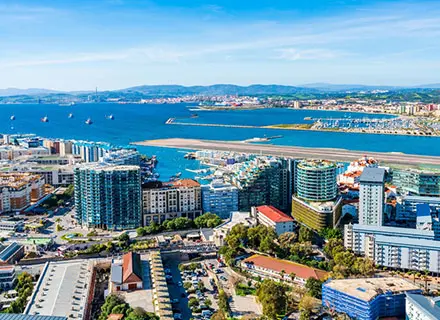

For more than three centuries, a strip of fencing at the foot of the Rock has done more than mark a boundary. It has stood as a physical reminder of imperial rivalry, dictatorship, blockade and, most recently, Brexit brinkmanship. On July 14, 2026, that fence came down for good.
On that day, workers finished dismantling the last sections of La Verja, the crossing between La Linea de la Concepcion in Spain and the British Overseas Territory of Gibraltar, after a treaty signed in Brussels marked the end of more than four years of tortuous post-Brexit negotiation between the UK, Spain, the European Union, and Gibraltar’s own government. It is being called, without much exaggeration, the fall of the last wall in continental Europe.
The symbolism is obvious. The economics are more interesting.
A border built for friction, now built for flow
Gibraltar is tiny, under seven square kilometres, home to roughly 38,000 people, but it punches wildly above its weight economically, built on financial services, online gaming and shipping, and boasting one of the highest per-capita incomes anywhere in the world. None of that would function without Spain.
Close to half of Gibraltar’s workforce, somewhere between 14,000 and 15,500 people, commutes across the border each morning from the surrounding Campo de Gibraltar region of Andalusia, one of the poorest corners of Spain, and commutes back again each evening.
For decades, that daily migration has taken place through a bottleneck: passport checks, customs inspections and, whenever relations between London and Madrid soured, deliberately extended queues that could turn a 10-minute crossing into a three-hour ordeal.
The new treaty removes that bottleneck entirely for land crossings. Instead of checks at the fence, Spain will now carry out Schengen border controls at Gibraltar’s airport and port on behalf of the EU, while Gibraltarian officials run a parallel, independent check of their own – an arrangement modelled on the juxtaposed controls already used at Eurostar terminals in London, Paris and St Pancras.
Crucially, and unusually, the EU’s new biometric Entry-Exit System, which has been generating long queues at airports across the bloc since it went live, will not apply at the land border itself. For the tens of thousands of people who walk or drive across every day, the crossing becomes, in effect, indistinguishable from moving between two ordinary EU neighbours.
That single design choice is likely to matter more to the regional economy than the headlines about sovereignty.
Border friction is a tax, and it has historically been a punishing one in the Campo de Gibraltar, a district with youth unemployment rates among the highest in Spain, where local livelihoods have long been hostage to the state of UK-Spain relations. Every hour lost in a queue is an hour not worked, not spent, not taxed.
Economists who study border regions consistently find that even modest delays act as a drag on cross-border investment, because uncertainty discourages the sort of long-term commitments – a lease, a mortgage, a hire – that make an economic zone function as one rather than two. Removing that uncertainty is, in the driest economic sense, a productivity gain handed to the region for free.
Money, workers and property
The immediate winners are easy to identify. Gibraltarian employers, particularly in financial services, online gaming and tourism-adjacent retail, gain more reliable access to the Spanish labour pool they already depend on; a firm that could previously lose staff-hours to a politically motivated go-slow at the frontier can now plan around a predictable commute.
Spanish workers, in turn, gain from wages that are considerably higher than those on offer locally in Cádiz province, without the friction that used to eat into the value of that wage differential. Property markets on both sides are likely to feel it too.
La Linea has long suffered from a peculiar economic geography: a town within walking distance of some of the highest wages in the region, yet unable to fully capture the spending and investment that proximity should generate, in part because the border itself deterred the kind of casual, everyday commercial exchange – lunch, shopping, services – that knits neighbouring towns together economically.
A frictionless crossing makes La Línea a far more attractive place to live for people working in Gibraltar but priced out of its notoriously expensive housing market, and a far more attractive place for Gibraltar-facing businesses to locate back-office functions that don’t need to sit inside the territory itself.
There is a broader trade dimension too, though it is worth being precise about its limits. Spanish officials have described the treaty as guaranteeing free movement of people and goods between Gibraltar and the surrounding area, and easier movement of goods would matter to a territory that imports almost everything it consumes.
But the deal is fundamentally a people-and-services arrangement, built around Schengen membership for border purposes rather than a full customs union; it resolves the border-crossing problem for workers and travellers far more comprehensively than it resolves questions of tariffs, product standards and regulatory alignment on goods, which will continue to be worked through under separate technical protocols.
Businesses trading physical goods into Gibraltar should expect the practical experience of moving people and services to improve dramatically, while the goods side of the ledger evolves more gradually.
What it means for the wider European economy
For Brussels and London, the Gibraltar deal matters less for its economic scale – the Rock’s economy, while formidable per capita, is a rounding error next to the EU’s – and more as a piece of unfinished Brexit business finally closed off.
Along with the Northern Ireland arrangements, Gibraltar was one of the last significant loose threads left over from Britain’s departure from the bloc, and its resolution removes a recurring source of diplomatic friction between London and Madrid that had periodically spilled into wider UK-EU relations.
European officials have framed the deal as a template of sorts: proof that pragmatic, functionally creative solutions can resolve even the thorniest legacy Brexit disputes without either side conceding on the underlying sovereignty question.
That is a useful precedent at a moment when the UK and EU are still negotiating the texture of their post-Brexit relationship on several other fronts, from youth mobility to regulatory alignment on food and agriculture.
There is also a signalling effect for investors. Gibraltar has spent the years since 2016 in a kind of suspended animation, its access to the EU single market for its dominant industries (online gambling, insurance, funds) steadily eroded, with firms hedging by opening EU-facing subsidiaries elsewhere.
Certainty about the border, even if it doesn’t fully restore market access, reduces one major variable in the calculation of whether to keep, expand or relocate operations on the Rock.
For a jurisdiction whose entire business model rests on regulatory stability and predictability, removing a recurring geopolitical risk factor is itself a form of economic stimulus.
Travel, tourism and the tension underneath
For travellers the change is straightforward and welcome. Day-trippers, cruise passengers connecting onward into Andalusia, and the steady flow of British tourists using Gibraltar as a gateway to southern Spain will no longer face the queues that made a visit to the Rock, at its worst, a logistical gamble.
Family visits and school trips between communities that are, in effect, one urban area artificially divided by a fence, become unremarkable again in a way they have not been for years.
But it would be wrong to read the fall of the fence as the disappearance of the border altogether. Gibraltar’s government has been candid that physical barriers are being replaced by digital ones: an expanded network of live facial recognition cameras, additional CCTV, a larger police presence and more resources for customs and coastguard agencies.
Chief Minister Fabian Picardo captured the trade-off neatly, describing the shift as swapping a physical fortress for a digital one.
That is a sensible security response to a genuinely more porous frontier, but it is also a reminder that ‘no more fence’ does not mean ‘no more border’; merely a border that has become invisible to most people crossing it in good faith, while remaining very visible to the systems tracking who is crossing.
Politically, the treaty resolves the practical border question without resolving the underlying dispute over sovereignty that has simmered since Spain lost the Rock at the Treaty of Utrecht in 1713.
Spanish nationalists have periodically viewed any softening of the frontier as a step toward reclaiming the territory outright, while Gibraltarians, who voted overwhelmingly to remain British in successive referendums, will be watching closely to ensure closer economic integration with Spain does not become a backdoor to a change in status they have consistently rejected.
None of that is likely to trouble the accountants at Gibraltar’s insurers and gaming firms, or the thousands of workers who will simply notice their commute is shorter this week than it was last week.
For a region whose economic history has been repeatedly interrupted by walls – built by dictators, reinforced by diplomatic spats, threatened by Brexit – the removal of the last one is, whatever the unresolved politics behind it, a straightforwardly good piece of economic news.