


For half a century, Alaskan politicians have promised a pipeline to carry the North Slope’s stranded natural gas to market.
For half a century, the numbers have refused to add up. On September 30, that history collided with the 2026 midterm campaign in the Oval Office.
Flanked by Senator Dan Sullivan, a Republican fighting for his political life, President Donald Trump announced that South Korea would put roughly USD 54 billion into Alaska LNG.
Within hours, Seoul said no such commitment existed. Korea’s industry minister, Kim Jung-kwan, said he had lodged a strong protest with Commerce Secretary Howard Lutnick because the announcement went far beyond what had been agreed.
The episode captures why Alaska LNG has become one of the most closely watched issues of the November elections.
It is a project that almost every Alaskan politician supports, that few independent analysts believe will pay its way, and that Republicans now need to look unstoppable before voters go to the polls on 3 November.
What Alaska LNG actually is
Alaska LNG is three megaprojects stitched together. The first is a gas treatment plant on the North Slope, where gas has been pumped back underground for decades for want of a way to move it.
The second is an 807-mile, 42-inch pipeline running south across the state to Nikiski on Cook Inlet.
The third is a liquefaction terminal there, designed to produce up to 20 million tonnes of liquefied natural gas a year for export across the Pacific.
The developer is Glenfarne, a New York-based energy firm that took a 75% stake in March 2025. The State of Alaska keeps the remaining 25% through the Alaska Gasline Development Corporation.
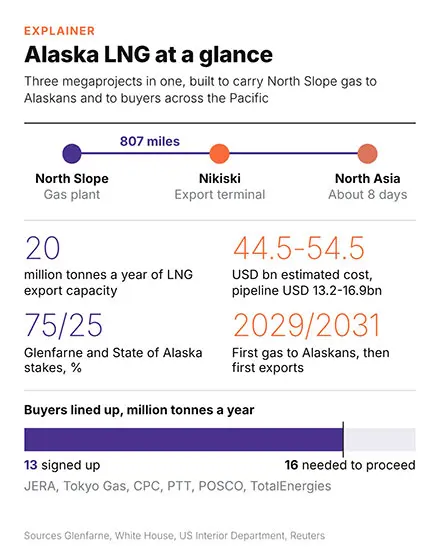
It wants 16 million tonnes, or 80% of capacity, under contract before taking a final investment decision. That decision, first promised for late 2025 and then for early 2026, has still not arrived.
Where South Korea fits in
Seoul’s role traces back to Trump’s tariffs. In July 2025, South Korea agreed to a USD 350 billion investment and trade package in return for Washington capping tariffs on Korean goods, including cars, at 15% rather than 25%.
The terms were finalised in October 2025 and written into a memorandum that November.
The package has two parts. USD 150 billion goes to shipbuilding cooperation, branded “Make American Shipbuilding Great Again”.
The other USD 200 billion is a cash pool for strategic energy and infrastructure projects in the US, paid out at no more than USD 20 billion a year to protect Korea’s currency.
The September 30 announcement was the first big draw on that pool. Alongside Alaska LNG, it named a USD 22.3 billion gas-fired power plant in Encinal, Texas, and up to USD 120 billion for eight large nuclear reactors. Seoul says only the Texas plant has been finalised.
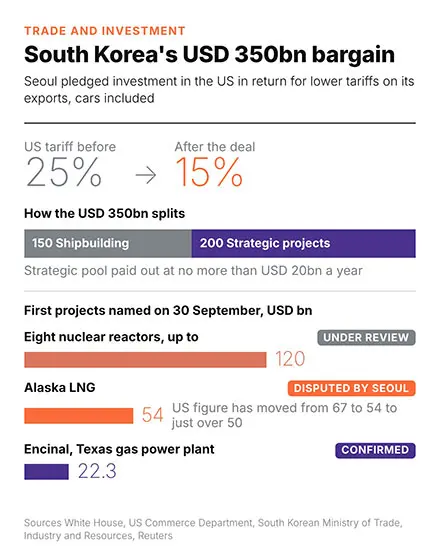
Korea’s caution is partly about the sums. Kim said the US side had floated USD 67 billion before settling on USD 54 billion and then Lutnick’s figure of just over USD 50 billion, shifts he described as evidence that the project itself is not yet solidly defined.
President Lee Jae Myung said Alaska LNG would move only to working-level talks, and only if its commercial viability is confirmed and Korean legal procedures are followed.
The joint statement both governments eventually published says only that they agreed to start working on the project, subject to “commercial reasonableness”. Washington also offered a non-binding promise of priority access and competitive pricing for Korean buyers.
 Why Washington calls it an energy security project
The case for Alaska LNG rests on geography. Interior Secretary Doug Burgum argues that a cargo from Cook Inlet reaches North Asian buyers in about eight days, five of them in US waters, without passing through the Panama Canal, the Strait of Hormuz or the Strait of Malacca.
That pitch has gained force since the war with Iran began this year. Iranian strikes on Qatar’s energy infrastructure knocked out roughly a fifth of global LNG supply, and recent tracking suggests LNG flows through Hormuz remain more than 75% below normal.
Japan, South Korea and Taiwan, all heavy users of Gulf gas, are rethinking their supply. For Washington, a Pacific export hub would tie key allies to American supply and narrow the US trade deficit with them at the same time.
There is a domestic security argument too. Southcentral Alaska, home to most of the state’s population, heats and powers itself with gas from Cook Inlet, where production is in long decline.
Hilcorp, the basin’s dominant producer, expects its firm supply contracts to start running out from 2028, and utilities are preparing to import LNG from around 2029.
A University of Alaska study published in February concluded that it is hard to see the region avoiding imports in the near term. For Alaskans facing rising bills, North Slope gas is the only home-grown alternative on the table.
The cost question that will not go away
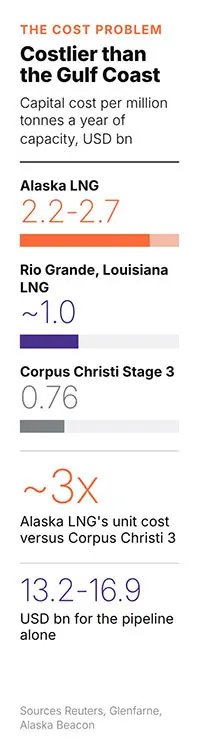
The problem is price. Glenfarne puts the total bill at USD 44.5 billion to USD 54.5 billion, with the pipeline alone costing USD 13.2 billion to USD 16.9 billion.
Reuters calculates this at USD 2.2 billion to USD 2.7 billion for each million tonnes of annual capacity, the highest of any US export project ever proposed.
Cheniere’s Corpus Christi Stage 3 in Texas was built for around USD 760 million per million tonnes, while Gulf Coast projects now under way sit near USD 1 billion.
That gap explains Seoul’s hesitation. Korean officials say their priority is recovering principal and interest, while Washington has political as well as commercial interests in the outcome.
The project turns on whether Asian buyers will pay a premium for gas that avoids Middle East chokepoints, with Canadian Pacific projects chasing the same customers.
Politics at home has added uncertainty. Glenfarne says it needs the state to replace its 2% annual property tax with a much smaller levy on gas throughput, a cut of 80% to 90% that would cost state and local governments more than USD 10 billion over 30 years.
After two special sessions, the bill died in July, falling two votes short in the state House amid a fight over taxing privately held oil companies such as Hilcorp.
A new governor and legislature will inherit the problem. Larry Persily, a veteran gasline analyst, has said he does not expect the project to be built.
 Why Republicans are going all in
That is the backdrop to an aggressive Republican campaign. Alaska, which Trump won comfortably, has become one of the Democrats’ best chances of flipping a Senate seat.
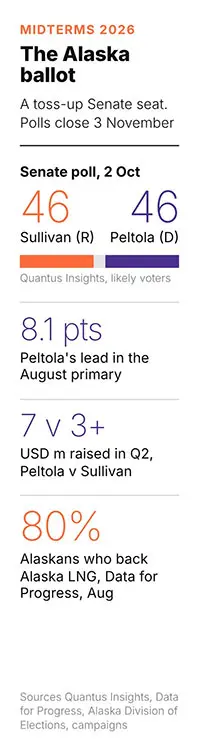
Mary Peltola, the former congresswoman, finished 8.1 points ahead of Sullivan in the August primary and has heavily outraised him. A Quantus Insights poll released on 2 October had the pair tied on 46%.
For Republicans, Alaska LNG serves two purposes at once. It keeps the federal government visibly behind a project that has repeatedly stalled, signalling to lenders and to Seoul that the White House will not let it die.
The difficulty is that Alaska LNG does not divide voters the way Republicans might like. A Data for Progress poll in August found that 80% of Alaskans support the project.
Peltola backs it too, praising Trump’s advocacy and promising to continue the bipartisan push as a senator.
The real fight is over who can be trusted to deliver it and on what terms, particularly on tax, where Republicans are attacking Democratic appetite for higher oil and gas levies.
That leaves Republicans with a delicate balance. Overselling the Korean money risks a backlash if Seoul walks away after the election.
Underselling it hands Peltola the argument that the incumbent has been promising a pipeline for a decade with little to show.
For now, the party has chosen to go big, betting that a project which has defied economics for 50 years can at least deliver a Senate seat.
Image Courtesy: White House