

Intel raised USD 20 billion from an upsized share offering on Tuesday, the largest equity raise in its history and one of the biggest of a year already crowded with them.
The chipmaker had told the market on Monday it wanted USD 15 billion. Demand was so heavy, reportedly north of USD 100 billion in orders, that it lifted the size by a third and priced 210.5 million shares at USD 95 apiece, a discount of just 2.6% to the previous close.
The money is going into the most capital-hungry business in technology, contract chip manufacturing. Intel wants to build fabs and advanced packaging capacity fast enough to serve customers other than itself, and it is cashing in a share price that has roughly tripled this year to pay for it.
From near-shutdown to the centre of the strategy
Rewind twelve months and the foundry unit was close to being switched off.
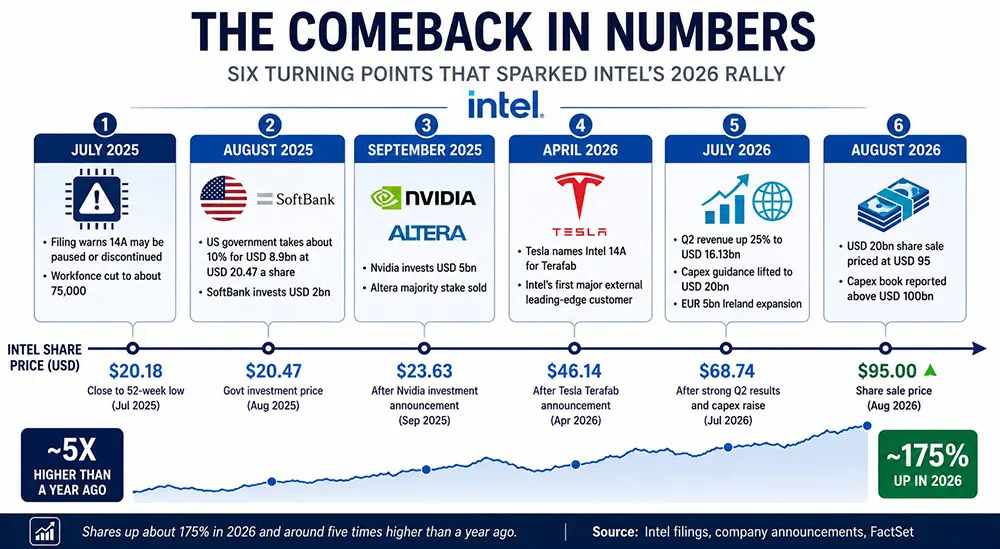
In its July 2025 quarterly filing, Intel warned that without a significant external customer for its next-generation 14A process, it might pause or discontinue the pursuit of leading-edge manufacturing altogether, and slow or stop its Ohio build.
That was the bottom. Intel had lost close to USD 19 billion in 2024 and a further USD 3.7 billion in the first half of 2025.
Then the capital arrived. Washington converted CHIPS Act grants into an USD 8.9 billion equity purchase, taking about 10% of the company at USD 20.47 a share. SoftBank put in USD 2 billion.
The Tesla contract that changed the argument
The commercial validation came in April 2026, on Tesla’s first-quarter earnings call, when Elon Musk confirmed that Tesla would use Intel’s 14A process for chips destined for Terafab, the vast AI silicon complex he is building in Austin. SpaceX is expected to use the same node.
Terafab is an extraordinary ambition, targeting something in the order of one terawatt of annual compute, roughly double current US output, at a cost Bernstein has put anywhere between USD 5 trillion and USD 13 trillion.
Where the profits actually come from
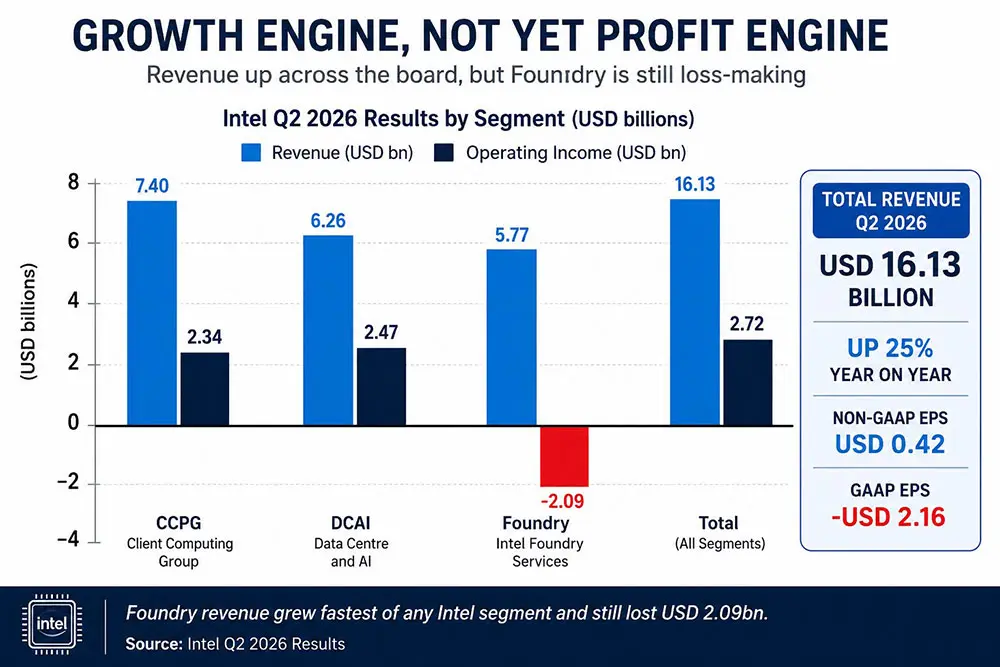
One caveat is worth stating clearly, because the market narrative has run ahead of the accounts. Intel Foundry is not yet a profit engine. It is the strategic centre of the company and its fastest-growing reporting line, but it is still loss-making.
In the June quarter, foundry revenue rose 31% to USD 5.77 billion while the unit lost USD 2.09 billion at the operating level. That is a real improvement on the USD 3.17 billion loss a year earlier, and on the USD 2.51 billion of the final quarter of 2025, but it is a narrowing loss, not a profit.
The profits sit in products. Data Centre and AI, where revenue jumped 59% to USD 6.26 billion, delivered USD 2.47 billion of operating income. The client group added USD 2.34 billion. Group revenue of USD 16.13 billion was up 25%, the strongest growth in more than fifteen years, and the seventh consecutive quarter to beat guidance. Non-GAAP earnings came in at USD 0.42 a share. The headline GAAP loss of USD 2.16 a share reflects a USD 12.5 billion non-cash charge on shares held in escrow for the government under the Secure Enclave agreement, not operating deterioration.
A stock run in a once-in-a-generation sector rally
Intel shares have gained about 175% in 2026 and have roughly quintupled since last August. That is a comfortable win over both AMD and Nvidia, and over the Philadelphia Semiconductor Index, which is up around 75% for the year.
The sector backdrop has been extraordinary. The SOX index rose 101% in the first half of 2026, its best half since 1999, after an 87.8% second quarter that was the largest quarterly gain in records going back to 1994. By comparison the Nasdaq Composite added 12.8% and the S&P 500 9.6% over the same six months.
That rotation cut both ways. The index fell 19% from its record high during July, Intel gave back close to a third from a peak of USD 142.35, and Marvell dropped 40% from its own high.
Can Intel actually take on TSMC
Not on current form, and the gap is not close.
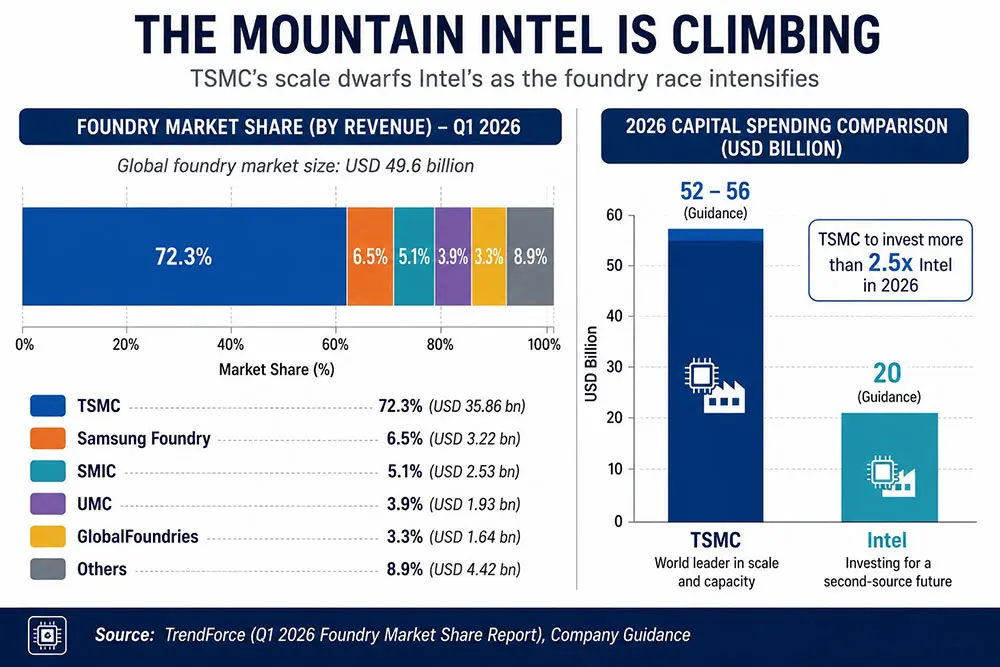
TSMC held 72.3% of the global foundry market in the first quarter of 2026, up from 70.4% the quarter before, on USD 35.86 billion of revenue. Samsung was second with 6.5% and SMIC third with 5.1%.
Scale is only part of it. A foundry sells trust, design kits, verified IP libraries and predictable yields as much as it sells wafers, and TSMC has spent nearly forty years building that. Intel is still assembling the 14A design kit, with version 0.9 the release at which customers commit real volume.
There are genuine reasons to take Intel seriously. 18A is in high-volume manufacturing using High-NA EUV lithography, ahead of TSMC on that equipment. Yields have been improving at around 7% to 8% a month.
The realistic prize is not leadership. It is becoming the credible second source for leading-edge logic, in the United States, for customers who want an alternative to a single Taiwanese supplier.