
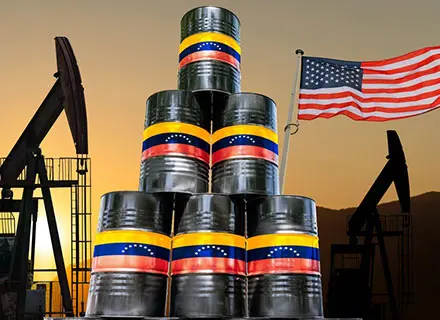

Washington, he said, had secured majority American control of more than 65 billion barrels of proven oil reserves in Venezuela, and the arrangement would substantially lower petrol prices for Americans long into the future.
The claim is enormous. The detail, so far, is thin. No text of any agreement has been released, the White House has said little beyond the president’s post, and administration officials initially disagreed among themselves over whether the thing had actually been signed.
What settled the question was a statement from Venezuela’s acting president, Delcy Rodriguez, who confirmed the accord and framed it as the start of a national recovery.
For a business audience, three things matter here. What the deal actually does. What it says about a country that spent two decades insisting its oil was not for sale. And whether any of it reaches an American petrol pump before voters go to the polls in November.
What has been agreed, and how it is meant to work
The structure is unusual, and that is the most interesting part of it. This is not a purchase of oil, nor a conventional concession round.
According to officials briefed on the arrangement, the US government and an unnamed private operator in Venezuela have formed a new company, and that company has been granted rights to a set of untapped fields for 100 years.
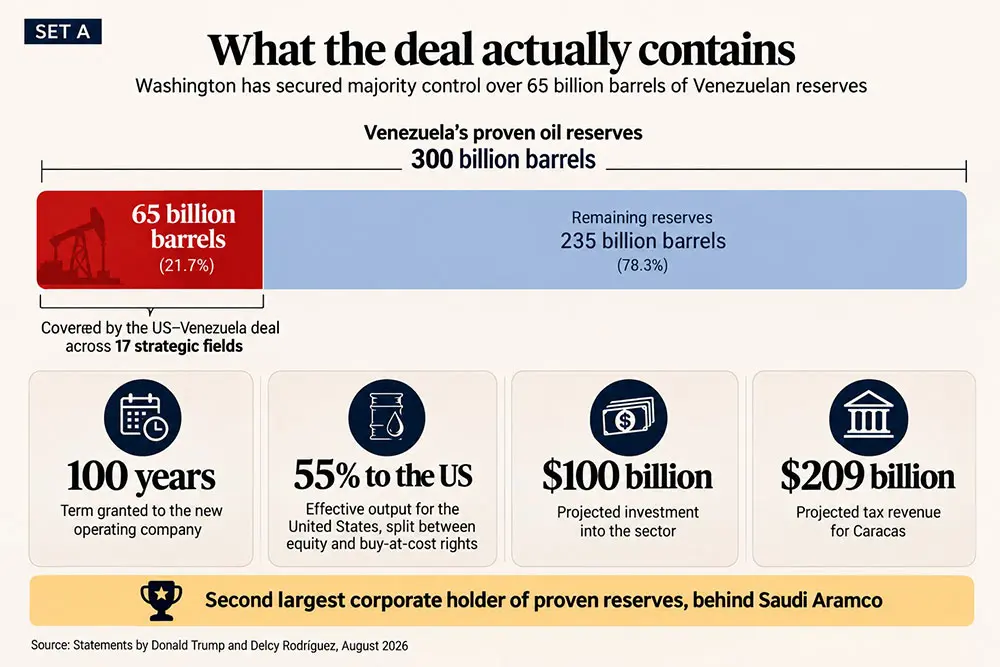
Rodríguez’s statement puts the scope at 17 strategic fields with a proven potential of 65 billion barrels. She said the agreement could pull more than USD 100 billion of investment into the Venezuelan oil industry and generate more than USD 209 billion in tax revenue for Caracas over its life.
On the American side, the United States takes 55% of the new company’s effective output. That figure blends two different things, an equity stake in the vehicle itself and a right to buy crude at cost.
Equity is a claim on profit. Off-take at cost is a claim on physical barrels. They behave very differently on a balance sheet and in a commodity market.
Where those barrels go is also unusual. American purchases are earmarked for the Strategic Petroleum Reserve and for the military rather than straight into the commercial pool.
Trump credited Secretary of State Marco Rubio and War Secretary Pete Hegseth with negotiating it alongside Rodríguez.
One official described the resulting entity as the second largest corporate holder of proven reserves anywhere, behind only Saudi Aramco.
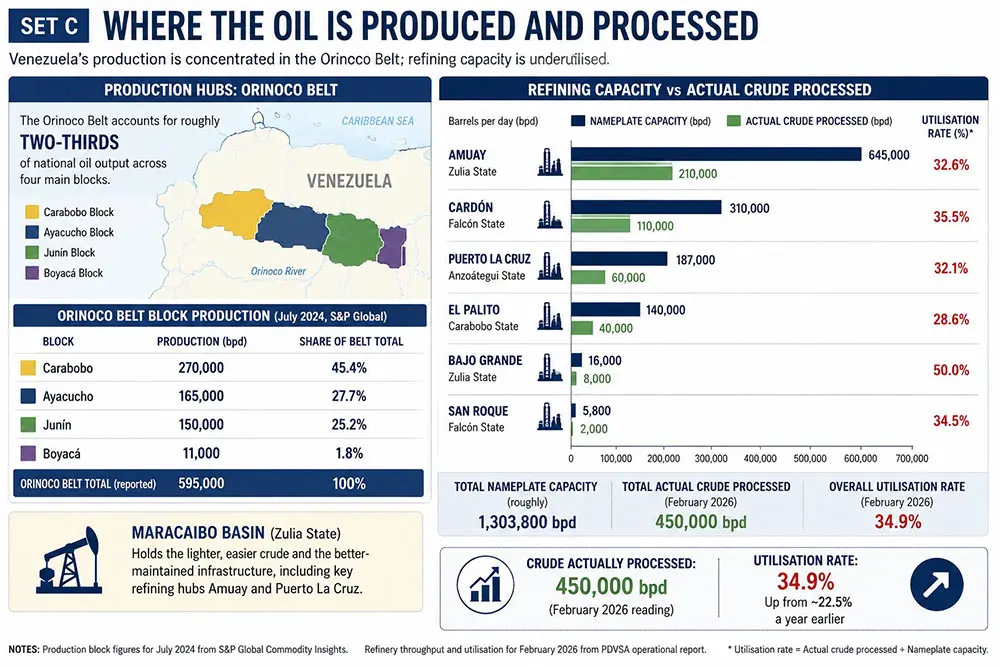
On paper that is true. In practice, nobody has yet said who pays for the drilling rigs, the pipelines, the diluent or the refinery repairs, or who the private operator even is. Those are not footnotes. They are the deal.
The quiet death of Venezuelan resource nationalism
None of this would have been legally possible eighteen months ago, and that is the deeper story.
Since Hugo Chavez tightened state control in the mid 2000s, Venezuelan law reserved upstream activity for wholly state-owned entities or for joint ventures in which the state held a controlling stake of at least 60%. Oil sovereignty was not merely policy, it was the founding argument of the Bolivarian project.
That framework collapsed with startling speed. American forces seized then president Nicolas Maduro in a night raid on Caracas in January and flew him to New York to face federal drug trafficking charges.
Three weeks later, on January 29, the National Assembly amended the Organic Hydrocarbons Law, and Rodriguez signed it within two hours of the vote.
Private investors can now conduct exploration and production directly, ending PDVSA’s monopoly on primary activities.
Where a joint venture is used, the state’s minimum share falls from 60% to 50.1%, and private partners can operate fields, market the output and receive sale proceeds even as minority holders.
The implementing regulation followed on July 9, the first comprehensive regulatory overhaul of the Venezuelan oil sector since 1943, and it extended the opening into refining, marketing and distribution. Mining rules were reformed in April.
An electricity overhaul is in the legislature. The Assembly passed the hydrocarbons amendment unanimously, which tells you something about how thoroughly the old consensus has evaporated, and how little room the interim government had to manoeuvre.
Not everyone in Caracas is applauding. Ricardo Hausmann, the Harvard economist and former Venezuelan planning minister, called the new deal shameful and argued that Rodríguez has neither the legitimacy nor the constitutional power to bind the country to it.
Ordinary Venezuelans interviewed after the announcement made a blunter version of the same point, that the resources are being traded for political survival.
That legitimacy question is a live commercial risk, because a contract signed by an interim administration installed after a foreign military operation is a contract that a future government may decline to honour.
The OPEC question
Days before the oil deal surfaced, Bloomberg reported that Venezuela was closely examining plans to leave OPEC, and that the idea had come up in conversations with American officials. No final decision has been taken.
The symbolism would be considerable. Venezuela supplied the original idea for the cartel and helped found it in 1960 alongside Iran, Iraq, Kuwait and Saudi Arabia. The practical effect on supply, though, is close to nil in the near term.
The cumulative pattern is what should worry OPEC. Angola walked out in 2024. The United Arab Emirates left earlier this year after prolonged frustration that quotas were capping its expanded capacity. Iraq warned in June that it might follow if a capacity review does not deliver a larger allowance.
By one estimate, the UAE and Venezuela together would strip more than five million barrels a day of capability from the group, roughly 17% of what core members held at the start of 2026. An organisation that loses members during a price spike is an organisation whose discipline is being tested from both directions.
Is that a foreign policy win for Washington? On its own terms, plainly yes. Successive American administrations have objected to a producer cartel setting prices and rationing output, and Trump has been more explicit about it than most.
A founding member defecting into an American commercial orbit, while a second major producer has already gone and a third is grumbling, is the sort of erosion that no amount of anti-cartel rhetoric could buy.
The caveat is that a weaker OPEC is not automatically a cheaper barrel. The group’s other function is holding spare capacity that can be released when supply is disrupted.
Fragment that and you get a market with fewer shock absorbers, which cuts both ways depending on whether the next surprise is a glut or a war.
The midterm arithmetic
Which brings us to the politics, because that is clearly what the timing is about.
American petrol averaged about USD 4.08 a gallon at the end of August, against USD 3.20 at the same point in 2025.
The cause is not Venezuela. It is the war with Iran, which began on February 28, has now passed the six month mark, and has choked Persian Gulf shipping through the Strait of Hormuz.
Crude went above USD 100 a barrel within days of the first strikes. The International Energy Agency (IEA) warned in its August report that inventory buffers are depleting and that the urgency of reopening the strait has increased.
For a President elected on affordability, that is a serious exposure. Polling this summer found 63% of Americans blaming the Iran war for higher pump prices, and 46% saying petrol costs would shape how they vote in November.
Trump has repeatedly promised that oil will drop like a rock once the war ends. The war is not ending.
So the Venezuela announcement functions as a supply-side answer to a demand-side political problem. The difficulty is that it cannot deliver on the relevant timescale.
Amy Myers Jaffe of New York University put it plainly, that the deal may help in the long run but will do nothing for the price at the pump this weekend.
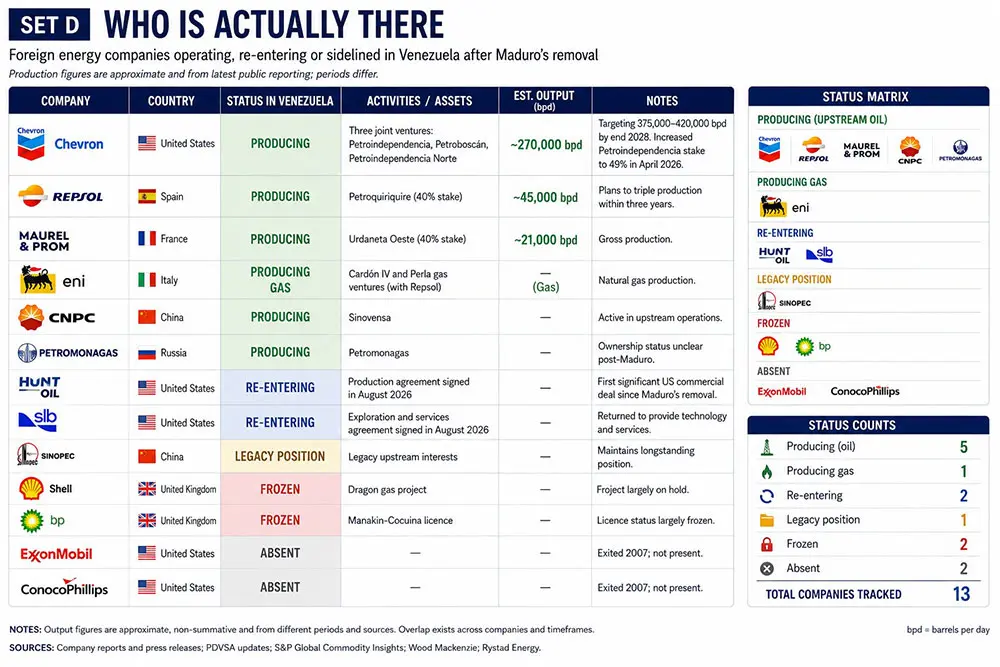
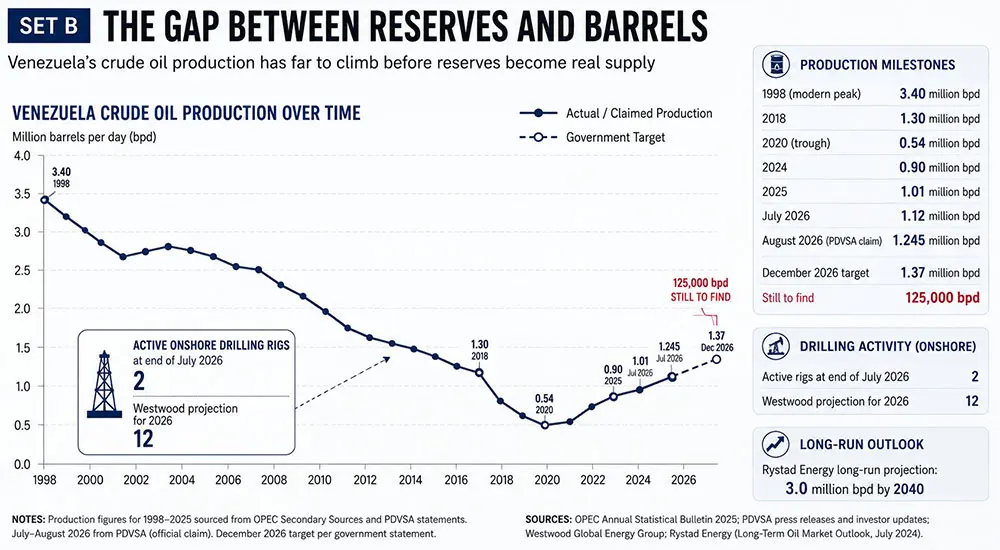
Kevin Book of ClearView Energy Partners noted that Venezuela has genuine headroom, having once produced more than 2.5 million barrels a day above current levels, but that deploying capital at this scale takes many years.
The physical evidence supports the sceptics. At the end of July, Venezuela had two active onshore drilling rigs. Almost all of this year’s production growth has come from Chevron optimising existing wells rather than from new drilling, and optimisation has a ceiling.
Capital Economics cautioned that the reserve figures inherited from the Chavez era may be inflated, and that even with legal and security guarantees American companies may find better commercial opportunities elsewhere.
The likely effect before November, then, is sentiment rather than supply. A large headline number, a story about American energy dominance in the hemisphere, and possibly some softening in futures if traders believe the long-run supply picture has changed.
Democrats are already attacking from the other side, with Senator Tim Kaine calling it corruption at epic scale and questioning whether prices will fall at all.
Republicans such as Senator Bernie Moreno are selling it as a win for both countries.
Barrels vote slowly. Voters do not.