
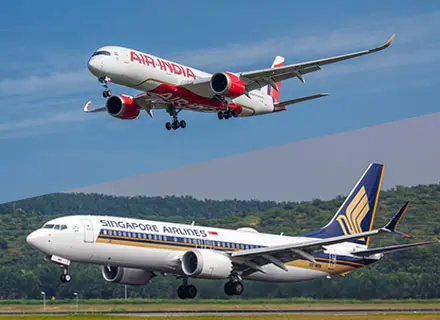

Singapore state investment firm Temasek has backed Singapore Airlines’ long-term strategy in India and defended its investment in Air India but stopped short of committing fresh capital as the loss-making Indian full-service carrier seeks about USD 1.5 billion from its owners.
The statement comes amid growing scrutiny in Singapore over Singapore Airlines’ exposure to Air India, in which it holds a 25.1% stake. Tata Sons owns the remaining 74.9%.
Temasek, which is the majority shareholder of Singapore Airlines, said it viewed the airline’s decision to invest in Air India from a long-term perspective and supported the strategy. It also acknowledged that turning around the former state-owned carrier would involve complex, multi-year operational and integration challenges.
The comments followed reports that Air India is seeking about USD 1.5 billion in fresh equity from Tata Sons and Singapore Airlines.
Temasek did not say whether it would support any contribution by SIA to the proposed funding round.
The investment has attracted political attention in Singapore. Kenneth Tiong, a lawmaker from the opposition Workers’ Party, has argued that Temasek’s funds should not be used to support Air India through Singapore Airlines.
Tiong has also submitted a parliamentary question asking whether losses from SIA’s foreign associates have been assessed against the airline’s ability to provide essential transport services and whether they trigger notification requirements under Singapore’s civil aviation legislation. The matter is scheduled to be raised in Parliament on September 8.
Temasek, however, highlighted the strategic rationale for SIA’s presence in India. Singapore Airlines has been pursuing the development of a second hub outside Singapore, and Temasek said India, the world’s third-largest air transport market after the United States and China, was well positioned to serve that role.
SIA has had a presence in India for years, including through now-defunct Vistara, which it entered in 2013. Its investment in Air India following the merger with Vistara allows it to deepen its exposure to the country’s expanding aviation market.
The financial performance of Air India has nevertheless made the investment increasingly challenging. Air India and Air India Express recorded combined losses of about $2.33 billion for the financial year ended March 2026, more than double the previous year’s deficits.
The losses have also affected Singapore Airlines. SIA’s net profit fell 57% to S$1.184 billion in FY2025-26, although the decline was also influenced by the absence of a one-off accounting gain associated with the Vistara merger.
Air India’s transformation has been complicated by airspace restrictions, geopolitical disruptions, fuel-price volatility, and the fallout from last year’s Ahmedabad crash that killed 260 people. The carrier is also undertaking a substantial overhaul of its fleet, technology, workforce, and operating systems.
Temasek said such a transformation could not be expected to follow a straight path, with results influenced by aircraft innovation, fleet renewal cycles, geopolitical developments, and disruptions to airspace.
Outgoing Tata Sons chairman N Chandrasekaran has similarly described Air India’s turnaround as a five- to 10-year journey. He has pointed to supply chain constraints, legacy systems, fleet requirements, organizational culture, and the need to build a larger pool of airline professionals.
SIA’s exposure to Air India dates from the November 2024 merger of Air India and Vistara. In March 2025, SIA injected another USD 131.4 million into the combined airline, taking the total cost of its investment to about SUSD 2.096 billion at that time.
The latest potential capital requirement would therefore represent another significant financial commitment.
For now, Temasek’s position provides strategic backing rather than a funding guarantee. The immediate question is whether Singapore Airlines will participate in Air India’s proposed USD 1.5 billion capital raise and, if so, how much it will invest.
The debate highlights the tension at the heart of SIA’s Air India strategy: India offers a potentially valuable second growth hub, but capturing that opportunity requires substantial capital and patience while the airline undergoes a costly transformation.