
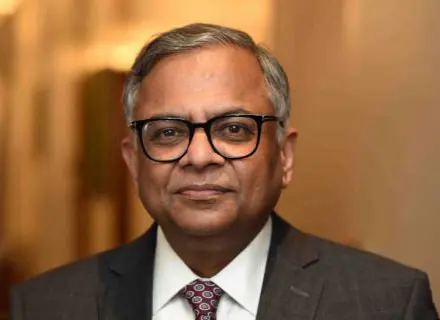

Natarajan Chandrasekaran, the man brought in to prove that a career professional could run India’s most storied conglomerate, will not seek another term as chairman of Tata Sons.
The timing was pointed. The announcement landed less than a week before the holding company’s annual general meeting on August 18. Group stocks fell as much as 4%, with TCS, the company Chandra himself once ran, the heaviest loser.
The six-month stalemate
The dissenting board member has not been officially named, but the reporting points one way. Noel Tata, chairman of Tata Trusts, which controls roughly 66% of Tata Sons, wanted three things before signing off.
There was a second, quieter argument about the term itself. Chandra is 63 and the group’s retirement age for executive roles is 65, so the Trusts were reportedly comfortable with two more years rather than five.
The numbers behind the row
Tata Sons’ latest annual report gave Noel Tata his ammunition. For the year to March 2026, consolidated net profit fell 35% to about 266 billion rupees, roughly USD 2.78 billion, even as consolidated revenue rose 17% to 6.61 trillion rupees.
Nearly all the damage came from unlisted arms. Air India and Air India Express together lost 22,238 crore rupees, more than double the 10,859 crore they lost a year earlier, on combined revenue that fell nearly 9%.
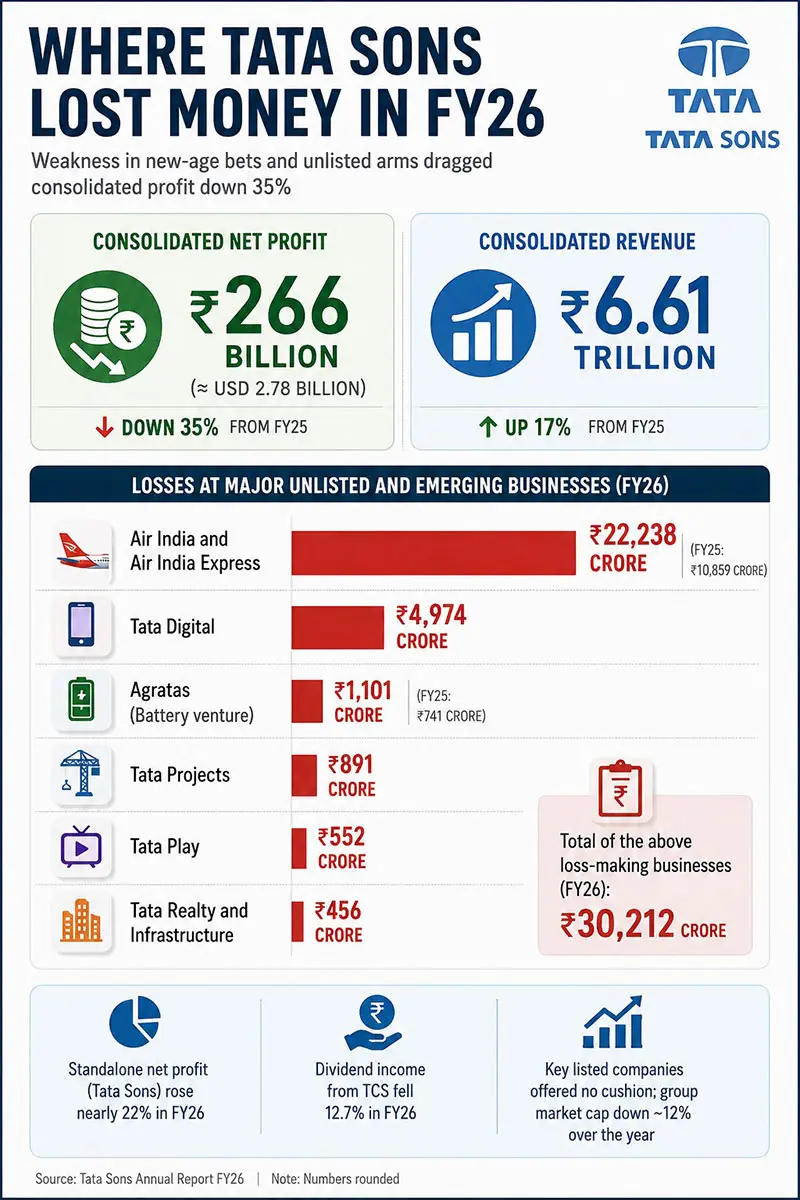
The listed side offered no cover. Market capitalisation across the group’s quoted companies fell about 12% over the year, driven by a sharp derating of TCS.
What actually went wrong
None of the big losses were mysteries, and few were purely self-inflicted. Air India was rebuilding a state carrier from a standing start, then absorbed the crash of AI171 in June 2025, airspace closures, fuel price spikes from the West Asia conflict and adverse currency moves.
Jaguar Land Rover, historically the profit engine at Tata Motors, lost five weeks of production to a cyberattack that shut its plants from early September 2025, and finished the year with revenue down 20.9% to GBP 22.9 billion, compounded by US tariffs, weak Chinese demand and the phase-out of legacy Jaguar models ahead of an all-electric relaunch.
Tata Digital’s losses were the cost of buying market share against better funded rivals. Tata Electronics is a different sort of loss. Its revenue roughly doubled to 1.31 trillion rupees, making it the group’s fourth-largest company by turnover, and it broke even at the operating line. What sits below that line is the cost of building a semiconductor industry from scratch.
The Chandra record
He took charge on 21 February 2017, the first non-Parsi and the first career executive to lead Tata Sons, inheriting a group in open civil war. What followed was a decade of consolidation and expansion.
He reorganised around 30 group companies into ten verticals under a One Tata banner of simplification, synergy and scale, bought Bhushan Steel out of insolvency in 2018 and Neelachal Ispat in 2022, took Air India back from the government, acquired BigBasket and 1mg, listed Tata Technologies in 2023 and Tata Capital in October 2025 in the group’s largest ever IPO, and split Tata Motors in two.
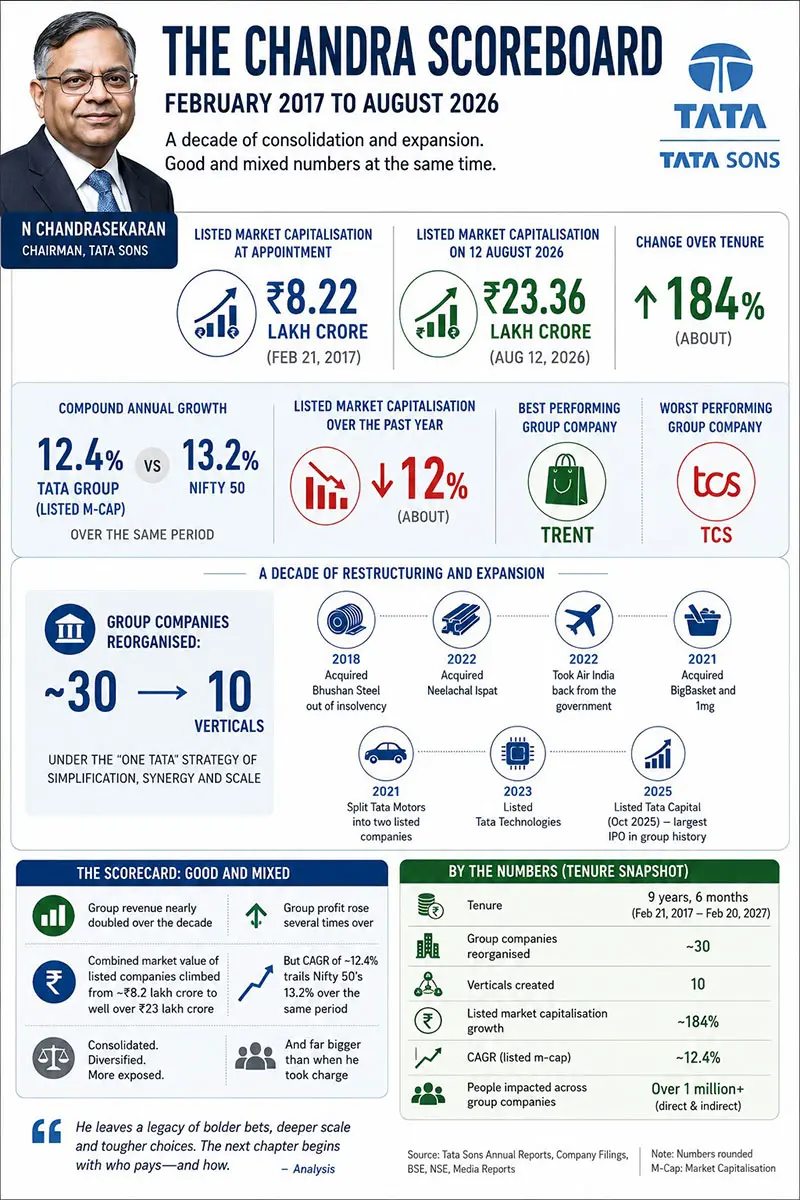
The scoreboard is good and mixed at the same time. Group revenue nearly doubled and profit rose several times over.
The chip and iPhone question
Chandra’s boldest wager was electronics. Tata bought Wistron’s iPhone plant in Karnataka in 2023, expanded at Hosur, and made itself central to Apple’s shift away from China at a moment when India assembles most of the iPhones sold in the United States.
On top of that he committed roughly USD 14 billion to semiconductors, a 91,000 crore rupee fabrication plant at Dholera with Taiwan’s PSMC, targeting 50,000 wafers a month at 28 to 110 nanometres, and a 27,000 crore rupee assembly and test facility in Assam.
These projects are the reason his exit matters beyond Bombay House. A fab loses money for its first several years by design, and India’s semiconductor mission has no comparable private anchor.
A successor under pressure to restore profitability could slow the ramp, seek partners to share the burden, or push harder for state support.
TCS in the age of AI
The crown jewel has been the most disrupted asset in the portfolio. TCS closed March 2026 with 584,519 employees, down 23,460 in a year, after announcing cuts of about 2% of its workforce concentrated in middle and senior management.
Chief executive K Krithivasan has been unusually candid, telling staff to pass AI productivity gains on to clients even where that cannibalises billing. Annualised AI revenue crossed USD 2.3 billion by the March quarter, real but small against a USD 30 billion base.
The succession shadow
Tata has done this badly before. Cyrus Mistry was removed in October 2016, reinstated by an appellate tribunal in 2019, and the matter was settled only when the Supreme Court found for Tata Sons in 2021, costing the group four years of distraction.
The listing question
That tension has a name, and it is the IPO. The Reserve Bank classified Tata Sons as an upper layer non-banking financial company in 2022, which ordinarily forces a listing.
The case for listing is transparency and access to capital for exactly the sort of long-gestation bets that just cost Chandra his job.
Chandra leaves in February with the group larger, more diversified and more exposed than he found it. The argument he lost was never really about whether the bets were right. It was about who gets to keep paying for them.
Image Courtesy: Tata Consumer Products