
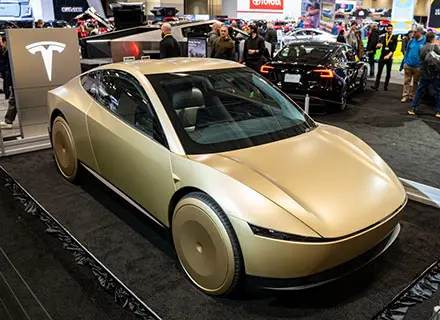

Tesla opened its Cybercab to paying passengers in Austin on September 3, and within hours the United States road safety regulator had opened an investigation into whether the vehicle is legally allowed on public roads at all.
Those two events, hours apart, tell you most of what you need to know about where Tesla sits in the robotaxi race.
The Cybercab is the first vehicle Tesla has built specifically for driverless work. It seats two, opens with upward-swinging butterfly doors, wears a distinctive gold paint job and carries no steering wheel, no pedals and no mirrors.
Tesla has fitted Starlink hardware for connectivity and a large central screen, and has been selling the car as a lounge on wheels rather than a taxi.
Chief executive Elon Musk has framed it as the product that turns Tesla from a carmaker with slowing sales into an autonomy company.
A very small beginning
Start with scale, because it is the fact most easily lost in the launch imagery. Roughly 45 Cybercabs were registered for commercial robotaxi use in Texas at launch, inside an Austin fleet of a little over 300 vehicles that is otherwise made up of Model Ys.
Tesla’s wider robotaxi service now covers about seven American metros, including Dallas, Houston, Miami, Orlando, Tampa and the San Francisco Bay Area, where state rules still require a human in the driver’s seat.
Manufacturing, at least, is real. The first Cybercab came off the line at Gigafactory Texas in February and volume production began in April, with planned capacity of up to 125,000 units a year. Musk has talked about a long-run target of two million a year and a build rate of one vehicle every ten seconds.
He has also put the price target at under USD 30,000, narrowing it to around USD 25,000 on earnings calls, and an eventual operating cost near 20 cents a mile.
None of those figures is a published price or a verified cost. Tesla has no consumer configurator for the car and is instead courting fleet buyers, asking companies to register interest in purchasing vehicles or building depot infrastructure.
That is a meaningful shift. It moves capital cost, insurance and depot operations off Tesla’s balance sheet and onto whoever buys in.
The regulator moved first
The National Highway Traffic Safety Administration opened audit query AQ26002 on the day of the launch, covering an estimated 1,000 Cybercabs. It is not about a crash. It is about paperwork and permission.
Federal motor vehicle safety standards assume manual controls, and Tesla self-certified the Cybercab as compliant without a steering wheel, brake pedal or mirrors. NHTSA wants to test that judgement.
There is a precedent, and it is not a comfortable one for Tesla. Zoox self-certified its purpose-built robotaxi in 2022 and NHTSA opened an almost identical audit query. Zoox eventually took the formal route, applying for a temporary exemption from eight federal standards, and only received final approval in July 2026.
That detour cost the Amazon-owned company roughly four years, and the approval came capped at 2,500 vehicles a year for two years.
The Department of Transportation has proposed removing the manual control requirements for vehicles designed to drive themselves, which would settle the question in Tesla’s favour, but that rulemaking is not finished.
The software question is separate, and older
Running alongside is a much larger investigation into Full Self-Driving itself. In March, NHTSA escalated its inquiry into FSD’s behaviour in poor visibility to an engineering analysis, the final investigative step before the agency can push for a recall.
It covers roughly 3.2 million Tesla vehicles and is tied to nine crashes in sun glare, fog and airborne dust, including one fatality.
In July the agency went further, asking Tesla to confirm whether fifteen specific marketing statements by the company and by Musk imply more capability than the system actually has. Failure to answer fully carries penalties of nearly USD 28,000 a day, capped near USD 139 million.
The Cybercab runs a more advanced build of the same camera-only stack. That is the crux of the readiness question.
Tesla has forgone sensor redundancy by choice, betting that the scale of its driving data beats a mix of lidar and radar, and regulators have not yet accepted or rejected that bet.
The operational record so far is mixed rather than alarming. Federal data covering Tesla’s Austin service from July 2025 to March 2026 logged 17 reported incidents, of which six were minor contact events judged at fault or partly at fault.
Austin police have confirmed no major crashes and no citations issued.
Two of the more serious incidents involved remote teleoperators taking manual control, one hitting a fence and one a construction barricade, which raises a different question about how much of the safety record depends on humans watching screens somewhere else.
Europe has not signed off on this
It is worth being precise here, because the point is widely misreported. The Dutch vehicle authority RDW granted Tesla a provisional European type approval in April 2026 after more than eighteen months of testing covering over 1.6 million kilometres. Lithuania, Estonia, Denmark and Belgium have since recognised it, taking the total to five countries.
But that approval covers FSD Supervised, a Level 2 driver assistance system cleared under UN Regulation 171. RDW was blunt about the distinction, stating that vehicles fitted with the system are not autonomous or self-driving and that the driver remains responsible at all times.
The regulator also noted that the European software differs substantially from the American version. Nothing in Europe has validated the technology now carrying passengers without a driver in Austin.
Europe demands type approval before deployment, while the United States allows manufacturers to self-certify and push software updates afterwards. That gap is the whole story.
Waymo is not waiting
The competitive picture is where the readiness argument turns commercial rather than philosophical. Waymo is delivering more than 500,000 paid rides a week across a growing list of American metros and is targeting a million a week by the end of the year.
It raised USD 16 billion in February at a valuation of about USD 126 billion, runs a fleet of roughly 3,500 vehicles, has passed 20 million lifetime trips and 220 million autonomous miles, and is opening in London and Tokyo.
Independent forecasters expect the million-ride target to be missed, with one estimate putting the likely fourth quarter figure nearer 775,000. Missing it would still leave Waymo an order of magnitude ahead of Tesla on rides delivered.
Zoox is smaller but structurally closer to Tesla in one respect. It also built a purpose-made vehicle with no controls, and it began charging for rides in Las Vegas in August, its first commercial market, after nearly two million autonomous miles and more than 350,000 riders.
Uber has taken the opposite approach and is trying to own none of the hardware. Its expanded partnership with Nvidia aims to put Level 4 vehicles on the Uber network in Los Angeles and San Francisco in the first half of 2027, scaling to 28 cities by 2028 and eventually 100,000 vehicles, built on the DRIVE Hyperion platform and the Alpamayo model.
It has a separate arrangement with Zoox for Las Vegas and Los Angeles under which Zoox carries insurance and fleet costs, plus tie-ups with WeRide and Baidu in the Middle East and a Munich programme with Autobrains.
Describing Uber as still finding its feet is fair, since almost none of this generates revenue yet, but the strategy is coherent. Uber is betting that demand aggregation outlasts any single autonomy stack.
So is it ready?
The vehicle works. Early riders describe smooth driving and a comfortable cabin, and Tesla has a manufacturing advantage nobody else in this field can match. If the Cybercab really lands near USD 25,000 against rival vehicles costing several times that, the unit economics eventually favour Tesla.
What Tesla does not yet have is permission, scale or an unambiguous safety record. Forty-five cars in one city is a demonstration, not a service. A federal audit into whether the car may legally operate at all is a real risk given how long the same process detained Zoox.
And a launch-day fare comparison in Austin, where a Tesla robotaxi quoted USD 19.58 against USD 12.96 for an Uber on the same route, suggests the promise of cheap autonomous mobility is still some way off.
Tesla has done the hard engineering. The harder part, which is regulatory clearance and fleet scale, is exactly where its competitors have a three-year head start.