
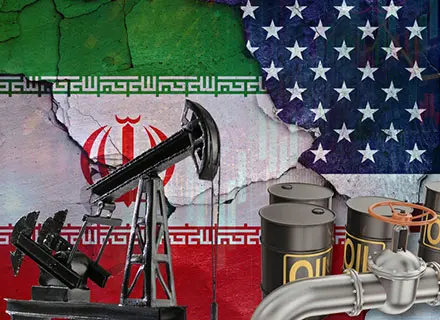

For half a century the Gulf’s business model rested on a single assumption, that oil and gas loaded at Basra, Ras Tanura, Ras Laffan and Jebel Ali would sail out through a 21-mile-wide gap between Oman and Iran without incident.
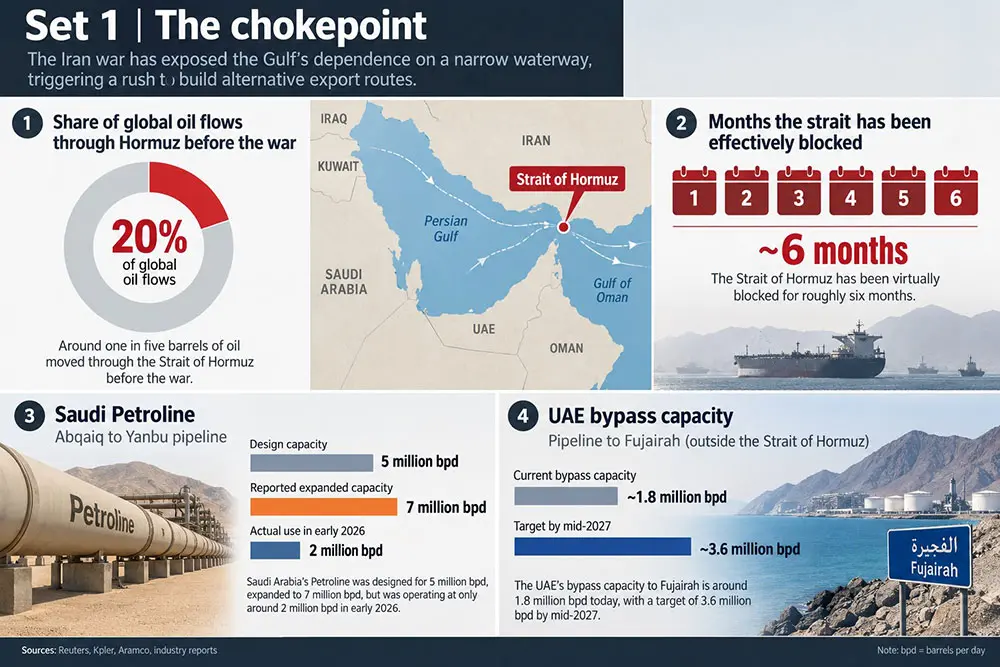
The Strait of Hormuz was previously a chokepoint for around 20% of global oil flows, and it has been virtually blocked for much of the past six months, prompting a burst of billions of dollars in investment commitments as Gulf energy exporters try to future-proof economies now facing a severe slowdown.
Trade has been redirected to Saudi ports on the Red Sea and to the United Arab Emirates’ eastern ports, but capacity there is smaller.
The scramble is no longer about finding a workaround for one bad quarter. Gulf governments are now looking at ways to build permanent, integrated solutions that get around the strait entirely, according to an industry source who declined to be named because of the sensitivity of the matter.
Ports, ports, ports
The most striking shift is in how Gulf capital is being allocated. For a decade the headline spending went into tourism, sport, giga-projects and artificial intelligence (AI). That order has been rearranged almost overnight.
Ports have become a mission-critical priority for Gulf governments including Saudi Arabia, a second industry source told Reuters, adding that where two years ago sport was the buzz, for the next year or two it will be “ports, ports, ports”.
The numbers behind that shift are grim. AD Ports, which runs terminals in the UAE and internationally, saw UAE container throughput as well as bulk and general cargo volumes fall by around two thirds in the second quarter from a year earlier, describing the period as the most significant challenge in its 20-year history.
Abu Dhabi sovereign wealth fund L’IMAD has said it plans to buy out the rest of AD Ports as it revamps the company’s strategy.
Fujairah is the tell. Sitting on the Gulf of Oman, outside the strait, it is the one Emirati port that tankers can reach without entering the Persian Gulf at all.
Saudi Arabia is running the same play at greater scale. The Kingdom has fast-tracked billion-dollar plans to steer oil away from Hormuz, including a capacity expansion of its crude pipeline to the western Red Sea coast, which could also help neighbours move oil without crossing the strait.
The Abqaiq to Yanbu system, known as Petroline, was designed for five million barrels per day, with Aramco reporting in March 2025 that capacity had been raised to seven million, and as of early 2026 only around two million barrels per day was being used, leaving substantial headroom.
Funding, for now, is not the binding constraint. Costs could run into hundreds of billions of dollars over coming years, and Gulf sovereign wealth funds, among the biggest in the world, are already stepping in to accelerate the push, while some governments may also court external capital as international infrastructure funds circle the region’s assets.
Zin Bekkali, chief executive of UK-based Silk Invest, argues Gulf governments have the capital to fund most of this internally, and that infrastructure is clearly set to benefit.
The bill for six months of war
The spending is happening against a badly deteriorating macro backdrop, which is precisely why it counts as strategy rather than stimulus.
Qatar and Kuwait’s economies are expected to contract by just over 8% this year, according to a Reuters poll, while Saudi Arabia is forecast to grow only 1.4% after 4.5% in 2025. Qatar, among the world’s top LNG exporters before the war, depends entirely on the strait to ship gas and is also dealing with severe production shortfalls after damage to its energy facilities.
Landlocked in effect, if not in law, the smaller producers have the worst hand. Kuwait Petroleum Corp is in talks with Saudi Arabia and the UAE about expanding their pipeline systems to carry Kuwaiti oil.
Kuwait was forced to declare force majeure in March, and Bahrain’s Sitra refinery was struck repeatedly. The reputational damage may outlast the physical damage. The war has shaken the standing of Gulf hubs as safe havens, and that is a harder thing to rebuild than a jetty.
Iraq, the dark horse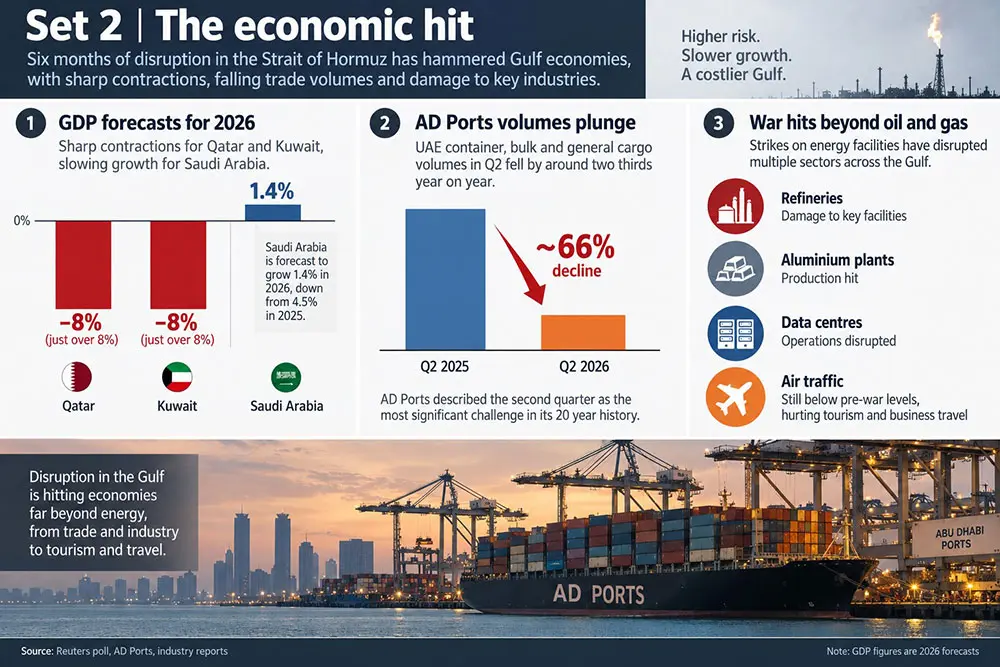
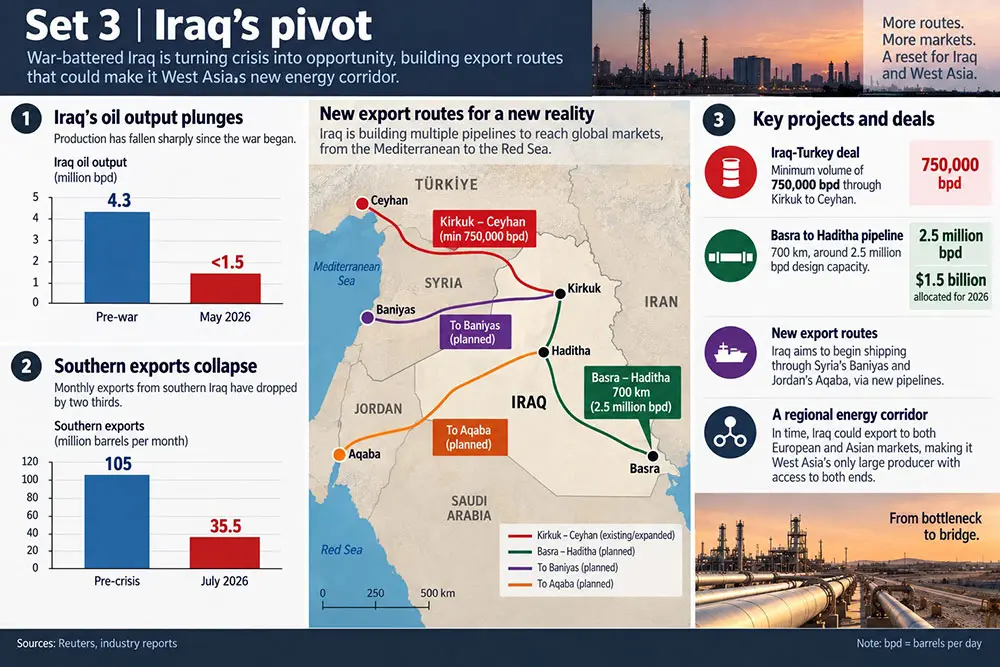
If there is a winner-in-waiting, it is the country least equipped to look like one. Iraq entered the war with a single functioning export outlet, the southern terminals at Basra, and paid for that concentration immediately.
That collapse has done what two decades of feasibility studies could not, which is force Baghdad to build overland. Iraq is working to expand exports through Turkey’s Ceyhan port and aims to begin shipping through Syria’s Baniyas and Jordan’s Aqaba, involving new pipelines.
In August, Iraq and Turkey signed a one-year agreement providing for a minimum of 750,000 barrels per day through the Kirkuk to Ceyhan line while a broader framework covering oil, electricity and water is finalised.
The bigger prize is the Basra to Haditha trunk line. Designed for around 2.5 million barrels per day, it would move southern crude westwards and fan out in three directions, towards Baniyas, Ceyhan and Aqaba, while feeding refineries along its route.
Execution risk is real. The old Kirkuk to Baniyas line has been out of service since it was damaged during the 2003 invasion, and Iraq has announced the Aqaba route before without building it.
But the strategic logic has changed. A Basra to Mediterranean corridor would make Iraq the only large producer able to reach European and Asian buyers from both ends of West Asia, and it would give Kuwait and, in time, Gulf gas a second landbridge that does not depend on Saudi goodwill alone.
West Asia becomes the workaround
What began as a Gulf problem is being solved on a West Asian map. Syria’s Mediterranean coast, Jordan’s Red Sea outlet and Turkey’s Ceyhan terminal have all been pulled into the energy security calculations of countries that previously treated them as peripheral. Damascus, in particular, acquires leverage it has not held in a generation.
Rail is following the same logic. Turkey and Saudi Arabia intend to build a line connecting the two countries through Jordan and Syria within three or four years, Turkey’s transport minister said in June, with other Gulf states expected to join.
The honest caveat is that none of this arrives soon. There has been some reopening of the strait, though trade remains limited and there is no clear end in sight to the conflict between Iran and the United States despite a cooling of hostilities.
Pipelines take years, ports take longer, and every alternative route carries its own exposure, whether that is Red Sea shipping risk or Iraqi and Syrian security.
Afaq Hussain, formerly of the Atlantic Council’s Middle East Initiative, put the lesson plainly, saying the crisis showed these vulnerabilities are real and can strike any chokepoint at any time, and that backup routes are worth building even when they look uneconomical at first.
For a region that has spent fifty years optimising for cost, learning to pay for redundancy may be the most expensive lesson of all.