
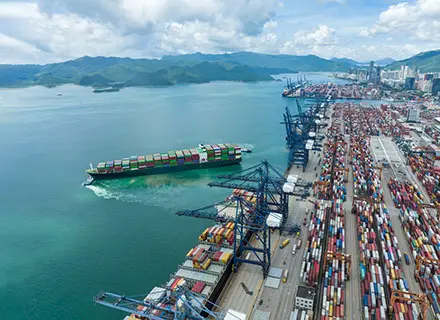

Strong overseas appetite for high-tech and AI-related products led to a tremendous boom in China’s export growth in August, providing a vital lifeline for the world’s second-largest economy, which has been weighed down by sluggish domestic demand.
As per the Chinese customs data, exports from the Asian giant surged 25% year-on-year in August in US dollar terms, matching forecasts and accelerating from the 23.9% growth seen in July.
However, the Xi Jinping administration still needs to address the dichotomy between resilient exports and weak domestic activity, as policymakers struggle to revive consumption and investment as they pursue a 4.5%-5% GDP growth target for 2026.
Imports, on the other hand, jumped 28.2%, compared with a 27.5% year-on-year increase in July and a forecast of a 30% rise.
In the first eight months of 2026, exports of high-tech products have gone up 42.9% in US dollar value terms. Semiconductor export values more than doubled even as volumes edged up just 4.1%, while car exports rose more than 50% in both value and volume.
As per Zhaopeng Xing, ANZ’s senior China strategist, strong demand for AI products as well as electric vehicles, solar cells, and lithium-ion batteries has offset the impact from weather events. Companies, however, are rushing to send goods to the United States due to tariff uncertainties from the Donald Trump administration.
Despite the sluggish domestic demand, China’s push to dominate key technologies has driven investor appetite for tech stocks, while surging AI-related demand has lifted a new generation of manufacturers.
Chipmaker CXMT has emerged as the biggest success story, with the business swinging to a first-half profit in its maiden earnings report since listing, as soaring semiconductor prices and strong demand for AI-driven computing lifted sales.
However, industries in the non-tech sectors have been grappling with producer price inflation and soft demand. While exports have emerged as the favorite option for Beijing to offset industrial overcapacity, both the United States and the European Union (EU) are now asking the Jinping administration to lower its trade surpluses.
China’s trade surplus rose to USD 119.09 billion in August, from July’s tally of USD 112.5 billion. The surplus in the first eight months of this year has reached USD 805.51 billion, putting the annual number on track to top USD 1 trillion for the second year.
Trade surplus with the United States rose to USD 29.18 billion from USD 28 billion in July, with China’s exports to the world’s largest economy jumping 34.4% year-on-year, outstripping the 17.8% growth in imports.
While the trade truce between Beijing and Washington, which reached late 2025, has held despite periodic frictions, the two sides are now exploring reciprocal tariff cuts on USD 30 billion worth of goods as they prepare for another summit later this month.
While China’s exports of rare earths in August rose month-on-month in volume, the ratio remained well below the year-to-date monthly average. Crude oil imports, meanwhile, dropped 23.4% year-on-year in volume.
China’s domestic struggles include a cooling GDP growth to 4.3% in the April-to-June period, and August’s economic data shows that both industrial output and retail sales slowed at the start of Q3.
In another challenge for Beijing, fixed-asset investments have declined in the first seven months, and the property market, which was previously a growth driver, is still experiencing its post-COVID downturn phase.
The Jinping government, for its part, has stepped up fiscal support for the economy, including deploying an 800 billion yuan (USD 119.21 billion) financing tool to revive infrastructure investment.
“The latest trade data do not materially strengthen the case for an imminent interest rate cut,” said Hao Zhou, a Hong Kong-based analyst at Guotai Haitong Securities.
“While further policy support cannot be ruled out, the combination of resilient external demand, steady industrial momentum, and increasingly targeted fiscal measures implies that the timing and necessity of additional monetary easing will require further observation,” the analyst concluded.
Auto Sector: Not Immune From Weak Home Demand
China’s automobile giants are facing the same trend as the broader economy: strong exports and a sluggish domestic market, with BYD and others witnessing sales falling for the 11th month in a row.
As per the China Passenger Car Association (CPCA) data, vehicle exports jumped 77.5% from a year earlier to 894,000 units in August, easing from an increase of 88.2% a month earlier.
However, sales at home fell 23.7% to 1.55 million vehicles, worsening from July’s decline of 21.1%.
Electric vehicle and plug-in hybrid sales, accounting for 64.7% of total domestic sales in the world’s largest automobile market, shrank 10.1% year on year in August, widening from a 3.9% drop the month before.
Meanwhile, export growth in the segment accelerated to 154.7% from 147.8% in July.
Realising that their fortunes back home won’t rebound soon, Chinese automakers have intensified their overseas expansion efforts, with BYD and Geely Auto hitting fresh export records last month.
Despite tight trade restrictions, Chinese carmakers have continued to gain on the overseas front, expanding their presence in Europe and winning customers in emerging economies with competitively priced yet feature-loaded vehicles.
According to the CPCA’s own estimates, China will export 12 million vehicles by 2026. The ratio is expected to rise to between 18 million and 20 million units by 2030.