
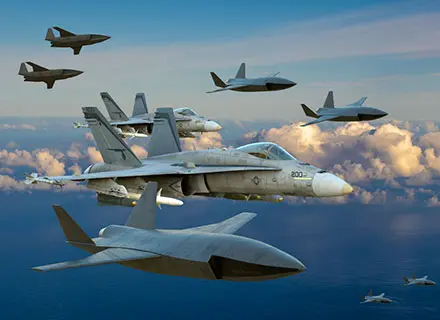

Farnborough International Airshow 2026 was the biggest edition in the show’s 78-year history, with exhibition space sold out twice over and more than 100,000 visitors expected through the gates. Some of the loudest attention fell on aircraft that will never carry a pilot.
Boeing’s MQ-28 Ghost Bat made its first-ever static appearance, shown alongside a Brimstone missile, while General Atomics and Anduril Industries brought full-scale models of their own uncrewed fighters. None of these machines are meant to fly wars alone.
They fly beside a human pilot, taking on the jobs nobody wants to risk a cockpit for. The industry calls them loyal wingmen, or “Collaborative Combat Aircraft,” and they are central to most major air forces’ future planning.
ALSO READ | Europe’s defence boom turns tanks and drones into stock markets’ favourite trade
A wingman drone is built to operate in close coordination with a manned fighter. That might mean flying ahead to draw out enemy radar, jamming an opponent’s sensors, carrying spare missiles to extend a fighter’s magazine, or simply giving an adversary another target to worry about.
These aircraft are cheaper to build, and cheaper to lose, than a crewed jet, which changes the arithmetic of risk considerably for a commander deciding what to send into contested airspace.
Artificial intelligence (AI) does the actual flying, holding formation and reacting to threats from only high-level direction, though in every programme examined for this piece, the decision to pull the trigger still sits with a person.
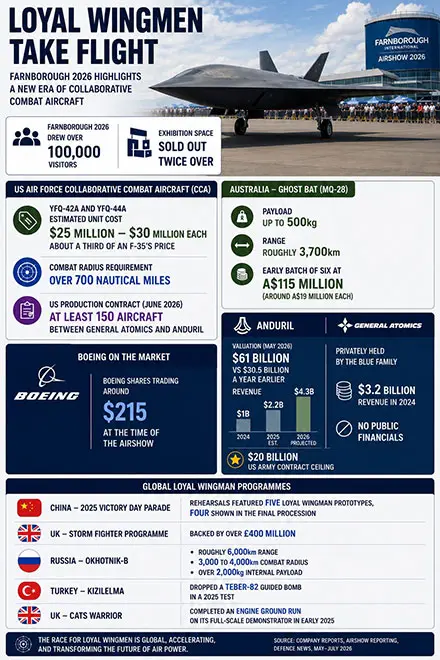 Washington’s Collaborative Combat Aircraft programme has the biggest head start. General Atomics and Anduril were chosen in 2024 to build the first generation, designated the YFQ-42A and YFQ-44A.
The General Atomics design, drawn from its Gambit family of drones and nicknamed Dark Merlin, first flew in August 2025 and carries its weapons in an internal bay. Anduril’s YFQ-44A, developed from the “Fury” aircraft it inherited when it bought Blue Force Technologies, followed two months later, mounting its weapons externally to trade some stealth for lower cost.
Both are built to a combat radius requirement of over 700 nautical miles and are estimated at $25 million to $30 million per aircraft, about a third an F-35’s price. In June 2026 the Air Force awarded both companies production contracts, four months ahead of schedule, covering at least 150 aircraft between them by the end of the decade.
ALSO READ | Can Britain’s 298 billion pound ‘Defence Investment Plan’ keep the country safe?
“By moving fast from competitive selection into full-scale manufacturing,” Air Force Secretary Troy Meink said at the time, the service intends “to stay ahead of the pacing challenge.”
A month later, the YFQ-44A completed the programme’s first live weapons test over the Mojave Desert, firing an AIM-120 AMRAAM with a human operator retaining control of the release decision throughout. General Atomics has its own live-fire trial due this autumn.
Separately, six companies are competing just to write the autonomy software that will fly these jets. The Air Force has floated a total requirement of a thousand or more CCAs, and is already drafting tougher requirements for a second, more capable increment.
The finances behind these programmes are as striking as the hardware. Anduril, which builds the YFQ-44A alongside its Lattice autonomy software, closed a USD 5 billion funding round in May 2026 that valued the company at USD 61 billion, roughly double the USD 30.5 billion mark it carried twelve months earlier. Revenue rose from USD 1 billion in 2024 to an estimated USD 2.2 billion in 2025, and the company has told investors to expect USD 4.3 billion in 2026.
In March the US Army awarded it a ten-year enterprise contract with a USD 20 billion ceiling. General Atomics discloses none of this. It remains privately held by brothers Neal and Linden Blue, who bought the company in 1986 and reported USD 3.2 billion in revenue for 2024 without ever filing a public account of profit or margin. Boeing sits somewhere between the two extremes.
ALSO READ | As threat of war looms, Europe hikes spending on military and defence equipment
Its shares were trading around USD 215 at the time of the airshow, still leaning on Ghost Bat and its wider defence and services portfolio to offset certification delays and supply-chain trouble in its commercial jet business.
The Ghost Bat itself began life a decade ago as Australia’s Loyal Wingman project, a joint effort between Boeing and the country’s Department of Defence. It carries up to 500 kilograms of payload over a range of roughly 3,700 kilometres, and an early batch of six was ordered for AUSD 115 million, around AUSD 19 million each, full production pricing undisclosed.
It has completed air-to-air missile trials and taken part in live exercises, and its Farnborough debut was a more confident showing for Boeing than its scaled-back 2024 presence, when the company was still dealing with the Alaska Airlines door-plug fallout. It is, by most accounts, the most mature design in the field, and other air forces weighing their own options keep coming back to it.
China’s efforts have moved with less fanfare but arguably greater speed. The Hongdu GJ-11 Sharp Sword, a stealthy flying wing design, is now reportedly forward deployed in Tibet, flying alongside J-20 and J-16D jets, while a naval variant, the GJ-21, has been spotted in trials tied to catapult launches from China’s newest carriers. A separate, lower-cost design, the Feihong FH-97A, is built to fly with the J-20 and can reportedly command its own swarm of smaller drones.
ALSO READ | European defence company Destinus tests deep-strike system Ruta Block 2
Rehearsals for Beijing’s 2025 Victory Day parade featured five distinct loyal wingman prototypes, four of which appeared in the final procession, prompting speculation in state media that China may be first to field an operationally ready design, ahead of the United States. Beijing has already begun marketing the technology abroad too, showing an export version of the Sharp Sword to the United Arab Emirates in February.
Europe’s picture is messier. The UK, Italy and Japan are jointly developing the Global Combat Air Programme, known in Britain as Tempest, and the Royal Air Force has named its own drone element Storm Fighter, backed by more than four hundred million pounds as part of a stated ambition to build Europe’s first sixth-generation air force.
Italy’s Leonardo has partnered with Turkey’s Baykar to trial its Kizilelma drone in the role, and the two firms used Farnborough to release fresh results from their K-SWARM trials, in which a manned M-346 jet directed two Kizilelma aircraft through a full formation flight using nothing but high-level commands.
That success contrasts with the rival Franco-German-Spanish effort, whose next-generation fighter component was scrapped in June 2026 after Paris and Berlin could not agree on who would build what. The British Army is running its own smaller version of the same idea through Project NYX, inviting seven companies to design drones that can fly escort for Apache attack helicopters.
Turkey’s Baykar has begun mass production of the Kizilelma, an unmanned stealth fighter that dropped a TEBER-82 guided bomb in a 2025 test, is due to enter Turkish service this year, and is being pitched, beyond its Italian trials, as a candidate for Tempest as well.
Russia’s answer is the Sukhoi S-70 Okhotnik-B, a heavy flying wing aircraft with a claimed range around 6,000 kilometres, a combat radius of 3,000 to 4,000 kilometres and an internal payload above 2,000 kilograms, meant to operate alongside the Su-57.
Its combat record has been a cautionary tale for the whole field. In 2024, one Okhotnik reportedly lost its data link over Ukraine, drifted off course, and was shot down by a Russian Su-57, exposing exactly the kind of communications and fail-safe weaknesses that every other programme is racing to design around.
Moscow has since offered the pairing to India, alongside a twin-seat “drone commander” version of the Su-57. India has its own project regardless. Hindustan Aeronautics’ CATS Warrior, intended to fly with the Tejas fighter and carry the indigenous Smart Anti-Airfield Weapon along with other precision munitions, completed an engine ground run on its full-scale demonstrator in early 2025.
None of this is without risk. Anduril’s own record is a useful check on the marketing. In November 2025 the Wall Street Journal reported a string of setbacks across its autonomous systems, including engine damage to a Fury airframe during a ground test that summer, more than a dozen Navy vessels malfunctioning during a California exercise, and Ukrainian forces withdrawing Anduril’s Altius loitering munitions from front-line use in 2024 after repeated failures against Russian jamming.
Anduril calls this a selective reading of routine development setbacks. The US Congressional Research Service, separately, has flagged for lawmakers how much decision-making authority to hand autonomous software as it matures, and whether the Air Force has planned adequately for storing, transporting and sustaining hundreds of large uncrewed aircraft.
What all of this adds up to is a bet that autonomy and affordability, not just stealth and speed, will decide the next era of air combat. Six companies competing for a single software contract in the United States shows where the real fight now sits.
Every airframe shown at Farnborough this month is still only half the story. None of them fly themselves without someone, somewhere, deciding whether they get to pull the trigger.