
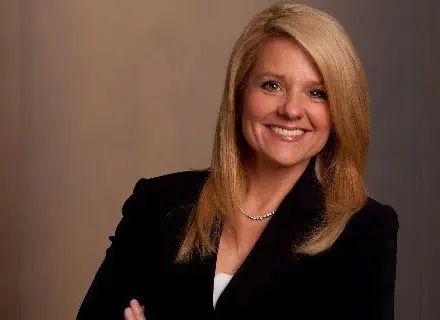

When SpaceX debuted on the Nasdaq on 12th June 2026 under the ticker SPCX, one figure was conspicuously present in New York while the other beamed in from Texas via video link. Elon Musk stood at a branded podium in Starbase, the company town he built on the Gulf Coast, while Gwynne Shotwell, SpaceX’s President and Chief Operating Officer, was physically at the exchange to ring the bell. For anyone who has followed the company closely, the optics were perfectly on-brand.
SpaceX raised USD 75 billion in what became the largest IPO in market history, pricing its 555.6 million shares at USD 135 each and reaching a valuation of roughly USD 1.77 trillion. Musk, as ever, got the headlines. Shotwell, as ever, got the job done.
The engineer who almost became a barista
Shotwell was born in 1963 in Evanston, Illinois, the middle daughter of a brain surgeon and an artist. She was a cheerleader, a varsity basketball player, and finished at the top of her high school class. None of that pointed obviously toward aerospace.
The nudge came from her mother, who dragged a teenage Shotwell to a “Society of Women Engineers” panel at the Illinois Institute of Technology. Shotwell recalled being largely bored until she spotted one particular woman on the panel: impeccably dressed, composed, effortlessly credible. “Her shoes were marvellous, her bag matched,” she told Marie Claire in 2017, “and she just made mechanical engineering accessible to me.”
She earned a bachelor’s degree in mechanical engineering and a master’s in applied mathematics from Northwestern University, then spent over a decade at the Aerospace Corporation before four years at Microcosm, a low-cost rocketry firm. In 2002, a former colleague offered her a tour of a barely-known startup called SpaceX. She spoke to its founder for three or four minutes.
“I wasn’t looking for a job. I didn’t have a resume,” she said. SpaceX called that afternoon, and after a month of deliberation she became employee number 11, joining as Vice-President of Business Development.
She had been clear-eyed about the stakes. If SpaceX failed, she told the Stanford Business School podcast, she was done with the industry entirely. “I’d rather sell real estate or be a barista.”
In September 2008, Shotwell was in a Glasgow hotel bathroom on a conference call to price SpaceX’s bid on a USD 1.6 billion NASA resupply contract while the company’s fourth Falcon 1 launch counted down half a world away.
It was, Musk believed, the last launch the company could afford before going bankrupt. The rocket reached orbit, the NASA contract followed, and Musk promoted Shotwell to President and COO before the year was out. She has held both roles for the 18 years since.
The operator behind the visionary
Colleagues describe a complementary dynamic that is as much about temperament as function. “Elon creates the urgent, sometimes uncomfortable disruption,” Derek Huerta, a former satellite engineer at SpaceX, told CNBC.
Shotwell supplies the operational continuity that converts disruption into delivery. Former NASA programme manager Kathryn Lueders, who worked directly with Shotwell for over 15 years, described her as “the steady interface for customers, stakeholders and the public.” Another former employee called her simply “the glue.”
She combines exacting standards with a rare social fluency. She can deliver tough feedback, said one colleague, and it would “taste like honey.” She earned a reputation for walking onto the factory floor or into mission control and asking forensically specific questions, from manufacturing tolerances to astronaut training simulations. Her compensation reflects her standing.
According to SpaceX’s IPO filing, her total package for 2025 came to USD 85.8 million, against a base salary of USD 1.08 million. By comparison, Boeing CEO Kelly Ortberg received USD 9.4 million in the same year, despite Boeing’s revenue being more than four times larger. Shotwell’s 12.6 million shares were valued at over USD 2 billion at the close of the IPO’s first session.
Selling the impossible, just late
The IPO has brought Shotwell into sharper public focus, and with it a clearer articulation of her philosophy.
“We fail on timeline, but that feels like the right fail to make,” she said. Musk’s formulation, which she repeated to investors, is that SpaceX makes the impossible but makes it late.
She has offered a counter-intuitive defence of failure itself: “If a launch goes perfectly, all you’ve learned is that that launch vehicle on that day worked. When you have failure, you actually get this treasure trove of data.”
SpaceX’s prospectus promises AI data centres in orbit by 2028, a Starship that operates with airline-like turnaround times, and a self-sustaining Mars colony. When pressed on a timeline for the colony, Shotwell ventured 2035, then immediately qualified that she is “so bad at predicting timelines.”
The financial reality is demanding: the company took on USD 29 billion in debt after absorbing xAI, with AI capital expenditure alone reaching USD 12.7 billion in 2025. The company moved, she said, “from those penurious Falcon 9 Dragon days to the more expensive capital-intensive Starship, and then to AI, because it is next-level expensive.”
The steady hand and the key-man question
The IPO has surfaced questions about SpaceX’s “key-man risk,” the dependency on Musk’s vision and public profile. Shotwell is the principal hedge against that risk. During Musk’s feud with the Donald Trump administration in June 2025, when he threatened to decommission the Dragon capsule, she quietly assured NASA officials the tensions would pass.
She has also defended him on personal grounds, sending a company-wide letter after harassment allegations in 2022 against her communications team’s advice.
“I don’t believe he could have done what he was accused of. But he is imperfect. I’m imperfect.” She has called him “probably the best CEO in history” and endorsed the supermajority voting control he holds.
Pressed on her own ambitions, Shotwell remains characteristically understated. She is preparing a 1,000-acre Texas ranch to become a vineyard. Given a Starship and a free itinerary, she says she would go to the moon, not Mars. Six months is a long journey.
It is a telling deflection. The woman who kept a failing rocket company solvent through sheer commercial tenacity, who priced a billion-dollar government contract from a Glasgow hotel bathroom, and who rang the opening bell on the largest public offering in stock market history has earned the right to a modest aspiration. The moon is, after all, reachable.