

The global hedge fund industry has just delivered one of its strongest opening halves on record, and it did so in a period that included a Supreme Court ruling that demolished American trade policy overnight, a shooting war in the Gulf and an oil price that behaved like a light switch.
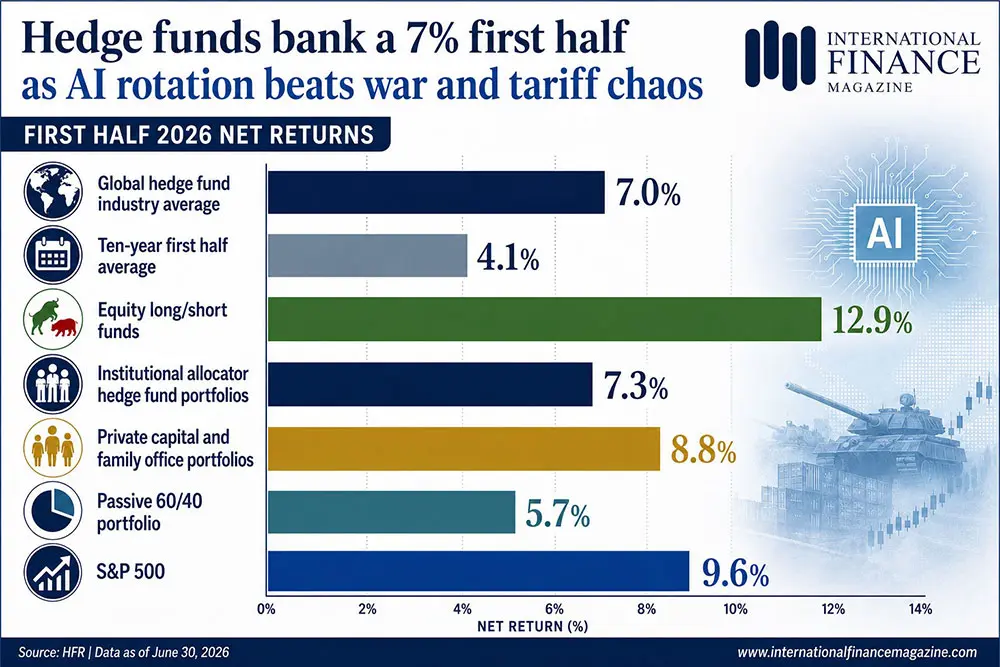
Goldman Sachs estimates that hedge funds returned an average of 7% net in the six months to June, comfortably ahead of the ten-year first half average of 4.1%.
Allocator level numbers were stronger still. Institutional investors reported average hedge fund portfolio returns of 7.3%, while private capital investors, including family offices and private banks, came in at 8.8%.
Only the first halves of 2020 and 2021 have been better, and this marks the sixth consecutive half year in which the industry has beaten its long run average.
That is a striking result given how the period actually felt. Equity markets sold off for five straight weeks in February and March, dropped sharply again in early April, then staged the best quarter since 2020.
Anyone who simply held on finished ahead. The interesting question is how hedge funds, which are supposed to earn their fees in exactly this kind of environment, actually made the money.
The AI trade became a rotation rather than a bet
The headline driver is artificial intelligence, but the detail matters more than the label. Goldman’s assessment is that managers have spent the past few years moving methodically through the AI supply chain rather than sitting on one crowded position.
Exposure travelled from semiconductor manufacturers to power infrastructure and data centres, and over the last twelve months shifted decisively towards memory stocks.
That rotation shows up in the positioning data. Hedge fund allocations to semiconductor shares climbed from around 10% of net equity exposure early in the year to as much as 24% in June, before easing back to 18%. Goldman characterised the pullback as a reset rather than a retreat.
Managers were also more selective within the megacap complex than the word “boom” suggests. Hazeltree’s first half crowding report, drawn from anonymised positioning across more than 600 global funds and roughly 16,000 securities, found continued heavy long exposure to the largest technology names, with Alphabet, Apple and Meta attracting stronger long interest over the six months.
Amazon saw weaker long positioning and heavier shorting. Short interest in Nvidia rose even as long exposure to semiconductors broadly increased, which is a fairly clear signal that funds were expressing views on winners and losers inside the theme rather than buying the theme wholesale.
Dispersion did the heavy lifting
Equity long/short funds returned an average of 12.9% in the first half and, according to Goldman, had already passed their record 2025 alpha by the end of June. The reason is technical rather than directional.
Single stock volatility was unusually high while correlation between individual stocks stayed low, which is close to the ideal environment for a stock picker. Technology, media and telecoms specialists benefited most, but consumer focused funds nearly doubled their returns year on year.
The flip side is brutal. Hedge Fund Research found the top decile of managers in its Fund Weighted Composite Index returned an average of 36.4% while the bottom decile lost 8.2%, a spread of 44.6 percentage points against 30.1 points in the previous quarter. The 7% industry average is a midpoint between outcomes that had almost nothing in common.
Context helps here. A passive 60/40 portfolio returned 5.7% over the same period, helped by an equity rally that offset softer fixed income, while the S&P 500 closed the half up close to 10%. On a headline basis, most hedge funds did not beat the index.
That is the wrong comparison for an industry that sells risk adjusted returns and low correlation, but it is the comparison allocators keep making, and it is why the alpha figures matter more to the sector’s pitch than the raw performance numbers do.
Trading the tariff calendar rather than the politics
The trade shock of the year arrived on February 20, when the US Supreme Court ruled six to three in Learning Resources v Trump that the International Emergency Economic Powers Act does not give the president authority to impose tariffs. Duties covering roughly 70% of the American tariff architecture were terminated four days later.
Within hours the administration invoked Section 122 of the Trade Act of 1974, imposing a flat 10% global surcharge for a statutory maximum of 150 days.
The Court of International Trade ruled against that measure on May 7, the decision went to appeal, collections continued, and the authority lapsed on July 24. Expedited Section 301 investigations and a widening set of Section 232 actions are now being used to rebuild the wall.
For hedge funds, the value was in the mechanics rather than the headlines. The dates were knowable, the statutory limits were knowable, and the sequencing of legal challenge, replacement and expiry created a calendar that could be traded.
Around USD 166 billion in collected duties became a live refund question, turning importer balance sheets into event driven and special situations material.
Sector relative value trades opened up between companies with tariff exposure and those without, and each legal turn refreshed the single stock dispersion that stock pickers were feeding on.
Looking through the Iran war, up to a point
The geopolitical shock was larger. American and Israeli forces struck Iran on February 28, killing Supreme Leader Ali Khamenei and senior military figures. Retaliation spread across the Gulf, war risk insurance seized up, and more than 200 oil and LNG vessels anchored outside the Strait of Hormuz.
Brent broke above USD 80 within days and pushed towards three figures during the worst of it. A fragile ceasefire in the summer was punctured by fresh American strikes in July.
Equity focused funds largely traded through it. Hazeltree’s data shows managers maintained their preference for equities and kept adding technology exposure while markets swung, on the view that the AI capital cycle was not a function of the Gulf.
Macro desks did not get off so lightly. Interest rate volatility around the Iran war produced losses that many discretionary macro managers had not fully recovered by midyear, making the strategy the clearest laggard of the half.
Quantitative managers also found the macro backdrop difficult despite continued strong inflows, and systematic long/short strategies suffered their worst five day stretch since December 2023 in late June as positions unwound.
Small funds humbled the giants
Among the large multi-strategy platforms, Point72 finished the half at 14.5% and Citadel’s tactical trading fund at 14.3%, with Citadel’s equities fund at 11.2% and its flagship Wellington fund at 5.7%.
Millennium returned 10.5% and Schonfeld’s flagship 8.4%, with its fundamental equities vehicle at 12.3%. Qube Research and Technologies’ Torus fund managed 18.6%.
Smaller specialists went further. Asia focused equity funds TAL China Focus and Keystone returned 95.1% and 62.7% respectively, Whale Rock gained 72.5%, CastleKnight 42.3% and Melqart Opportunities 29.1%.
Money is following the numbers
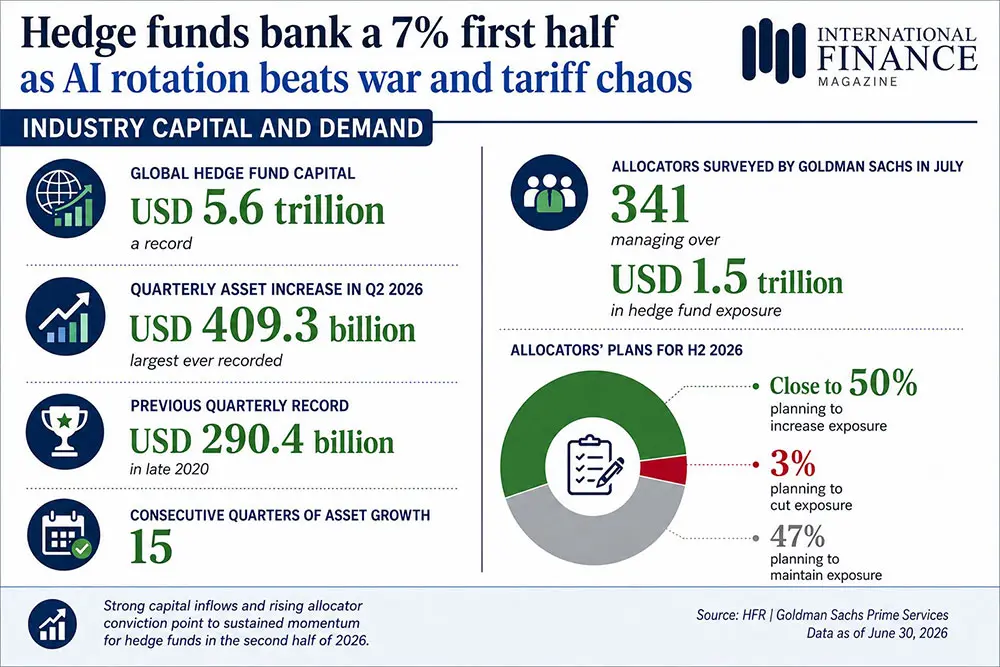
Global hedge fund capital reached a record USD 5.6 trillion in the second quarter, a fifteenth consecutive quarterly increase.
Assets grew by USD 409.3 billion in the quarter, the largest rise ever recorded and well past the previous high of USD 290.4 billion set in late 2020.
Every major strategy attracted fresh capital in the first half, the first time that has happened in five years.
Demand looks durable. In a July survey of 341 allocators overseeing more than USD 1.5 trillion in hedge fund exposure, close to half planned to increase allocations in the second half against just 3% planning cuts, with net demand for the asset class at a record and running ahead of private equity and real estate.
The second half will test whether that confidence is earned. Semiconductor exposure remains elevated, the Section 301 replacement tariffs are still landing, and American forecasts suggest Hormuz traffic may not normalise until early 2027. Dispersion has been generous to the industry this year. It cuts in both directions.