


When Jean-Francois Fallacher took charge of Eutelsat Group on June 1 2025, he inherited a company Europe had already decided it could not afford to lose.
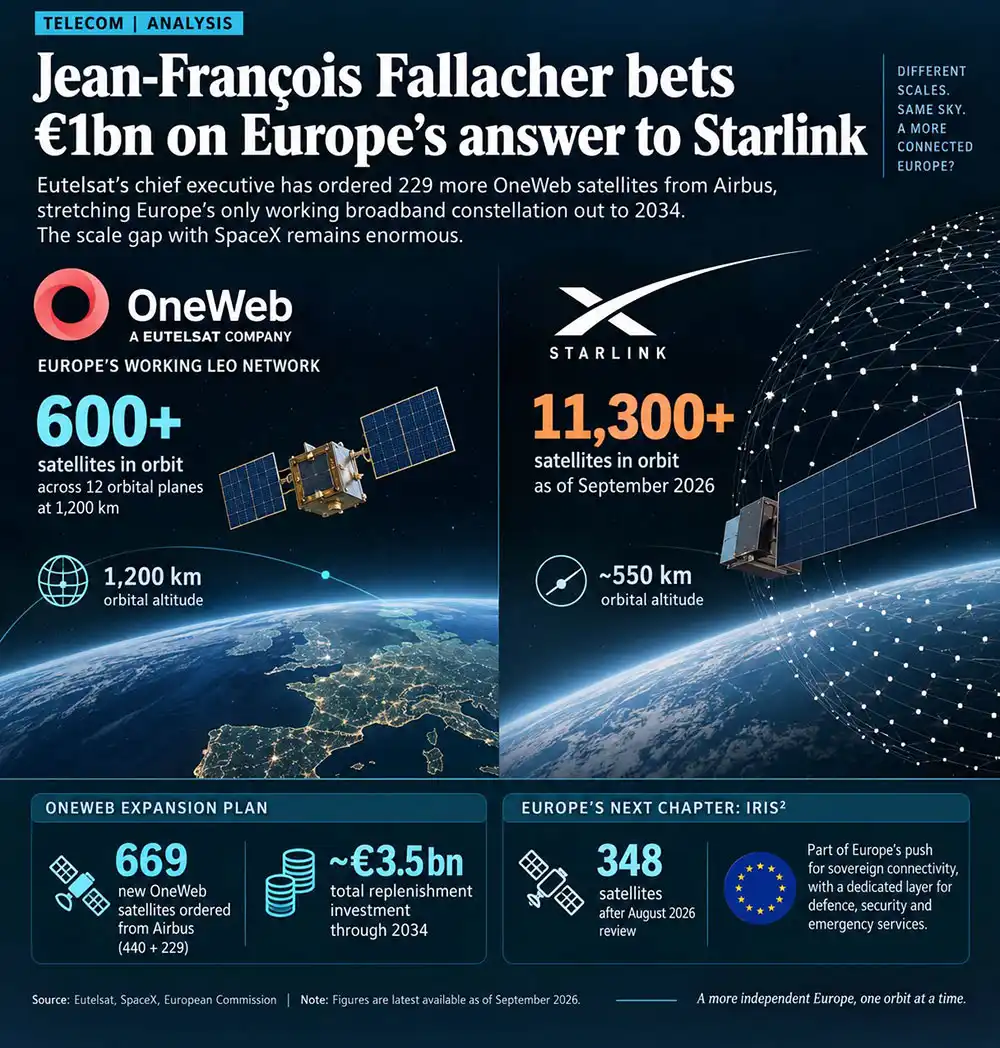
Fifteen months later, at the International Space Summit in Paris on September 10 2026, he committed roughly 1 billion euro to 229 more low Earth orbit satellites.
The order sits on top of 440 spacecraft already procured from Airbus Defence and Space, taking the total of new OneWeb satellites to 669 and allowing Eutelsat to keep replenishing and expanding the network through 2034.
It was the clearest signal yet that Europe intends to keep a broadband constellation of its own overhead, whatever SpaceX does next.
A telecom man in a satellite job
Fallacher is not a space industry lifer, and that was rather the point. He brings more than 30 years in European telecommunications, having run Orange France, Orange Spain, Orange Poland and Orange Romania, and having led national fibre-optic and 5G deployments as well as large-scale integrations involving both public and private stakeholders.
Earlier in his career he was chief operating officer of the internet service provider Wanadoo in the Netherlands and chief executive of the telecoms consultancy Sofrecom. Eutelsat described his appointment as a natural change that aligned the company fully with the telecom ecosystem.
He succeeded Eva Berneke, who oversaw the 2023 merger with OneWeb that created the world’s only combined GEO and LEO operator, and who secured Eutelsat a core role in the European Union’s planned IRIS² constellation.
The board’s reasoning was straightforward enough. Eutelsat is no longer primarily a broadcaster of television signals. It is a wholesale network operator selling capacity to telcos, governments, shipping lines and airlines, and it needed someone who had spent a career financing infrastructure and negotiating with states.
Buying continuity, and buying time
The Airbus order is, at heart, maintenance. Satellites in low orbit degrade and fall, so a constellation is less a one-off build than a treadmill. Eutelsat has signed an Authorisation to Proceed covering initial industrial activities for the 229 satellites, with the first spacecraft from the earlier 440-unit order due for delivery next quarter.
The new satellites will carry advanced digital channelisers to improve onboard processing, efficiency and flexibility, along with the ability to host third-party payloads, and the investment sits within the existing capital expenditure plan up to FY 2029. Manufacturing continues at Airbus’s Toulouse facility, which is already turning out the earlier batches.
Hosted payloads matter commercially. Eutelsat’s US arm has been pitching government agencies on placing imaging or space domain awareness sensors aboard the new spacecraft, folding them into the existing launch schedule. That turns a replenishment programme into a revenue line.
Why Europe is paying attention
OneWeb currently flies more than 600 satellites across 12 synchronised orbital planes at an altitude of 1,200km, delivering high-speed, low-latency connectivity worldwide.
Eutelsat is the only European operator of a fully functioning global LEO network. It is also working to complete a network of 44 ground stations by the end of 2026.
The next phase is IRIS², and it has grown considerably. The original December 2024 concession covered roughly 290 satellites at a project cost of 10.6 billion euro.
After an August 2026 review, the European Commission and the SpaceRISE consortium expanded the constellation to 348 satellites, with total planned investment now exceeding 15.6 billion euro.
Public funding from the Commission and the European Space Agency accounts for 11.6 billion euro, with Eutelsat, SES and Hispasat collectively investing up to 4 billion euro. Eutelsat’s own share is 2.23 billion euro.
The Commission is adding a dedicated layer of 66 LEO satellites for defence, security and emergency services, which SES says will lift secure governmental capacity by 60% within the EU.
Poland has committed 656 million euro and Hungary 500 million euro, while Spain has announced a national programme of between 1.6 billion euro and 2 billion euro.
Eutelsat leads the design, deployment and operation of the LEO segment, including a commercial Ku-band constellation expected in service by mid-2032, which should give it access to more than twice OneWeb’s current capacity.
The strategic argument is blunt. European officials point to damaged undersea cables and jammed signals, and want secure communications that keep working in a degraded environment without depending on countries or companies outside the Union. The state has put money behind that view.
A 828 million euro reserved capital increase priced at 4.00 euro a share was subscribed by the French State for 551 million euro, the UK Government for 90 million euro, CMA CGM for 100 million euro, Bharti Space for 30 million euro and FSP for 57 million euro, leaving the French State with 29.65% of capital and voting rights, followed by Bharti on 17.88% and the UK Government on 10.89%.
Separately, France’s defence procurement agency agreed a ten-year framework worth up to 1 billion euro covering priority access to OneWeb capacity. The first call-off under it, the Centaure contract, is valued at around 350 million euro over up to eight years.
Two constellations, two philosophies
On infrastructure the two networks barely resemble one another. Starlink flies at roughly 550km with laser inter-satellite links, its own rockets and its own terminals.
OneWeb satellites use a bent-pipe payload, receiving from ground gateways in Ka-band and transmitting to users in Ku-band, which makes the network dependent on its gateway footprint rather than on in-orbit routing. The higher orbit means fewer satellites are needed for global reach, at some cost in latency and capacity density.
On milestones, OneWeb got there first in one narrow sense. By March 2023 it had completed its full 648-satellite constellation, making it the first LEO broadband constellation to reach full planned deployment, and it now serves enterprise, government, maritime and aviation customers without any consumer offering.
Starlink then ran away with the market. By June 30 2026 SpaceX reported 12 million Starlink subscriber lines, exactly double the figure a year earlier, across 164 countries, with connectivity revenue of USD 11.39 billion in 2025, up 49.8%.
The cost gap is the real story
Pricing reflects the split. Starlink sells Residential Lite at USD 80 a month and standard service at USD 120, with hardware around USD 349 and business tiers from USD 250 to USD 500.
OneWeb has no published consumer rate at all, negotiating capacity wholesale with customers such as AT&T, BT, Marlink and airlines.
Starlink’s compact consumer dishes cost between USD 200 and USD 700, while OneWeb’s enterprise terminals run from USD 5,000 to USD 15,000.
OneWeb contracts carry a minimum 12-month commitment and pricing that reflects enterprise-grade service level commitments smaller operators do not offer.
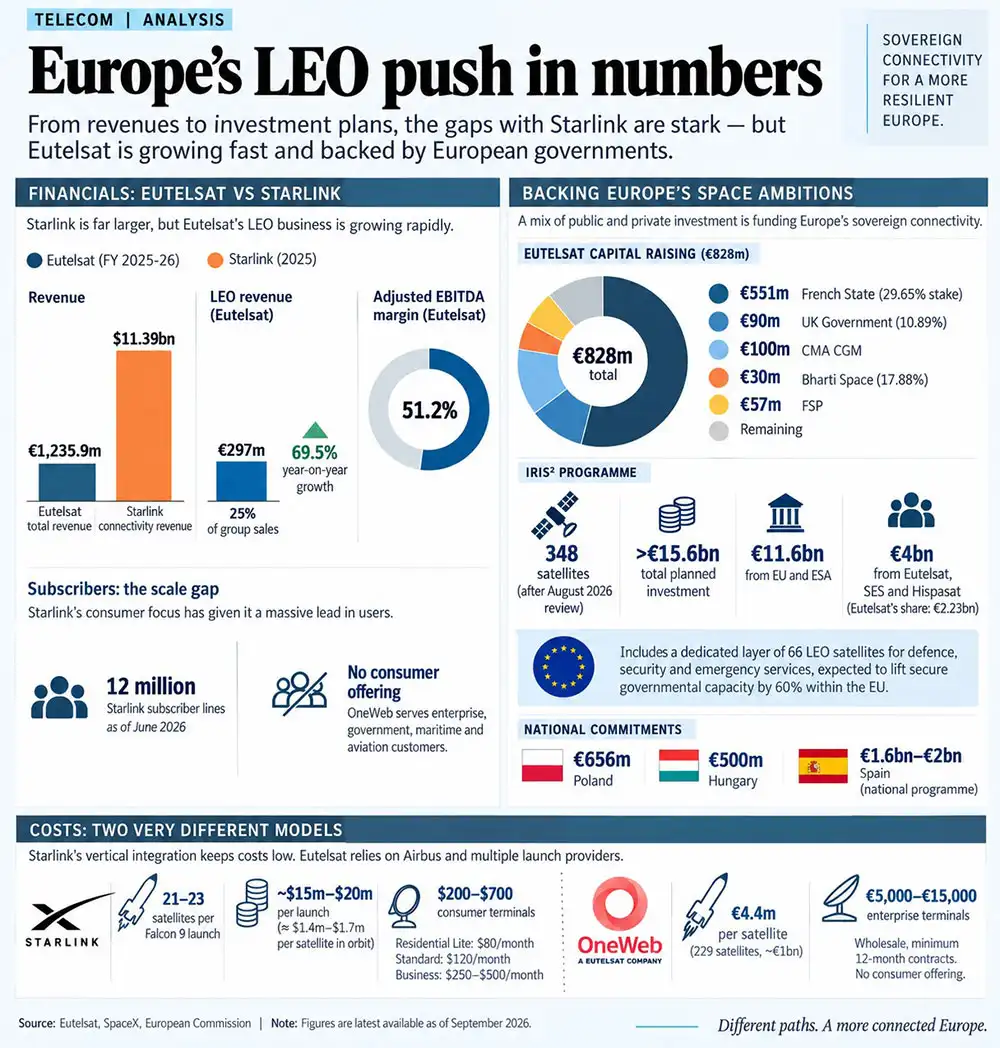
The gap widens upstream. Each Falcon 9 mission carries 21 to 23 V2-mini satellites at an internal cost of roughly USD 15 million to USD 20 million, putting Starlink’s per-satellite-in-orbit cost at about 1.4 million euro to 1.7 million euro. Eutelsat’s 229 satellites work out near 4.4 million euro each before launch.
Eutelsat’s counter is that it is not fighting on that ground. The group has said plainly that it addresses only B2B and B2G markets and is not trying to compete with Starlink on consumers.
What could still go wrong
Launch access is the sharpest constraint. Eutelsat has had to use SpaceX Falcon 9 rockets for its first refresh batch because Ariane 6’s manifest is fully booked, an awkward position for a sovereignty champion.
It has since ordered two Ariane 64 launches for 2027 and 2028, alongside about ten launches from MaiaSpace scheduled from late 2027 to 2029, though MaiaSpace is a debut vehicle yet to fly.
Then there are margins. Shares fell as much as 8% on the FY 2025-26 results after adjusted core earnings slipped to 632.4 million euro and the margin dropped to 51.2%, below analyst estimates, with the finance chief explaining that the fast-growing LEO segment still generates lower margins than the legacy geostationary business.
Video, still the largest segment, declined 13.1%. Fallacher has argued the market has this wrong. He told analysts that Eutelsat looks undervalued against Starlink’s post-IPO valuation given the asset it operates, and noted that SpaceX’s own disclosures revealed a surprising dependence on US government revenue.
Competition is also thickening. Amazon planned to deploy 700 Amazon Leo satellites by mid-2026, and IRIS² timing remains a political variable, with the expansion requiring money drawn from the EU’s 2028-2034 budget and further member state contributions.
Fallacher’s wager is that sovereignty buys patience. For now, Europe appears willing to grant it.
Image Credit: Eutelsat