
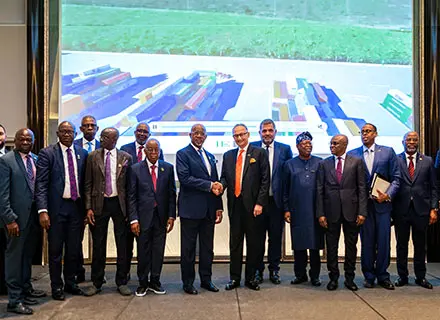

DP World has signed preliminary agreements to develop a deep-sea port and special economic zone in Nigeria’s Ogun State, extending the Dubai-based logistics group’s push into African trade infrastructure as it seeks to build integrated links between ports, industry, and inland markets.
The agreements cover the proposed Gateway Deep Seaport and the Ogun State Blue Marine Special Economic Zone.
Together, the projects are planned across about 10,000 hectares and are expected to attract more than USD 7 billion in initial investment and create more than 50,000 direct jobs when fully developed, according to Nigeria’s government.
The memoranda of understanding were signed in Paris on September 24 in the presence of President Bola Tinubu.
The scale of the Nigerian project is significant, but it should be distinguished from DP World’s separate commitment of about USD 3 billion to port infrastructure and logistics across Africa.
That continental programme includes the development of the Port of Ndayane in Senegal and Banana Port in the Democratic Republic of Congo, as well as the expansion of Maputo in Mozambique and Dar es Salaam in Tanzania.
For Nigeria, the proposed Gateway Deep Seaport is intended to provide an alternative to the heavily used Lagos port corridor.
The project is planned with a four-kilometer berth and an 18-meter draft, allowing it to accommodate larger vessels.
Nigerian officials say the new gateway could ease pressure on Apapa and Tin Can Island ports and reduce delays and logistics costs for importers and exporters.
ALSO READ | DP World to invest USD 3 billion for global expansion as Middle East disruption hits profit
The adjoining special economic zone is designed to go beyond cargo handling. DP World said the concept would bring manufacturing, processing, logistics, and port infrastructure together, enabling companies to import inputs, add value locally, and export finished products.
The model reflects a broader shift among major global port operators towards integrated logistics platforms rather than ports operating simply as points where containers are loaded and unloaded.
The location is also central to the project’s commercial case. The development sits along the Lagos-Calabar Coastal Highway, with the federal government highlighting a 28-kilometer section in Ogun State that is scheduled for completion before the end of 2026.
President Tinubu has said the road will provide a critical connection between the port and industrial zone, Lagos, the Nigerian hinterland, and wider African markets.
The government is also positioning the projects within a broader industrial and energy corridor.
The proposed development is near a Nigerian Navy operating base and dockyard and the OK LNG project. The combination of maritime infrastructure, road access, manufacturing facilities, and energy projects is intended to create a cluster capable of supporting trade and industrial activity around the new port.
The move also fits DP World’s wider global expansion.
ALSO READ | DP World expands UK logistics network with GXO grocery warehouse takeover
The group operates across 85 countries and handles 110 million twenty-foot equivalent units, according to company figures.
Its focus on end-to-end logistics reflects a market where supply chain resilience, infrastructure capacity, and access to consumer economies are becoming increasingly important for investors.
The agreements come as Nigeria tries to address longstanding bottlenecks in its logistics system.
The country has one of Africa’s largest consumer markets, but businesses have faced congestion, inadequate infrastructure, and high logistics costs.
The government has been pursuing port reforms and digital trade measures, including a National Single Window aimed at reducing bureaucracy and streamlining import and export procedures.
DP World already has a substantial presence in Nigeria. The company says it employs more than 7,000 people in the country and has built businesses in logistics and market access, particularly in healthcare and consumer sectors.
On October 1, it also announced a partnership with Nigerian conglomerate Tropical General Investments to strengthen logistics capabilities and supply-chain services in Nigeria and across West Africa.
The Nigeria agreements therefore add another layer to DP World’s African strategy, which is centered on controlling or operating infrastructure at multiple points along trade corridors. Its investment in Ndayane is intended to create a major Atlantic gateway for Senegal, while Banana Port is designed to improve maritime access to the Democratic Republic of Congo. The company is also expanding operations in Mozambique and Tanzania.
The strategy gives DP World exposure not only to port fees but also to the wider logistics chain, including warehousing, road transport, industrial zones, and market access.
That approach can potentially create more revenue streams while allowing the operator to capture cargo flows beyond an individual terminal.
ALSO READ | Iran war: DP World boosts truck fleet as Gulf shifts to road freight
For Nigeria, the proposed Ogun hub could alter the geography of trade if it moves from agreements into construction and operation. But the MoUs represent an early stage rather than a completed investment.
Delivery will depend on financing, regulatory approvals, infrastructure connections, and execution by the public and private-sector partners.
The projects nevertheless underline the growing importance of ports as strategic economic infrastructure in Africa.
As governments seek to attract manufacturing and reduce dependence on imported finished goods, deep-water ports connected to industrial zones can become platforms for both trade and production.
For DP World, the Ogun agreements extend a strategy of building connected trade corridors across emerging markets.
For Nigeria, the test will be whether the proposed port and economic zone can translate the scale of the investment plans into lower logistics costs, greater industrial capacity, and sustained trade growth.
Image Courtesy: DP World