
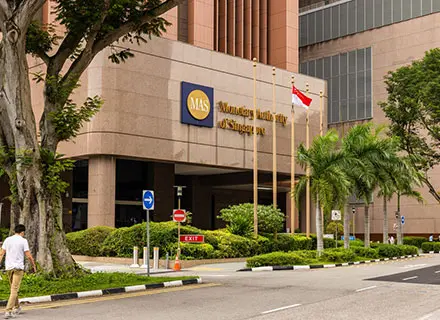

The timing is the story. Public money is going in precisely as private money is going out.
The sector looks healthy from a distance
By headcount and company count, Singapore’s fintech industry is in good shape. The city-state hosts more than 1,800 fintech firms employing close to 10,000 people. Gan put total fintech investment in 2025 at close to SUSD 3 billion and said the momentum would continue.
The industry has also matured commercially. Boston Consulting Group’s 2026 global fintech report found that worldwide fintech revenues passed USD 500 billion in 2025, growing 22% year on year, roughly four times the pace of incumbent financial firms.
Singapore’s own digital banks tell a similar story of grinding towards break-even. Trust Bank posted its first profitable month in March 2026, a little over three years after launch, with FY2025 income before operating expenses up around 39% to SUSD 135 million and its annual loss narrowing about 42% to SUSD 53.5 million.
The funding picture is much harsher
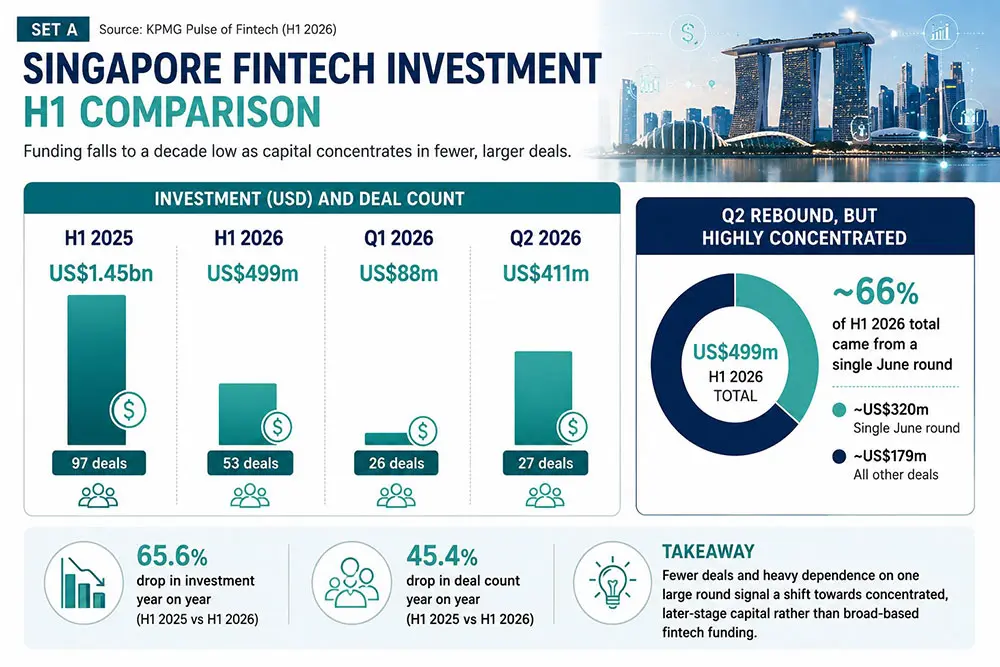
KPMG’s Pulse of Fintech report for the first half of 2026, published three days before the MAS announcement, is sobering. Singapore’s fintech sector drew just over USD 499 million across 53 deals.
The shape of that number matters more than the number itself. A very quiet first quarter brought in about USD 88 million across 26 deals.
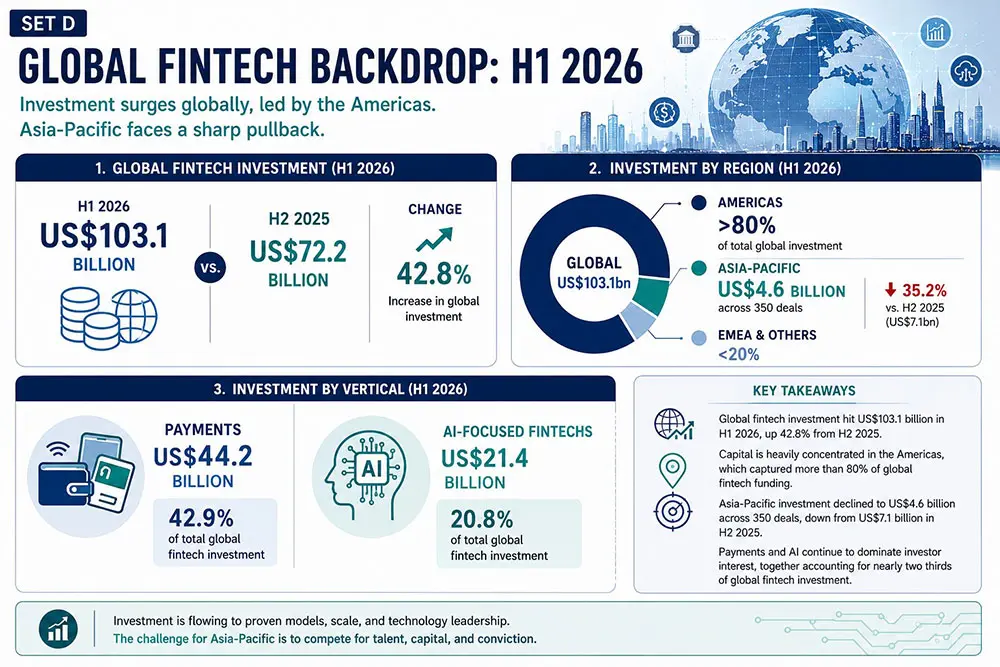
Singapore is not alone. Asia-Pacific fintech investment fell to USD 4.6 billion across 350 deals, down from USD 7.1 billion in the second half of 2025.
What policy got right
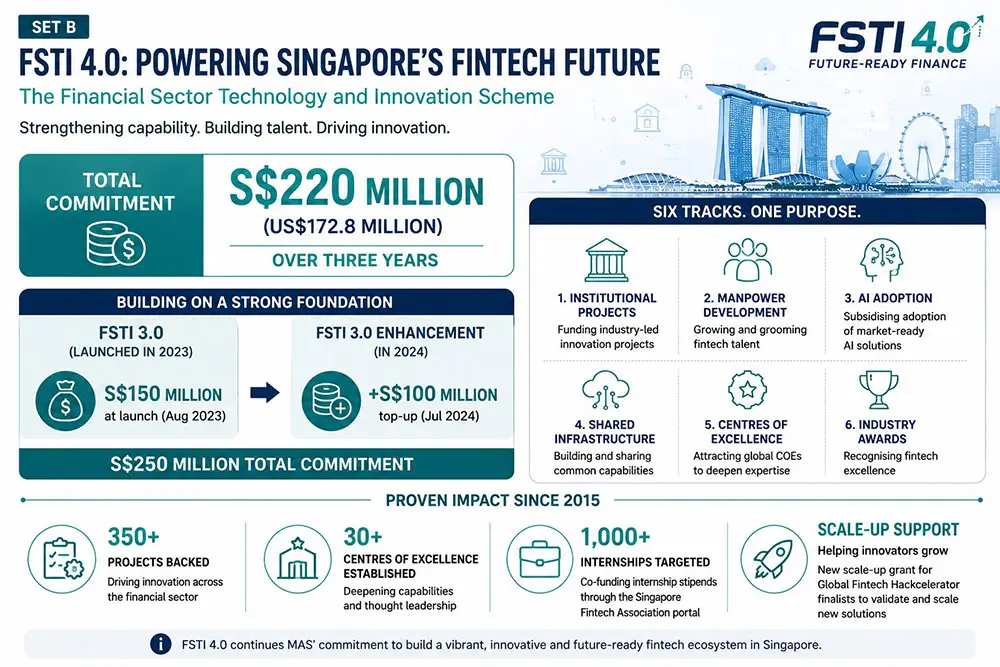
Singapore’s advantages are real and were built deliberately. FSTI has backed more than 350 projects and helped establish over 30 centres of excellence since 2015.
The tax position helps too. Corporate income tax sits at 17% with exemptions that pull the effective rate lower, there is no capital gains tax, and digital payment tokens are exempt from GST.
Where it hurts
That same enforcement instinct has cost Singapore something. On June 30 2025, MAS brought its Digital Token Service Provider regime into force under the Financial Services and Markets Act.
Talent is the second pressure point, which is why an entire FSTI track is devoted to it. The third is early-stage capital.
The scheme runs across six tracks covering institutional projects, manpower, AI adoption, shared infrastructure, centres of excellence and industry awards.
The headline number deserves care. FSTI 3.0 opened with SUSD 150 million in August 2023, but MAS added a further SUSD 100 million in July 2024 to fund a new quantum track and enhanced AI grants, taking that round to SUSD 250 million.
Measured against the opening commitment, SUSD 220 million is a clear increase. Measured against what FSTI 3.0 actually grew into, it is a reduction of roughly 12%.
MAS may well top up the new round in the same way, as it has done before. But on the figures announced this week, the regulator is not obviously spending more than last time.
The institution track funds financial institutions and fintechs working on artificial intelligence, distributed ledger technology and quantum. A separate strand subsidises adoption of market-ready AI products listed on PathFin.ai, the MAS-led knowledge platform.
The shared infrastructure track is aimed squarely at firms that want modern capability without paying to build it alone. The centre of excellence track courts global companies willing to base research, product development and regional leadership functions in Singapore.
On talent, MAS will co-fund internship stipends with a target of at least 1,000 placements over three years, matched through a new portal run by the Singapore Fintech Association. A new scale-up grant will help Global Fintech Hackcelerator finalists validate products after the competition.
Past finalists have collectively raised SUSD 3.8 billion.
Notably, MAS has named no recipient companies. This is a sector-wide mechanism, not a bet on champions.
The Hong Kong question
Hong Kong has spent the same period winning the visible contests. In the Global Financial Centres Index published in March, Hong Kong held third place globally with a rating of 765, one point ahead of Singapore on 764, and ranked first worldwide for fintech offerings, where Singapore came fourth.
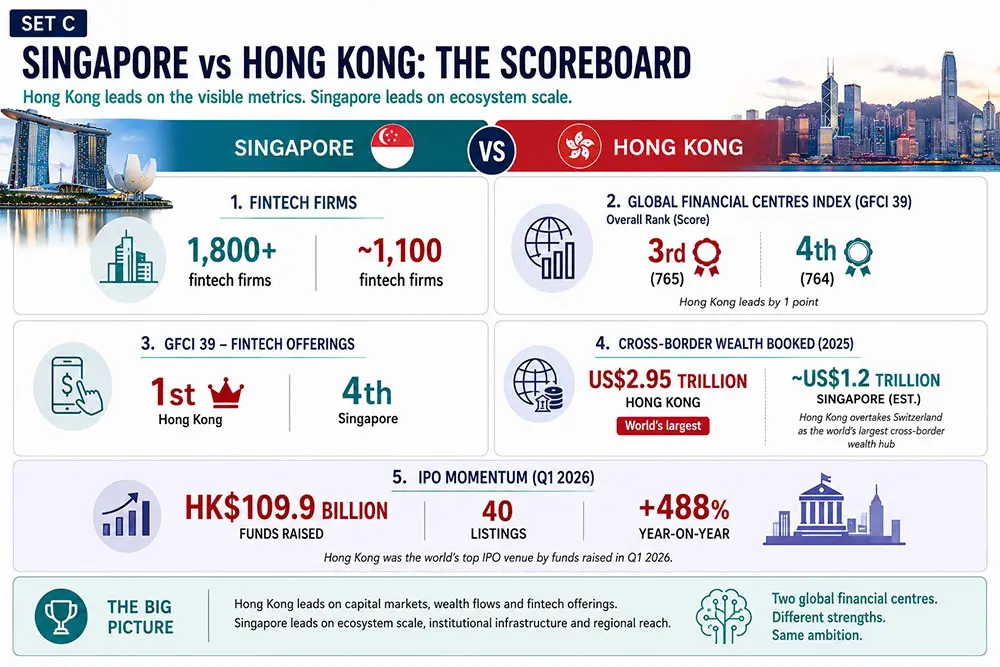
It has also overtaken Switzerland as the largest cross-border wealth hub, with USD 2.95 trillion booked in 2025.
Its digital asset push has been louder. The Stablecoins Ordinance, in force since August 2025, produced Hong Kong’s first licensed issuers in April 2026. But the detail is instructive.
Both parents are note-issuing banks. That is a 5.6% approval rate, and it suggests regulatory comfort counted for rather more than crypto pedigree.
Delivery has been slow as well. Anchorpoint’s HKDAP token only began a phased rollout on 12 August 2026, restricted to institutions and professional investors, with 522,000 tokens recorded in circulation as of August 19.
Retail access is not expected before the end of the year and HSBC’s own token is still pending. Hong Kong is not first in Asia here either. Japan licensed JPYC in August 2025 and the yen-pegged token went live that October.
Two models, one race
The models differ in kind, not just degree. Singapore runs a builder’s model. The regulator co-funds infrastructure, sets standards early, exports rails into ASEAN and treats the ecosystem as something to be engineered.
Both share the same weakness. An InvestHK ecosystem survey of 130 Hong Kong fintechs, published in 2025, found 58.8% naming talent scarcity as their top concern and 43.9% citing access to capital. Those are Singapore’s complaints too.
As of today, Hong Kong leads on the scoreboard and on capital markets momentum.