
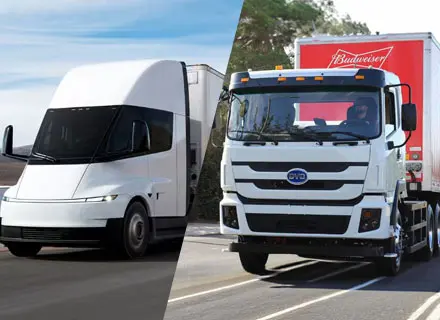

The ongoing IAA trade fair in Germany’s Hanover has set the upcoming narrative for Europe’s trucking industry, with the continent shaping up to be the next major battleground between Tesla and its Chinese rivals.
The Elon Musk-led American EV titan is preparing to bring its semi-electric truck to Europe, while Chinese companies led by BYD are already laying plans to build and sell electric heavy-duty trucks on the continent.
Intensifying the competition further, Chinese self-driving technology company Pony.ai is looking to bring autonomous electric trucks to the same market as well.
Talking about Tesla, the latter plans to bring its Semi to Europe, expanding into a heavy-duty vehicle market where rivals already offer battery-powered trucks.
Tesla’s renewed European push comes nearly a decade after the automaker unveiled its Semi in 2017. Production was initially targeted for 2019 but got repeatedly delayed as the company prioritised battery-cell supplies for its passenger vehicles.
Tesla began limited deliveries of the vehicle to US customers, including PepsiCo, in late 2022.
In April 2026, Tesla said its first Semi had rolled off a high-volume production line in Nevada. Its July shareholder update, however, said production would begin in 2026, while removing an earlier forecast for volume production this year.
Tesla’s German website has now listed a version of the truck with a range of up to 550 kilometers at a gross combination weight of 40 tonnes. Energy use has been specified at about 1 kilowatt-hour per kilometer.
The company says the truck weighs about 9,100 kilograms without a trailer or cargo. It can also recover around 60% of its range in 30 minutes using Tesla’s Megacharger network, which can deliver up to 800 kilowatts.
Tesla is also highlighting route-based charging scheduling and dedicated service centers, features aimed at reducing downtime for operators.
BYD, which has already established itself as Tesla’s global rival, is planning to launch its first heavy-duty truck in Europe in 2027 and ultimately manufacture trucks locally, according to Stella Li, the company’s executive vice president and head of international business.
While stating that BYD’s long-term plan was to produce locally everything it sells in Europe, Li said the strategy would also help the Shenzhen-based automaker deal with one of the biggest issues facing Chinese EV manufacturers in the region: tariffs.
European manufacturers, including Traton’s MAN brand, have called on the European Union (EU) to impose tariffs on Chinese electric trucks similar to those already applied to the electric vehicles arriving from the world’s second-largest economy and the biggest auto market.
Unbothered, BYD is already preparing to expand its passenger-car manufacturing footprint in Europe. Its factory in Szeged, Hungary, is expected to begin mass production in 2027.
Apart from focusing on local manufacturing, BYD is also looking to offer truck fleet operators a broader package covering financing, solar-powered charging infrastructure, and a workshop network supported by mobile roadside assistance.
Pony.ai has introduced a new Level 4 autonomous heavy goods vehicle at the IAA Transportation trade fair. The fully electric truck, jointly developed with Chinese state-owned automaker GAC, will be entering volume production later in 2026.
Level 4 autonomy allows a vehicle to drive itself without a human driver under specific conditions and within designated zones. Pony.ai already has its Level 4 truck line-ups operating in China, with participation from human safety drivers.
Pony.ai said it was talking to European governments and potential customers about road tests, while its robotruck unit plans to launch in European and Middle Eastern markets over the next two years.
The company, particularly interested in markets riddled with high labour costs or labour shortages, sees Europe as an important arena for its robotic trucks.
While the company has already approached several ports and European governments about testing, only a handful of them currently have regulations that allow self-driving vehicle testing.
Geely unit Farizon, Sany, Sinotruk, and startups like Windrose and SuperPanther, along with Pony.ai and BYD, are also seeking a share of Europe’s road-based freight network.
Image Credit: Tesla & BYD USA