

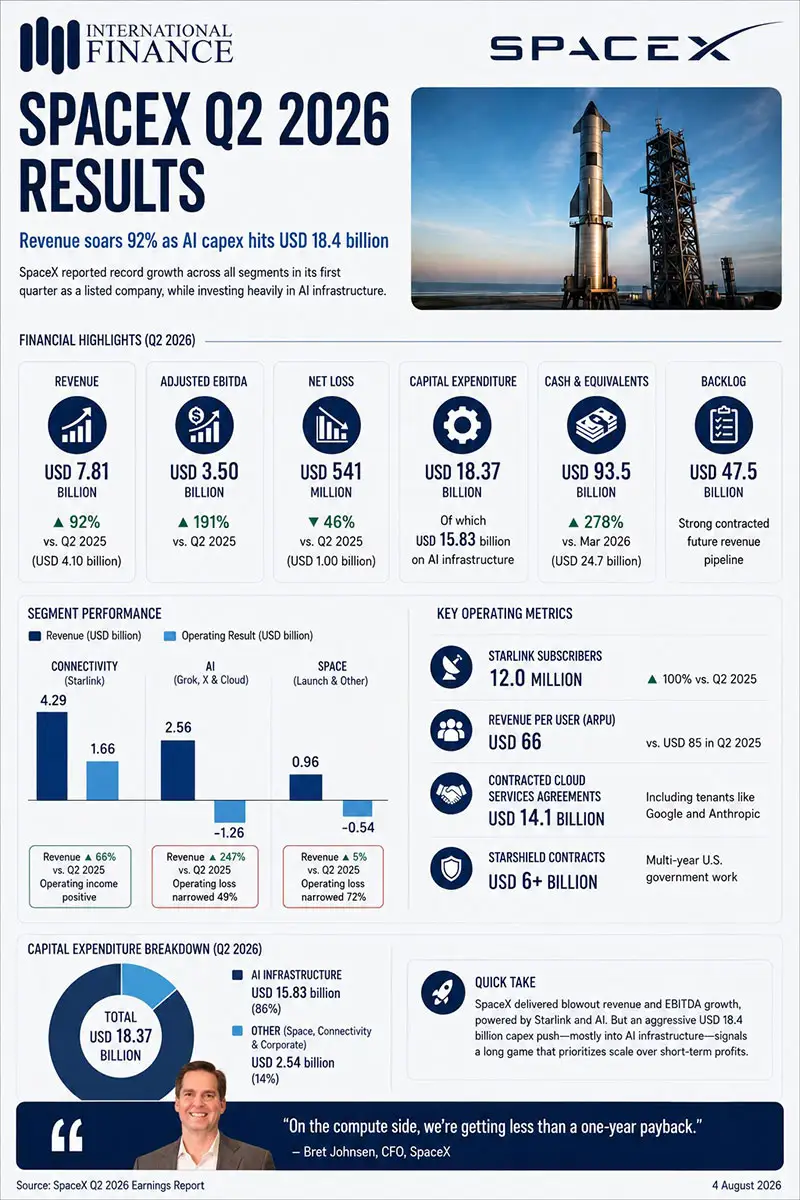
Revenue for the quarter ended June 30 came in at USD 7.81 billion, up 92% from USD 4.1 billion a year earlier and roughly USD 900 million ahead of the USD 6.93 billion consensus.
All three divisions beat their estimates. Connectivity, which houses Starlink, brought in USD 4.29 billion, up 66%, and delivered USD 1.66 billion of operating income. It remains the only profitable part of the company.
There was plenty else to like. Starlink passed 12 million subscribers, double a year earlier and up 1.7 million in three months. The company ended June with about USD 93.5 billion in cash and equivalents, against USD 24.7 billion in March, and a backlog of USD 47.5 billion.
Then investors read the cash flow statement.
The bill for the AI ambition
Capital expenditure in the quarter was USD 18.37 billion. Analysts had modelled around USD 13.2 billion. Of that total, USD 15.83 billion went straight into AI infrastructure, roughly double what the market had assumed.
Debt and finance leases climbed to USD 36.8 billion from USD 22 billion three months earlier.
The uncomfortable detail sits underneath. Starlink is funding this build-out, and Starlink’s own unit economics are softening. Average revenue per user was USD 66, flat on the first quarter but down from USD 85 a year ago, as growth shifted towards lower-income international markets.
Elon Musk used the call to double down rather than reassure. SpaceX will build its AI infrastructure exclusively on Nvidia silicon, he said, praising the Vera Rubin architecture and confirming the company is, in his words, “exclusive to Nvidia”.
The roadmap, and why satellite count is a financial story
The next Starship flight, IFT-14, is planned for the end of August, and it matters more than a test number suggests.
Satellite count is where the space story becomes a financial one. Each V3 satellite carries well over a terabit per second of downlink capacity, an order of magnitude beyond the current generation, and it is sized for Starship, not Falcon.
More capacity added per launch is the mechanism by which Starlink can keep signing subscribers in busy markets without degrading service, and it is the only credible path to stabilising ARPU.
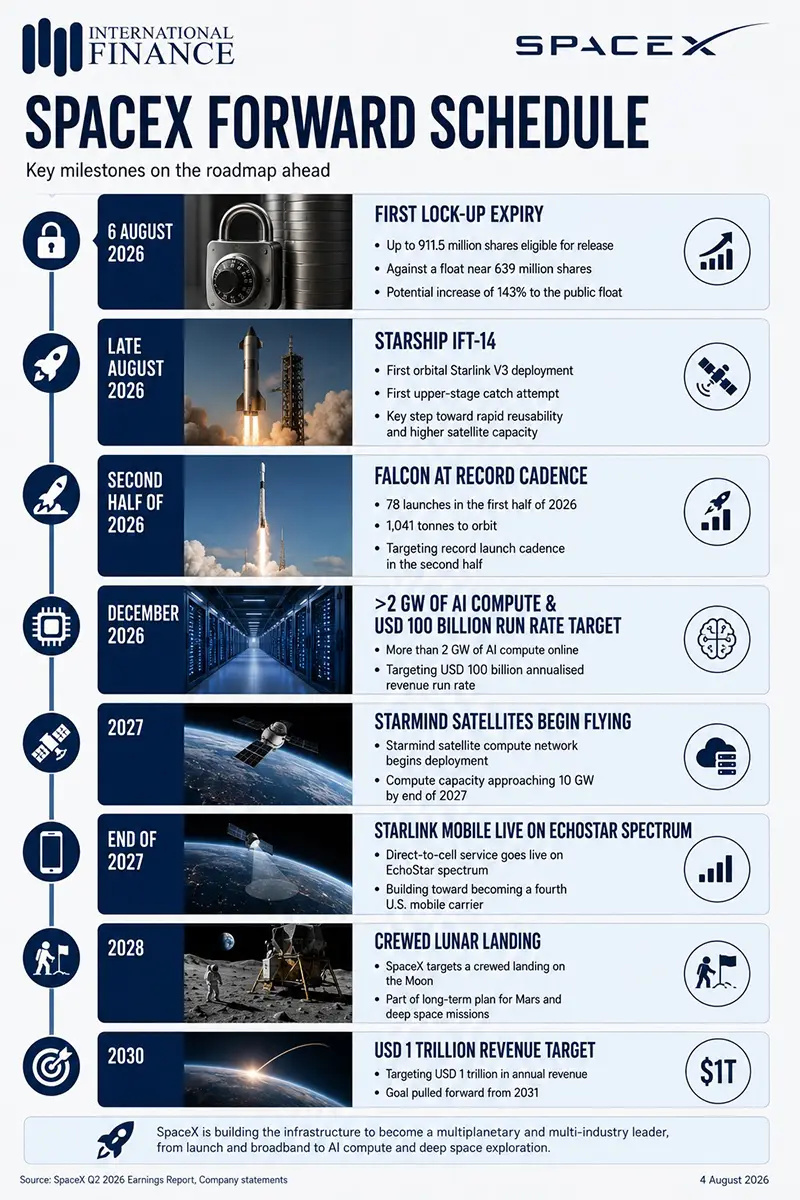
President Gwynne Shotwell noted 78 Falcon launches in the first half and 1,041 tonnes delivered to orbit, most of it the company’s own hardware.
Beyond that sits mobile. Starlink has struck direct-to-cell partnerships with SoftBank, NTT DoCoMo and Spark New Zealand, and the FCC has cleared the transfer of EchoStar spectrum, which Shotwell called a foundational advantage.
Satellites capable of a standalone service are targeted for 2027, with first customers by the end of that year and an explicit ambition to become a fourth US carrier.
American telecom shares fell on Wednesday morning. Shotwell also put a crewed lunar landing in 2028, and Musk repeated a USD 100 billion annualised revenue run rate by December and USD 1 trillion of annual revenue by 2030, a year earlier than previously signalled.
Every item on that list is capital before it is cash flow, which is precisely the tension the quarter exposed.
What the analysts are saying
Deepwater Management’s Gene Munster was the loudest bull, posting on X during the session that the market was “missing the point”.
JPMorgan’s Doug Anmuth was more measured. In a note published after the call he modelled capital spending approaching USD 200 billion in both 2027 and 2028, which he said would pressure free cash flow in a pattern now familiar across the hyperscalers.
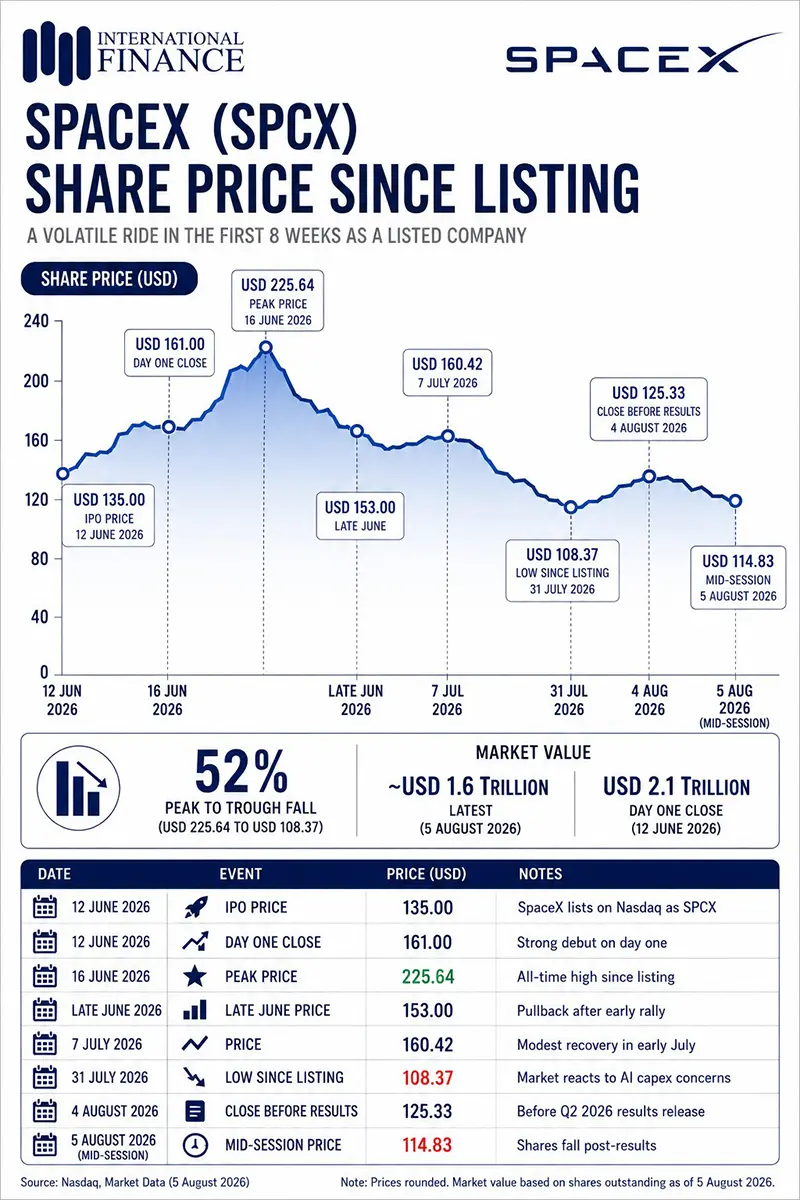
He also flagged Thursday’s lock-up expiry, which frees up to 911.5 million insider shares against a float of roughly 639 million, a potential increase of 143%, though he thinks much of the positioning has already happened. JPMorgan nudged its target up to USD 240 from USD 225.
The rest of the Street scattered. Morgan Stanley’s Adam Jonas has stayed Overweight with a USD 300 target on the view that the AI business is undervalued. Piper Sandler trimmed to USD 140 from USD 156 and Wells Fargo to USD 215 from USD 230, while Bank of America turned more constructive and UBS reiterated a buy.
What to watch
Four things over the next few weeks. Thursday’s unlock, and how much stock arrives. The IFT-14 outcome, which validates or delays the V3 capacity thesis. Any move towards formal capital expenditure guidance, the absence of which is damaging sentiment.
And the third quarter connectivity margin, the first period to capture June’s price rise. Short interest is near 34% of the float, so the market has already picked a side. The company now has to launch its way out of the argument.