
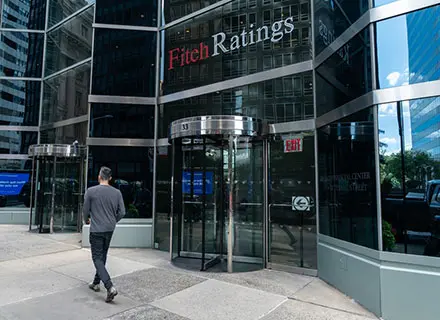

The UAE’s debt capital market expanded to about USD 320 billion outstanding at the end of June, as borrowers turned increasingly to US dollar funding despite regional volatility, according to Fitch Ratings.
The market grew 3% year on year in the first half of 2026, while US dollar debt issuance reached USD 24 billion, 40% higher than in the second half of the previous year.
Fitch expects the debt capital market to expand moderately through the rest of 2026 and in 2027, supported by funding diversification, financing requirements across sectors and regulatory reforms.
More than 70% of outstanding UAE debt was denominated in US dollars at the end of June, while sukuk accounted for 21% of the market.
The trend also reflects the UAE’s strategy of deepening capital markets and attracting international investors, while giving banks, companies and government-related entities flexibility over how they raise funds across market conditions over the medium term.
ALSO READ | With 84% share, Saudi Arabia emerges as Gulf’s top dividend market
Fitch said UAE issuers had generally maintained access to bond and sukuk markets despite volatility created by the Iran war.
“UAE issuers have generally maintained market access so far in 2026 despite regional volatilities,” said Bashar Al-Natoor, Fitch’s global head of Islamic Finance.
He said market diversity had increased, pointing to the first dirham digitally native notes, sovereign retail sukuk, blue and green bonds and certificates of deposit.
Fitch said the near-term trajectory of issuance would depend partly on regional stability. Improved conditions could create a more favourable funding environment, while renewed escalation in the US-Iran conflict could weigh on market growth.
Fitch expects consolidated UAE government debt to rise to 25% of GDP in 2026, from 22.7% in 2025. Banks and corporates are expected to continue issuing debt opportunistically.
Credit quality remains another support. Fitch reported that over 80% of UAE sukuk were investment grade, with no defaults recorded.
However, the proportion of issuers with stable outlooks declined to 81% during the first half, while Fitch placed Ras Al Khaimah and several corporate and sukuk issuers on Rating Watch Negative.
Liquidity in Fitch-rated UAE sukuk improved in August compared with March but remained below its pre-conflict level in January.
The UAE’s performance also sits within a wider expansion of Gulf debt markets. Kuwait Financial Centre, or Markaz, estimated that GCC bond and sukuk issuance reached USD 102.69 billion in the first half, up 6.5% from a year earlier.
Nasdaq Dubai also recorded 33 fixed-income listings worth USD 13.8 billion during the first six months. Total debt listed on the exchange reached USD 141 billion, including USD 98.6 billion of sukuk and USD 42.4 billion of bonds.
Fitch expects UAE issuers to remain among the largest emerging-market dollar debt issuers and among the world’s leading sukuk issuers and investors.
For borrowers, a deepening investor base and access to international capital provide alternatives to bank financing and domestic markets.
The main challenge will be maintaining that access if geopolitical tensions intensify or global borrowing costs rise.
ALSO READ | Sukuk liquidity edges closer to pre-Iran war levels but recovery fragmented, says Fitch
For now, however, the surge in dollar issuance suggests that UAE borrowers continue to see international debt markets as a reliable source of capital, reinforcing the country’s position as one of the Gulf’s most important fixed-income centres.