
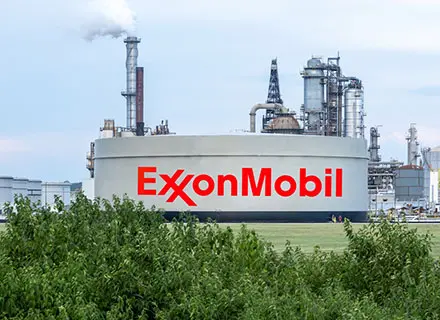

American multinational oil and gas corporation ExxonMobil and its partners will invest USD 1 billion in Nigeria’s offshore Usan. The Infill Project is expected to add about 40,000 barrels per day to the African country’s oil production capacity, Nigeria’s upstream petroleum regulator said.
The investment, announced at the 25th NOG Energy Week Conference and Exhibition on 8 July, marks ExxonMobil’s return to drilling operations in Nigeria after nearly a decade, with its last drilling campaign in the country conducted in 2016. Oritsemeyiwa Eyesan, chief executive of the Nigerian Upstream Petroleum Regulatory Commission (NUPRC), described the announcement as a significant development for the country’s upstream oil sector, noting that Esso Exploration and Production Nigeria, an ExxonMobil affiliate, had not drilled in Nigeria since that campaign.
The project falls within Oil Mining Lease 138 and involves on-block operations at the Usan field, which Esso Exploration and Production Nigeria operates under a production sharing contract alongside the Nigerian National Petroleum Company, with Chevron, TotalEnergies, and Nexen, a subsidiary of the China National Offshore Oil Corporation, as co-venture partners.
The Usan field was discovered in 2002 and developed in water depths of 2,400 feet using a floating production, storage, and offloading vessel and 42 subsea wells, comprising 23 production wells and 19 water and gas injection wells connected to a two-million-barrel-capacity FPSO. First oil was produced in February 2012, when the field had a gross production capacity of up to 180,000 barrels per day.
The investment comes as Nigeria, one of Africa’s largest crude producers and an OPEC member, seeks to reverse years of declining output through regulatory reform and renewed investment. The African country has faced persistent challenges, including oil theft, pipeline vandalism, and underinvestment, prompting the government to accelerate project approvals and encourage fresh capital inflows into the sector.
In a separate development, the NUPRC issued petroleum prospecting licenses to successful applicants from the 2022/2023 Mini Bid Round and the 2024 Nigeria Licensing Round. A total of 12 companies received 19 licenses covering deep offshore, shallow water, and continental shelf areas, with Broron Energy, Petroli Energy Marketing and Supply, Sahara Deepwater Resources, and Tulcan Energy among those receiving awards, underscoring the breadth of opportunities on offer in Nigeria’s licensing rounds.
Apart from its big-ticket investment in Nigeria, Exxon, in partnership with QatarEnergy, has entered Cyprus as well through a deal signed with the Mediterranean country’s government. Prospects of two offshore gas fields have been declared marketable, a milestone in efforts by the East Mediterranean island to develop its energy reserves.
The “Declaration of Marketability” signed in Nicosia has advanced a project central to the region’s ambitions to supply more gas to Europe.
ExxonMobil has reported discoveries in two offshore blocks in fields known as Glaucus and Pegasus. As per the company and the Cypriot officials, the combined discoveries could be between eight and nine trillion cubic feet.
The “Declaration of Marketability,” according to the Cyprus President Nikos Christodoulides, “represents a major step towards establishing the Eastern Mediterranean as a credible alternative energy corridor for Europe.”
“Some additional drilling on the two offshore fields would be required before moving into the front-end engineering and design (FEED),” the administration added further.
“A final investment decision is anticipated around 2029 and production in 2033,” remarked ExxonMobil Vice President and head of global expansion John Ardill.
QatarEnergy signed a preliminary deal with ExxonMobil and Egypt’s government in May 2026 to study the development and commercialization of gas discoveries in Cyprus using Egypt’s existing gas and LNG infrastructure.
“The reserves from Pegasus and Glaucus would probably be delivered with a pipeline tie-back to Egypt,” Ardill concluded.