
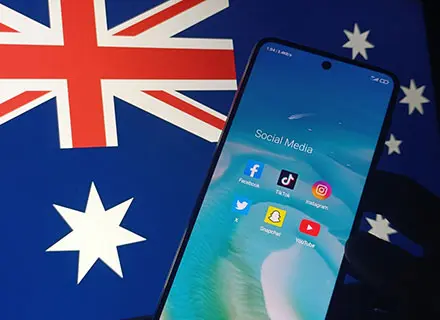

Australia is preparing to give millions of social media users the ability to switch off algorithm-driven feeds, in a fresh regulatory challenge to the business models of some of the world’s biggest technology companies.
The Albanese government on Tuesday released draft legislation that would require social media platforms to give users aged 16 and over a clear choice between personalised, algorithmically recommended content and a feed showing posts from friends, creators and accounts they have chosen to follow.
The proposal, called “My Feed, My Way,” is part of a broader Digital Duty of Care framework that would impose new obligations on digital platforms to identify and address risks to users.
Prime Minister Anthony Albanese said the policy aims to empower users rather than increasing government control over the internet.
“This is not about giving government control; it is about giving people control,” Albanese said as the government released the legislation for consultation.
Under the proposed rules, social media platforms would have to notify new and existing users about their feed options. Users could choose to have their default feed populated with personalised recommendations or opt out of those recommendations and see content from people and creators they follow.
Communications Minister Anika Wells said Australians over 16 would be able to opt in or out of algorithmic recommendations and that platforms would be required to respect that choice.
“Just as we have basic safety standards for cars, toys or food, the duty of care applies basic standards to the online products we use every day,” Wells said.
The measure represents a significant potential challenge to the way platforms such as Facebook, Instagram and TikTok keep users engaged. Recommendation systems analyse users’ behaviour and preferences to determine what content they are shown, allowing platforms to maximise engagement and, in turn, advertising opportunities.
Australia’s proposed intervention would not ban recommendation algorithms. Instead, it would force platforms to provide a meaningful alternative.
That distinction is important for Big Tech, which has faced growing criticism from governments, parents and regulators over whether engagement-focused recommendation systems can amplify harmful or extreme material.
Australia’s eSafety Commissioner has previously warned that recommender systems can expose children to dangerous viral challenges, sexual exploitation risks and harmful content loops. The regulator has also said systems designed to maximise engagement can amplify misogynistic, hateful and extremist material.
The proposed legislation goes considerably beyond social media. Digital services including online games, apps and AI chatbots would also be required to protect under-18s from features that can have negative behavioural effects, including addictive design and features that affect self-esteem.
Platforms would also have obligations concerning harmful material, including content promoting eating disorders, pornography, hostile ideas about women and gender equality, glorifying crime or dangerous stunts, and material capable of causing serious mental-health distress.
The government is proposing tougher enforcement powers for the eSafety Commissioner, including the ability to issue removal notices for “nudify” applications or websites and faster intervention against child cyberbullying and adult cyber abuse.
Companies that fail to comply with the Digital Duty of Care could face penalties of up to AUSD 109.2 million (about USD 79 million).
The proposed legislation builds on Australia’s increasingly aggressive approach to technology regulation.
In December 2025, Australia became the first country to introduce a broad minimum-age restriction preventing children under 16 from maintaining accounts on designated social media platforms. Facebook, Instagram, TikTok, YouTube, X, Reddit, Snapchat, Threads, Twitch and Kick are among the services subject to the restrictions.
The government is now extending its focus from who can use social media to how social media platforms shape what users see.
That shift could have implications well beyond Australia. The country’s under-16 restrictions have already attracted international attention, and Canberra is positioning the algorithm proposal as another world-leading intervention.
The government says the new rules are intended to create greater transparency and user choice rather than dictate what Australians can read or watch.
But the proposal is likely to face opposition from both sides of the political debate.
Some advocates argue that an opt-out model does not go far enough because users will still be exposed to algorithmic recommendations unless they actively disable them.
The Greens and other campaigners advocate for an opt-in model that would automatically disable personalised algorithms.
Critics from the conservative side, meanwhile, have raised concerns about government powers over online content and the potential for regulation to become a form of censorship.
For technology companies, the Australian proposal adds to a growing patchwork of regulations governing algorithms, online safety and children’s use of digital services.
The legislation is currently being released for targeted consultation, with the government planning to introduce it to Parliament later this year.
If enacted, Australia’s approach would establish a new principle for social media regulation: users would not necessarily have to accept the feed an algorithm chooses for them.
For Big Tech, the legislation could mean that users are no longer required to accept the algorithm as the default.