
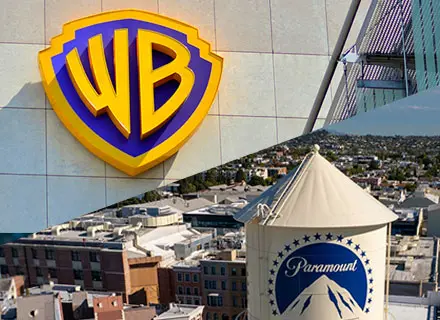

Paramount Skydance has completed its USD 110 billion takeover of Warner Bros. Discovery created one of Hollywood’s biggest entertainment companies, giving chief executive David Ellison control of a sprawling portfolio spanning film, television, streaming, and news.
The deal, completed on Tuesday, brings together the studios behind franchises including Mission: Impossible, Harry Potter, and DC alongside Paramount’s film operations and television assets. The merged entity also oversees HBO Max, Paramount+, CBS, and CNN, consolidating some of the industry’s most recognizable brands under one corporate umbrella.
The new company will operate under the Skydance name, with Ellison as chairman and chief executive and former Mattel chief executive Ynon Kreiz serving as co-chief executive. Shares began trading on the New York Stock Exchange under the ticker SKYD after the transaction closed.
For Ellison, the transaction marks an extraordinary expansion of a company that was founded only in 2010. Skydance initially built its reputation as a production and financing partner before merging with Paramount last year. It subsequently emerged as the successful bidder for Warner Bros. Discovery after competing against Netflix and other potential buyers.
The transaction is also a major bet on consolidation at a time when the traditional Hollywood business model is under pressure. Cable television subscriptions continue to decline, streaming platforms face high content costs, and studios are competing for audiences against technology companies, including Netflix, Amazon, and Apple.
The combined group intends to respond by creating a larger streaming operation. Paramount+ and HBO Max are expected to merge into a single service, significantly expanding Skydance’s library and subscriber base. The company has well over 200 million streaming subscribers across its services, according to the Financial Times.
Skydance also plans to increase its film output. It has committed to releasing at least 30 films annually during each of the first two years following the merger, rising to 32 a year for the following three years. The commitments formed part of a settlement reached with US states that had challenged the transaction.
The settlement was crucial to completing the deal. A coalition of 12 states, led by California, had sued to block the merger, arguing that combining two major Hollywood companies would concentrate too much power over film, television, streaming, and news.
Paramount ultimately agreed to additional safeguards, including an independent news oversight board covering CBS and CNN. It also committed to increase US film production spending by at least USD 300 million a year and maintain specified theatrical-release quotas.
The US Justice Department had already concluded in June that the transaction was unlikely to harm competition in streaming, linear television, or theatrical film production and distribution. Its eight-month investigation examined well over two million documents and information from more than 80 custodians.
European Union and UK regulators also cleared the deal, removing another significant obstacle to completion. The remaining legal challenge came from the states and the Writers Guild of America, which argued that consolidation could hurt employment, wages, and working conditions for Hollywood’s creative workforce. The union ultimately settled its case.
For investors, however, the central question is whether the enlarged company can translate its enormous collection of intellectual property into stronger cash flow.
Paramount Skydance has identified $6 billion in planned savings. Much of the savings are expected to come from eliminating duplication and combining technology and cloud infrastructure rather than direct labour cuts, although analysts expect the integration to have significant employment consequences across Hollywood.
The financial burden is substantial. The merged company is expected to carry about USD 80 billion in debt, leaving Ellison under pressure to deliver the promised efficiencies while investing heavily in content and maintaining the value of its traditional television networks.
The debt load makes achieving scale both the primary reason for the merger and its greatest risk. The enlarged company has greater bargaining power, a deeper content library, and more opportunities to spread technology and production costs across a larger customer base. But it must also manage the declining economics of cable television while spending enough on streaming to compete with much larger technology-driven rivals.
Analysts at MoffettNathanson expect the combined company to generate about USD 67 billion in revenue and USD 16 billion in EBITDA in 2028, with revenue rising to roughly USD 70 billion and EBITDA to USD 19 billion by 2030.
The deal also changes the balance of power in Hollywood’s news business. CNN and CBS News will remain separately led, with CNN chief Mark Thompson and CBS News editor-in-chief Bari Weiss retaining their positions and reporting separately to the new leadership. The structure aims to address concerns about editorial independence after the merger.
The immediate challenge for Ellison and Kreiz is therefore not simply integrating two companies. They must persuade investors that the merger can create a sustainable media business in an industry where size alone has not guaranteed success.
Netflix, Disney, Amazon, Apple, and a growing ecosystem of digital creators remain formidable competitors for both attention and advertising. Artificial intelligence is adding another layer of disruption, potentially changing how content is produced, distributed, and monetised.
Skydance is betting that combining some of Hollywood’s deepest film and television libraries with Paramount’s and Warner’s streaming platforms will provide the scale needed to compete. The $110 billion transaction may have created a new Hollywood heavyweight, but the harder task now begins: proving that bigger can also be more profitable.