

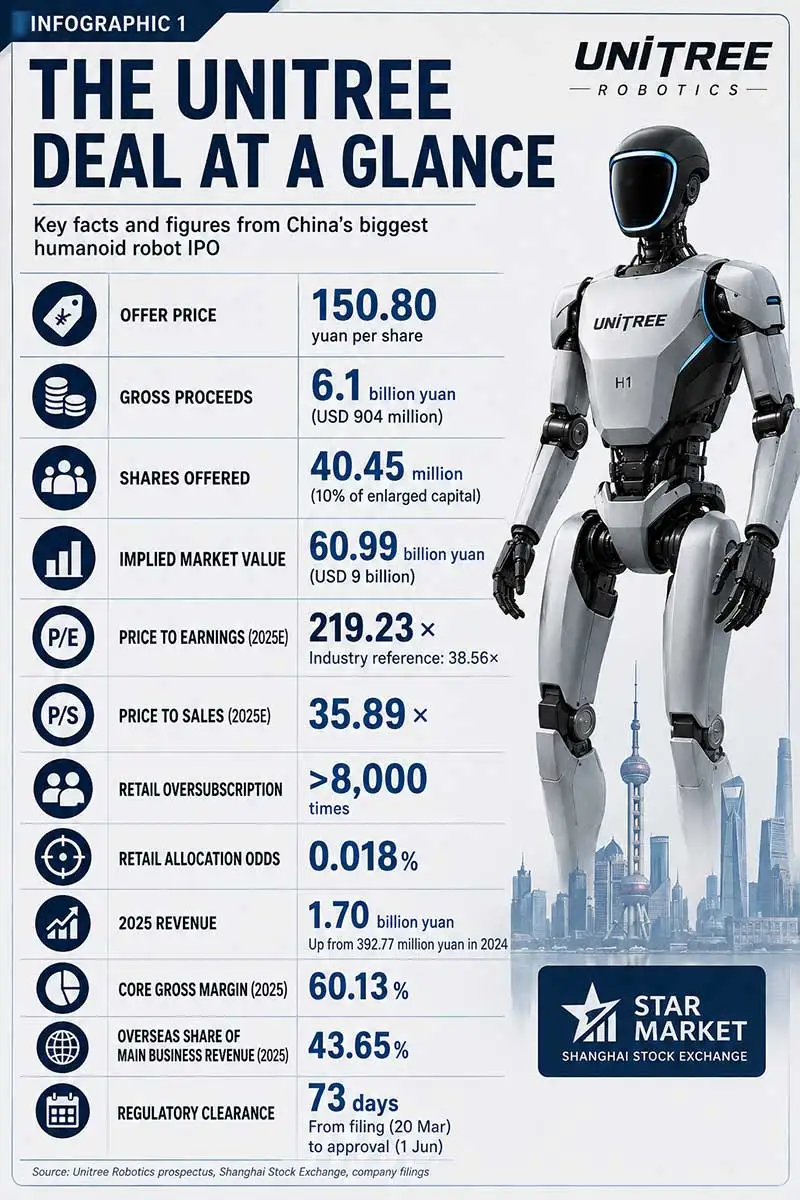
The Hangzhou-based company is offering roughly 40.45 million shares, or 10% of its enlarged share capital, on the Shanghai Stock Exchange’s STAR Market. At that price the company is worth around 60.99 billion yuan, close to USD 9 billion.
The reception has been extraordinary even by the standards of China’s technology listings. The offering was more than 8,000 times oversubscribed by retail investors, with the company disclosing odds of roughly 0.018% of receiving shares after a partial reallocation away from the institutional tranche.
The regulatory path was just as quick. The application was accepted on March 20 and cleared the listing committee on June 1, a span of 73 days and a record for the board.
What investors are actually paying for
The valuation is the story. The offer price implies a diluted price to earnings ratio of 219.23 for 2025 and a price to sales ratio of 35.89, both far above comparable general equipment manufacturers, against a reference industry multiple of 38.56 times.
The company itself warned investors about the risk of a share price decline given the premium. The final price came in about 45% above a market consensus of around 104 yuan after bookbuilding with institutions.
Underneath that multiple is a business growing at a rate few hardware firms manage. Revenue rose to 1.70 billion yuan in 2025 from 392.77 million yuan in 2024 and 159.13 million yuan in 2023, a compound annual growth rate (CAGR) above 220%.
The headline 219 times multiple is calculated on the lower of those two figures. Between 2023 and 2025 the company sold 33,294 quadruped robots and 5,632 humanoids, and gross margin on the core business climbed to 60.13%.
The strategic investor list explains part of the enthusiasm. Institutions taking 20% of the issuance include DeepSeek, Tencent’s Qishan Investment, PetroChina’s Kunlun Capital, China Southern Power Grid’s industrial finance arm and Tianyi Capital, alongside three National Social Security Fund portfolios.
DeepSeek alone was allocated 933,390 shares with a 36-month lock-up, a pairing meant to bridge large language models and robot hardware. This is state-adjacent capital and platform capital arriving together, which is how Beijing tends to signal that a sector matters.
Why everyone is rushing the exit door at once
Unitree is not an outlier. It is the first mover in a queue. AgiBot, valued above 20 billion yuan after backing from Tencent, JD.com and SAIC Motor, began its Hong Kong listing process in July, the first among a wave of 30 to 50 Chinese embodied intelligence startups to disclose listing plans.
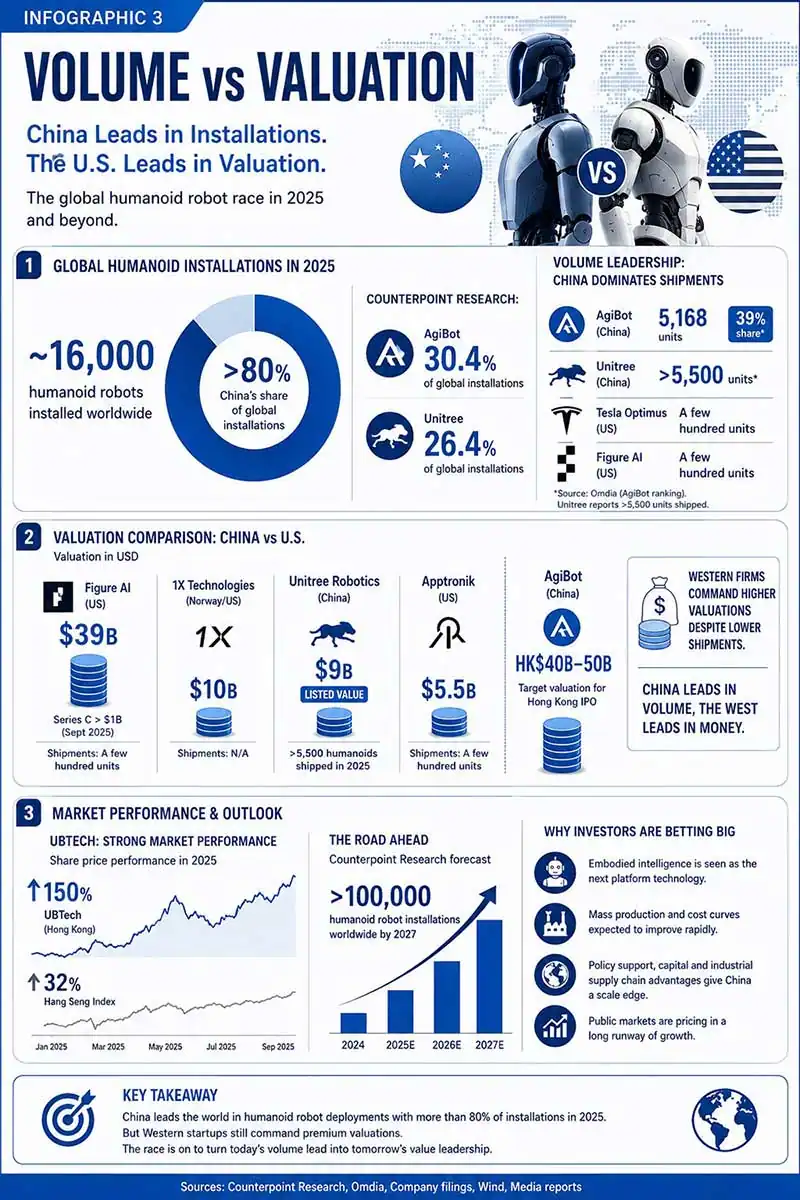
UBTech, which listed in Hong Kong in December 2023 as the first humanoid robot stock anywhere, saw its shares surge 150% in 2025 against a 32% rise in the Hang Seng Index.
Three forces are pushing companies towards public markets simultaneously. The first is capital intensity. Building humanoids requires actuators, reducers, sensors and factories, the training data problem is unsolved, and the burn rate is high while revenue is thin.
The second is the policy window. The 15th Five-Year Plan covering 2026 to 2030 elevates robotics and embodied intelligence from a niche subsidy target into the connective tissue of China’s economic modernisation strategy, with component localisation targets written into the top-level document rather than into subordinate ministry plans.
A 1 trillion yuan state venture fund for artificial intelligence (AI), robotics and emerging technologies sits behind it. Listing while that support is explicit is simply cheaper than listing later.
The third force is the valuation cycle itself. Sector financing in China reached 73.5 billion yuan in 2025, and the first two months of 2026 alone exceeded 20 billion yuan. Private rounds at those levels create pressure for public exits before enthusiasm cools.
The industrial base beneath the hype
The humanoid narrative sits on top of an automation build-out that is already the largest in history. China accounted for 54% of all industrial robots installed worldwide in 2024, or 295,000 of 542,000 units, and its installed base of about two million machines is roughly 4.5 times that of Japan in second place. Global operational stock stood at 4.66 million.
More telling is who supplies them. The share of local suppliers in Chinese domestic installations rose from 30% in 2020 to 57% in 2024, and Chinese firms now hold 85% of the domestic metal and machinery segment. For the first time, Chinese robot makers sold more units at home than foreign competitors.
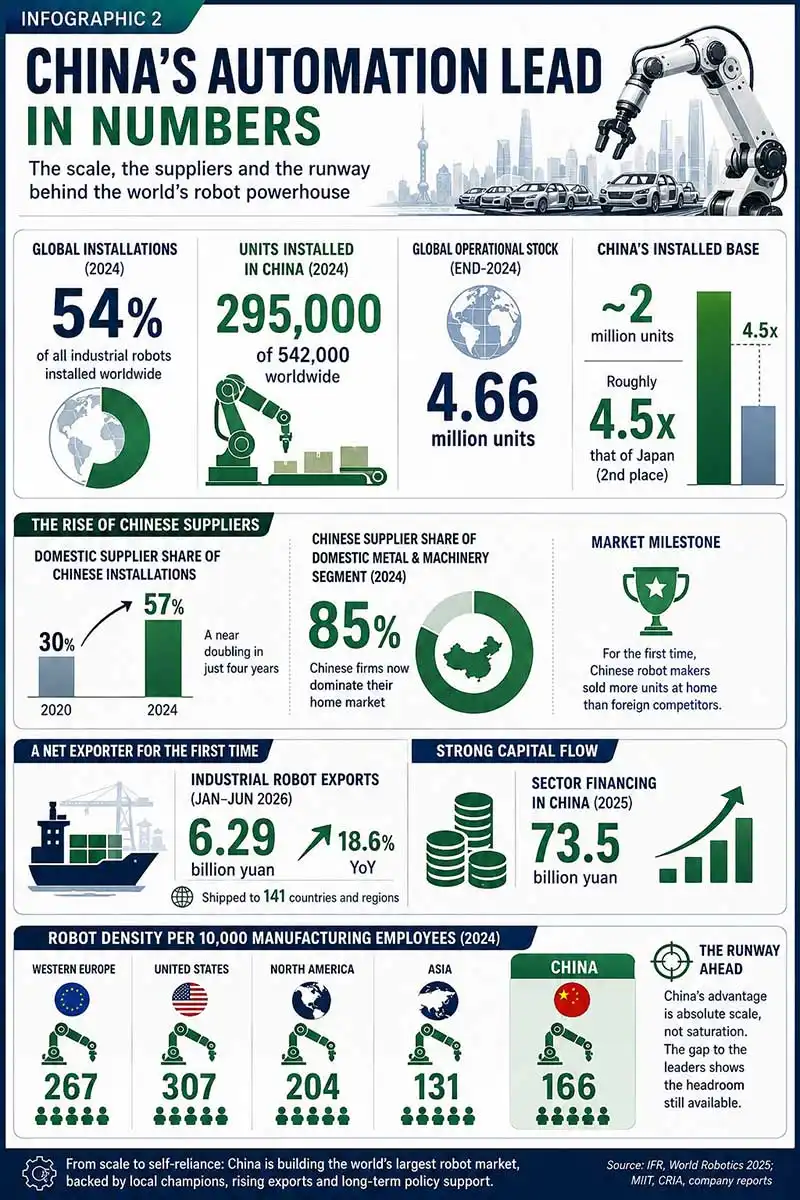
One caveat is worth stating plainly. On robot density, China is not yet the leader. Using updated labour market data from its own statistics bureau, the International Federation of Robotics puts China at 166 robots per 10,000 manufacturing employees, sixth in Asia and 22nd worldwide, against 307 in the United States.
Western Europe reached a record 267 and North America 204. China’s advantage is absolute scale, not saturation, which is precisely why the runway is long.
China against the West
On volume, the humanoid contest is already lopsided. Roughly 16,000 humanoid robots were installed worldwide in 2025, with China accounting for more than 80%, according to Counterpoint Research, which put AgiBot on 30.4% of global installations and Unitree on 26.4%.
Omdia ranks AgiBot first on 5,168 units and a 39% share, a reading Unitree disputes with its own claim of more than 5,500 humanoids shipped. American rivals including Tesla and Figure each shipped a few hundred units at most.
On money, the West leads by a distance. Figure is valued at about USD 39 billion after a Series C exceeding USD 1 billion in September 2025, roughly four times Unitree’s listed value, with 1X at around USD 10 billion and Apptronik at about USD 5.5 billion.
The historical pattern from solar panels, drones and electric vehicles is that scale wins once the underlying technology commoditises, which is the bet embedded in Unitree’s multiple.
Automation as industrial policy
For an economy facing a shrinking working-age population and rising wages, robots are a labour supply story as much as a technology story.
Automation is how China intends to keep its manufacturing base competitive while the demographic base erodes, and how it plans to cut dependence on imported precision components.
The Robot Plus initiative and the AI Plus Manufacturing roadmap aim to double manufacturing robot density by 2030, the Ministry of Industry and Information Technology has set up a standardisation committee for humanoid robots, and China is now leading formulation of international standards for elder-care robots, echoing its earlier standards campaigns in 5G and high-speed rail.
The risks arrived before the shares did. Overseas sales generated 731.66 million yuan in 2025, or 43.65% of main business revenue, and on July 28 the United States Federal Communications Commission added foreign-made humanoid and quadruped robots to its Covered List, blocking equipment authorisation for models not already cleared.
Unitree certified its current lineup weeks earlier, so those grants stand, but the North American path for new models is closed for now. The Pentagon has separately listed the company as having alleged military links, which Beijing rejects.
Growth is also cooling. First-half 2026 revenue guidance of 1.05 billion to 1.13 billion yuan implies growth of 36% to 45%, against 333% a year earlier, and adjusted net profit is guided to fall by between 6% and 22%.