
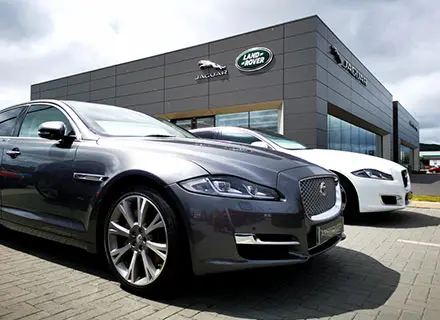

Jaguar Land Rover (JLR), the luxury arm of Tata Motors, has cut its full-year profit outlook, adding to concerns that slowing global demand, geopolitical uncertainties and rising competition may hurt profitability at the Indian carmaker.
The announcement sent shares of Tata Motors soaring on Monday.
The stock dropped 9.2% to INR 261, making it the worst performer on both the Nifty Auto and Nifty 50 indices.
The selling pressure on Tata Motors was so severe that the benchmark Nifty 50 gained 0.3%, while the Nifty Auto fell 1.1%.
The cut to JLR’s adjusted earnings margin forecast has especially rattled investors given the importance of the British luxury carmaker to Tata Motors’ overall financial performance.
JLR contributes around 80% of Tata Motors’ passenger vehicle revenue, and its operating performance is a key driver of the profitability of the Indian company.
Tata Motors Passenger Vehicles reported a consolidated net loss of INR 55.31 billion (around USD 587.7 million) for the September quarter.
The loss was mainly caused by one-off costs such as employee separation costs linked to JLR’s restructuring programme and other write-downs.
More importantly, JLR reduced its adjusted earnings before interest, taxes, depreciation and amortisation (EBITDA) margin forecast for the financial year to 2%-3%, compared with its earlier projection of approximately 4%.
The British carmaker also expects a free cash outflow of about £1.25 billion, reflecting the financial impact of one-off restructuring costs, weaker market conditions and continued investment in new vehicles.
JLR’s adjusted EBITDA margin for the July-September quarter was a mere 1.1%, with a free cash outflow of 540 million pounds.
The company anticipates revenue of approximately £25 billion for fiscal 2027, but JLR’s revised margin guidance suggests it may be a longer path to profitability than initially believed.
There have been encouraging developments in Tata Motors’ domestic passenger vehicle business but not without the strain on finances.
Sales in India were up 40% year-on-year in the three months to September 30, with domestic revenue rising by 51%.
But the Indian business’s recovery has not been enough to make up for the decline in JLR’s earnings.
China continues to be one of the greatest challenges facing Jaguar Land Rover, with domestic manufacturers consolidating their position in the world’s biggest car market.
Like its other European counterparts, the British luxury carmaker has seen big drops in Chinese volumes, with management suggesting the market shrank by nearly 30% in the September quarter.
The slowdown reflects a combination of weakening vehicle demand, aggressive pricing and intensifying competition from domestic manufacturers such as BYD.
China’s passenger vehicle sales themselves are facing a difficult outlook, with an industry body recently projecting that domestic sales could fall below 19 million units this year for the first time since 2014.
Despite the challenging conditions, JLR Chief Executive PB Balaji indicated that the company would continue investing in China while taking steps to protect its intellectual property.
It must be mentioned here that JLR is having a legal dispute with BYD, China’s largest automaker, and Tesla, a rival, over alleged similarities between the Land Rover Defender and the Shenzhen-based automaker’s Fang Cheng Bao Ti7 SUV.
North America, meanwhile, is emerging as a more encouraging market. JLR’s wholesale volumes in the region increased by 20% year-on-year during the first half of fiscal 2027.
The company, as per Balaji, intends to build on this momentum through a stronger product portfolio, improved supply-chain execution and better vehicle quality.
To restore profitability, Jaguar Land Rover is targeting double-digit growth in core earnings in fiscal 2028, supported by a two-year restructuring programme worth 1.7 billion pounds.
The cost reduction programme will target manufacturing, materials, logistics and warranty costs to reduce the company’s cash break-even volume to about 300,000 vehicles.
JLR believes that lower operating expenses, combined with new electric vehicle launches and expansion in North America, will help it achieve more sustainable profitability.
“Together with our growth plans for the US and disciplined execution of our enterprise missions to reduce our break-even to 300,000 units, we position ourselves well to deliver consistent cash-accretive growth in the coming years,” Balaji said during the post-earnings conference call.
However, the restructuring is already carrying a substantial financial cost.
JLR Finance Chief Richard Molyneux said that 295 million pounds of the 530 million pounds in exceptional charges reported during the quarter were associated with a voluntary redundancy programme covering approximately 4,000 employees.
The company is also dealing with the lingering impact of a cyberattack last year, while investments in new models and restructuring expenses continue to weigh on cash generation.
The challenges are not restricted to JLR. Tata Motors’ domestic passenger vehicle business also reported a decline in profitability despite strong revenue growth.
Its core earnings margin fell 180 basis points year-on-year to 4% during the September quarter, reflecting higher commodity costs and unfavourable foreign exchange movements.
Consolidated revenue, however, increased to INR 969.20 billion from INR 723.49 billion a year earlier.
The automaker has indicated that it could consider another vehicle price increase in the fourth quarter to offset rising input costs.