
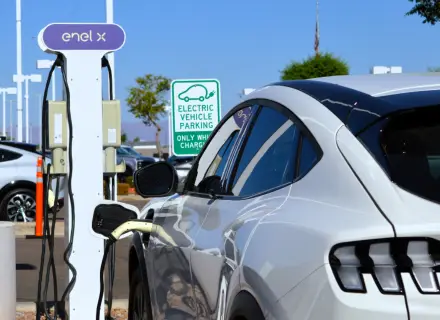

Italian energy giant Enel has rolled out 3,730 new electric vehicle charging points throughout Italy. It’s another step in their commitment towards faster, more convenient e-mobility for cities and businesses.
It was funded under the first call for proposals of Italy’s “National Recovery and Resilience Plan” and partly backed by the European Union’s “Next Generation EU Recovery Fund.”
The charging stations are spread across five regions, namely Campania, Lazio, Lombardy, Puglia, and Sicily, which cover around 21 provinces. The densest clusters are in the major cities, with Rome leading at 396 charging points, followed by Naples with 298, Milan with 227, Bari with 111, and Catania with 112.
Southern Italy boasts most of the charging stations, with around 40%. It’s important to note that the region had a weaker charging infrastructure historically and has now gotten a meaningful boost.
The new charging stations operate by providing an output of approximately 90 kilowatts of power per connector, allowing two electric vehicles to charge simultaneously and reducing driver wait times. Users can access this charging network through the “Enel On Your Way” app or card, or via 160 interoperable mobility service providers available in Italy and abroad. This system ensures that multiple EV brands can plug in without any difficulty.
The stations have POS terminals so customers can use their debit or credit card just like they would at a petrol station.
The first PNRR batch accounts for about 50% of the grants awarded so far. The three PNRR calls for urban charging infrastructure. PNRR stands for “Piano Nazionale di Ripresa e Resilienza,” which translates to National Recovery and Resilience Plan in English.
This plan is Italy’s effort to modernise its economy after the COVID-19 crisis through a huge package of grants and loans from the EU fund.
The PNRR pumps 191-194 billion euros into six big missions, which include digitalisation, green transition, and sustainable transport. Additionally, the funds also target educational research, inclusion, and healthcare.
The project funds various initiatives, including electric vehicle charging networks, renewable energy projects, school upgrades, and digital government reforms. PNRR also absorbs a large share of the cost. Companies bid for calls for proposals run by ministries.
The 3,730 EV charging points in Italy were partly financed under the first PNRR call for urban electric vehicle charging infrastructure, which is why you see PNRR linked to that rollout.
Enel is already working on an additional 200 charging points through the second and third PNRR calls, which will bring its total to around 5,000 charging points across nine regions, including Piedmont, Veneto, Emilia Romagna, and Tuscany.
For the business and retail sectors, EV expansion makes logistics easier while supporting the European nations’ energy transition goals.