

China witnessed a sudden loss in its growth momentum in April 2026, as the world’s second-largest economy had to with headwinds like higher energy costs from the Iran war and the persistently weak domestic demand. While industrial output cooled down, retail sales sank to over three-year lows.
While better-than-expected exports, along with the Xi Jinping administration’s domestic fuel-pricing controls, helped Beijing weather the energy shock, higher input costs threaten to squeeze already weak factory margins, apart from further dampening consumer spending if the Middle East conflict drags on.
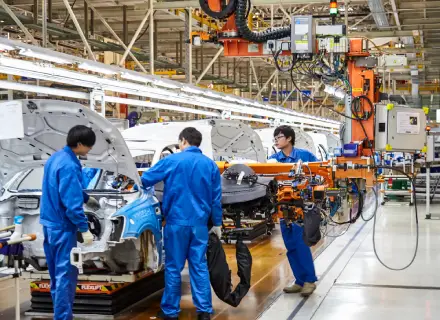
As per the data from the National Bureau of Statistics (NBS), factory output grew 4.1% from a year earlier (slowest growth since July 2023), compared with a 5.7% rise in March.
“The strong performance of the exporters helped to mitigate the weaknesses in domestic demand, but not enough to fully offset it,” said Zhiwei Zhang, president and chief economist at Pinpoint Asset Management, while interacting with Reuters.
Exports gathered pace in April as factories raced to meet a wave of orders from AI-related industries, while other buyers sought to stockpile components amid fears of the Iran war potentially pushing global input costs even higher.
Zhang didn’t expect the Xi Jinping administration to change its policy stance on just one month of weak data, stating that Beijing would likely reassess its policy stance in July when the Q2 GDP data comes out.
“Retail sales, a gauge of consumption, rose just 0.2% in April, cooling sharply from 1.7% in March and sliding to their weakest gain since December 2022. The figures were also well below forecasts centred on a 2% increase. The fragility of household consumption was underscored in April domestic car sales, which dropped 21.6% in April from a year earlier for their seventh straight month of decline, even as automakers ramped up efforts to expand in overseas markets to offset weakness at home,” reuters reported further.
“Retail sales growth in the first four months of 2026 points to still-weak household demand, with consumers concentrating spending on selective discretionary and upgrade categories rather than broad-based consumption,” said Yuhan Zhang, principal economist at the Conference Board’s China Center.
Zhang further added that the split highlights a two-speed recovery: steady spending on small lifestyle and tech upgrades, but weak appetite for big-ticket, credit-driven purchases tied to housing and income.
While the jobless rate reportedly nudged down to 5.2% in April from 5.4% in March, fixed-asset investment (FAI) contracted 1.6% in the first four months of 2026, compared with a 1.7% rise in the January-March period and a 1.6% expansion forecast. Domestic crude steel output also echoed the weak investment data, falling 2.8% from a year earlier.
“We believe weaker credit demand and heavy rainfall in southern China may have contributed to the April FAI decline compared with the first quarter,” said Lisheng Wang, economist at Goldman Sachs in a note, while cautioning that the occasional NBS “statistical correction” of previously reported data may have amplified the volatility.
As the Iran war and the stalemate at the Strait of Hormuz continued to disrupt the global supply chains, the Chinese leadership have already pledged to strengthen the country’s energy security, accelerate technological self-sufficiency and seek greater control of supply chains, while dealing with external shocks.
The world’s second-largest economy expanded 5.0% in the first three months of 2026, just touching the Beijing’s full-year target range of 4.5% to 5.0%. However, as per analysts, the recovery is running on uneven ground, with industrial output continuing to outstrip domestic demand.
“While a protracted downturn in the property market remains a drag on growth, the Middle East conflict has exposed the economy to external risks at a time of fragile consumption at home. China’s property investment contraction widened in April year-on-year, but new home prices fell at their slowest monthly pace in a year, offering some signs of stabilisation as local governments deploy measures to boost sales and shore up sentiment,” Reuters noted.
Also Read: