
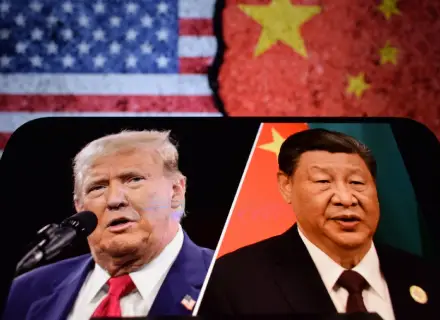

As the summit between United States President Donald Trump and his Chinese counterpart Xi Jinping came to an end in Beijing, a new fact sheet from the White House claims that China will buy “at least” USD 17 billion worth of agricultural goods from the United States annually.
While China will make the purchases through 2028, with the 2026 target applying to the remainder of the year on a proportionate basis, the deal came along with Beijing’s commitment to buy at least 87 million metric tonnes of American soya beans, which was made at the bilateral between Trump and Xi in South Korea in October 2025.
The White House further stated the Xi Jinping administration’s commitment to restore market access for American meat products by renewing the expired listings for more than 400 production facilities. Additionally, China will resume imports of poultry from states determined by the US Department of Agriculture to be free of avian influenza.
“Trump and Xi also agreed to establish two new bodies – the US-China Board of Trade and the US-China Board of Investment – to manage trade and investment between the sides,” the White House said.
The summit between Trump and Xi, which lasted between May 14 and 15, didn’t result in substantial understandings. However, as per the reports, both the heads of state sought greater alignment on economic issues and trade while avoiding sensitive issues like Taiwan and the Iran war. As per the White House, “The two sides had discussed ways to enhance economic cooperation, and they agreed on the need to keep the Strait of Hormuz open and that Iran can never have a nuclear weapon.”
Talking about the economic cooperation between the countries, Deborah Elms, head of trade policy at the Hinrich Foundation in Singapore, told Al Jazeera that Washington’s statements on the summit should be treated with caution until they are confirmed by the Chinese side.
“On agriculture purchases, I’m sceptical of any announcements that have been made by one side and not confirmed by the other. This is sometimes an issue in many relationships, but it’s acute under Trump 2.0, especially with China. An additional USD 17 billion in agricultural purchases annually would only provide a minor, albeit welcome, boost to the US economy. But the US is a USD 30 trillion economy. Even if these buys materialise, the net effect is going to be tiny,” the senior analyst remarked.
The ongoing salvos between Washington and Beijing have resulted in US-Chinese trade going down sharply from its peak. The figures, in 2025, stood at some USD 415 billion, down from more than USD 690 billion in 2022.
Another talking point in the White House’s fact sheet has been American access to rare earths. While the Trump administration said that Beijing would address Uncle Sam’s rare earth shortages, particularly the ones like yttrium, scandium, neodymium and indium, the Chinese side didn’t talk about it.
It is to be noted that Beijing controls the supply chain for these rare earths that serve as the backbone of the manufacturing of smartphones and electric vehicles, along with the American and Western weapon industries. The Xi Jinping administration, in the past, had used the export control of these minerals to gain leverage over the West during moments of economic and geopolitical upheavals.
Last but not the least, the United States has also specified Chinese plans to buy 200 Boeing aeroplanes, despite the world’s second-largest economy having the distinction of developing its own civilian jetliner called the Comac C919 (often touted as a direct rival to Airbus’s and Boeing’s narrow-body families).