

On 8 June 2026, Tim Cook took the stage at Apple’s Worldwide Developers Conference for what is likely the last time as chief executive. He will hand the CEO title to John Ternus on 1 September, moving to the role of Executive Chairman after fifteen years in charge.
Over that period, he grew Apple from a USD 350 billion company to one worth over USD 3 trillion. But the company he hands over faces a pointed question: did Apple wait too long to get serious about artificial intelligence?
WWDC 2026 was Apple’s answer. And it was a comprehensive one.
A New Siri, Built from Scratch
The centrepiece of the entire event was a completely rebuilt version of Siri, rebranded as Siri AI. The old Siri, the one that often struggled to understand requests, forgot context mid-conversation, and regularly handed users off to a web search, is gone.
In its place is a conversational assistant that can hold a thread across multiple exchanges, remember what was said earlier, and take action across apps without being told to start from scratch each time.
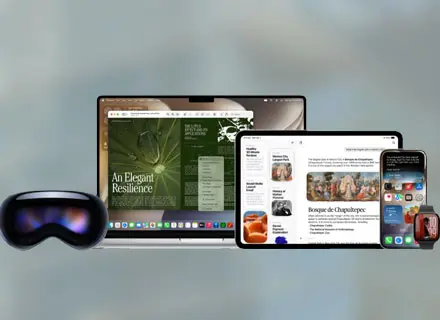
The visual change is immediately obvious. Rather than the familiar-coloured glow around the edges of the screen, invoking Siri AI brings up a dark-themed overlay from the “Dynamic Island,” the pill-shaped cutout at the top of recent iPhones. There is now a dedicated app that stores the full conversation history, synced across iPhone, iPad, Apple Watch, Mac, and Apple Vision Pro through iCloud.
Live demonstrations at the keynote showed what this actually looks like in practice. A user asked Siri AI to check the rules for a concert ticket lottery, set reminders around the relevant dates, pull together a watch-party menu based on what their friends had been discussing in Messages, and draft an email about it, all in one flowing conversation. That kind of chained task was simply not possible before.
Two capabilities make this work. The first is personal context understanding. Siri AI reads across a user’s messages, emails, and photos to surface relevant information without needing everything spelled out.
The second is onscreen awareness, which means the assistant can see what is currently on the screen and act on it. If a user is looking at a recipe, Siri AI knows that. If they are reading an email thread, it knows that too.
Writing Help and a Smarter Camera
Siri AI has also become a system-wide writing assistant through a feature called “Writing Tools.” It can generate a draft from scratch across any app, a message, an email, a note, and will adjust its tone depending on who the user is writing to. If someone typically messages their manager in short bullet points, the system will pick that up and mirror it automatically.
On the camera side, a capability called Visual Intelligence has been significantly expanded. On iPhone, it is now built into the Camera app. Point the phone at a dish in a restaurant and it will return nutritional information; hold it over a dinner bill and it can split the cost through Apple Cash. This feature is now available on iPad and Mac as well.
On iPad, it is accessible through the screenshot tool. On Mac, users can hold a keyboard shortcut, draw a box around any part of the screen, and ask Siri AI a question about it. On Apple Vision Pro, the spatial computing headset, Visual Intelligence works in the physical world, and users can look at a real-world object and query the assistant about it.
How the System Actually Works
The engineering underneath all of this is worth understanding, because it is central to Apple’s argument that it can compete with the big cloud AI players while protecting user privacy.
Apple uses what it calls a system orchestrator, essentially a traffic controller that sits in the background, watching what a user is doing and deciding where each query should go. Simple tasks are handled directly on the device itself by Apple’s own in-house model, called the “Apple Foundation Model Core.”
More demanding local tasks, fast dictation and expressive voice synthesis, go to a more powerful version of the same model. If a query is too complex for the device to handle locally, it gets routed to Apple’s cloud infrastructure, called Private Cloud Compute.
The key privacy claim is that any data processed through Private Cloud Compute is never stored, and Apple itself cannot access it. That is a meaningful distinction from how most cloud AI services work.
The Google Partnership
To power its most capable cloud-based features, Apple has partnered with Google and is using a custom version of Google’s Gemini AI model, specifically tuned to work within Apple’s system. This is not a simple API arrangement where Apple just plugs into Google’s chatbot. Apple’s own engineering team trained its models using techniques refined in part by Gemini’s outputs. The licence reportedly costs Apple around USD 1 billion a year.
This is a notable development. Apple and Google are fierce competitors in the smartphone market, yet on AI, they have found a significant point of collaboration. For Apple, it means access to world-class large language model capability without having to build everything from scratch. For Google, it means its Gemini technology is embedded at the system level of the world’s most profitable consumer hardware ecosystem.
Where This Leaves the Chatbot Market
The broader AI landscape has been shifting rapidly. OpenAI, which dominated the chatbot market through 2024 and most of 2025, has seen its share fall from around 87% to somewhere between 64% and 68%. Google’s Gemini has grown significantly, capturing between 18% and 21% of the market. The field is no longer winner-takes-all.
Siri AI enters this landscape differently from ChatGPT or Google’s Gemini. It is not trying to win on raw intelligence or breadth of knowledge. It is built to be deeply embedded in a person’s digital life, their specific files, their specific habits, their specific apps.
ChatGPT and Claude, for instance, have no access to a user’s personal data unless it is manually shared. Siri AI, by design, already knows it. That is a different kind of usefulness.
A New Mac Operating System
Apple also launched macOS Golden Gate, the 27th version of its desktop operating system, carrying significant technical changes beneath a refined visual surface.
Most consequentially, it drops support for older Intel-based Mac computers entirely, completing a transition to Apple’s own silicon chips that began in 2020. “Rosetta 2,” the translation layer that allowed older Intel software to run on newer Apple chips, is included for the last time. To run Siri AI on-device, a Mac must have an Apple M3 chip or newer, and at least 12GB of RAM.
The visual changes are more subtle. A global slider to adjust how transparent the interface appears, slightly tighter window corners, and coloured icons in the sidebar. Boot Camp, which allowed Macs to run Windows, has been removed. Support for older AirPort Time Capsule routers used as backup drives has also been dropped.
Elsewhere, Apple Watch gains multi-turn Siri AI support and a redesigned Smart Stack. Apple TV gets up to 30% faster app launch times. And across all platforms, improved child safety tools allow parents to set up dedicated child accounts with content filtering and automatic blocking of violent material.
What Comes Next
Cook’s legacy is a company with unmatched hardware-software integration and a privacy reputation that competitors cannot easily replicate. The challenge he has handed Ternus is to make that integration feel as intelligent as it is seamless.
WWDC 2026 was the clearest signal yet that Apple is not conceding the AI era to cloud-first competitors. It is instead betting that the most valuable AI is the one that already knows you, running quietly on hardware that fits in your pocket and is not sending your information to anyone else.