

In its place sits the “Original Content Rewards Programme,” built on one blunt premise. The platform should pay for work a creator actually made.
The timing carries its own subplot. The announcement landed days after Nikita Bier stepped down as head of product, a little over a year after taking the job. Bier had been the public voice of X’s product changes, including its anti-spam drives, and he remains with the company as an adviser.
Why the old programme broke
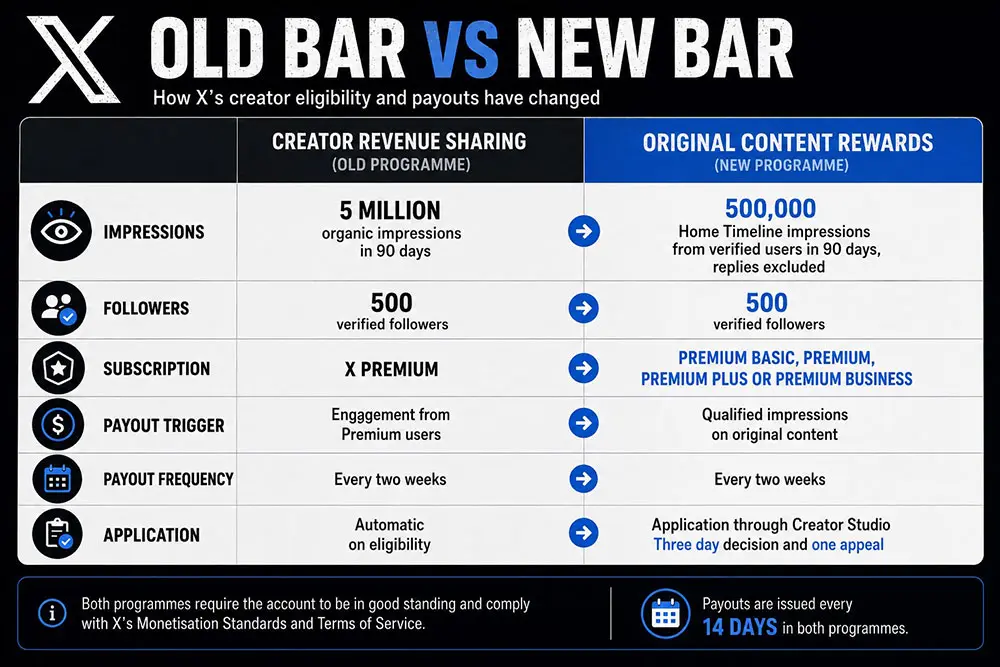
Creator Revenue Sharing launched in July 2023 and paid creators a slice of advertising revenue from ads shown in the replies under their posts. Eligibility began at 15 million impressions over three months, then dropped to five million within weeks, alongside a paid Premium subscription and at least 500 followers.
In November 2024 the model changed again, shifting the payout basis from reply ads to engagement from verified Premium subscribers, with X sharing a portion of subscription income rather than ad income.
Through every version, the metric that mattered was attention. Authorship was never part of the calculation. That gap is the whole story.
If a post only has to travel to earn, the cheapest way to make one is to take something that has already proved it can travel.
Screenshot aggregators, reply accounts parked under viral posts, clip farms reuploading other people’s videos with a watermark slapped on, threads that stitch together someone else’s reporting. All of it qualified. None of it added anything to the platform that was not already there.
Allegra Jacchia, who leads creator products at X, put the diagnosis plainly, saying the programme’s incentives were misaligned. Rather than bringing net new material to X, many participants were recycling other people’s work to chase a payout.
On the decision to scrap rather than patch, she said the company could have kept adding rules and exceptions, but that the better call was to start fresh and design a programme that rewarded originality from day one.
How the new programme works
Under Original Content Rewards, creators earn from what X calls qualified impressions on original content, with payments issued every two weeks.
A qualified impression is narrow by design. It is a unique view from a subscriber to X Premium Basic, Premium, Premium Plus or Premium Business, seen in the Home Timeline, with at least half the post visible on screen.
Repeat views from the same account on the same post count once. Paid and promoted impressions do not count. Neither do artificially generated or fraudulent ones.
Originality is defined broadly but firmly. Posts and threads a creator wrote themselves qualify, as do long form articles, reporting, investigations, firsthand accounts, analysis and commentary that adds a real perspective, self shot photography and video, and original graphics, memes and illustrations.
What fails the test is content where the creator’s contribution is minimal or absent. Text, images or video copied wholesale from other creators or downloaded from elsewhere and reuploaded does not qualify.
Neither does light editing, watermarking or text overlays on someone else’s material, aggregation, or thin summaries that add nothing.
Content created or posted by automated means is ineligible outright, and misleading posts that attract a helpful Community Note are shut out of rewards.
X frames the test for creators as a simple question. If the post vanished from the internet, what would be lost that only that creator supplied.
Who can join and how
Eligibility runs on four conditions. Applicants must be 18 or over in an eligible country. They must hold an active X Premium, Premium Plus or Premium Business subscription. They need at least 500 verified followers.
And they need at least 500,000 “Home Timeline” impressions from verified users in the preceding 90 days, with impressions on replies excluded from that count.
The account must also be in good standing, with no record of repeatedly breaching X’s monetisation standards or terms of service. Anyone whose monetisation is currently paused over a policy violation cannot enrol.
Applications go through Creator Studio, under the Original Content Rewards section, which also shows live eligibility status.
X says decisions arrive within three business days. Rejected applicants get one appeal, and if that fails they can reapply after 90 days provided they still meet the criteria.
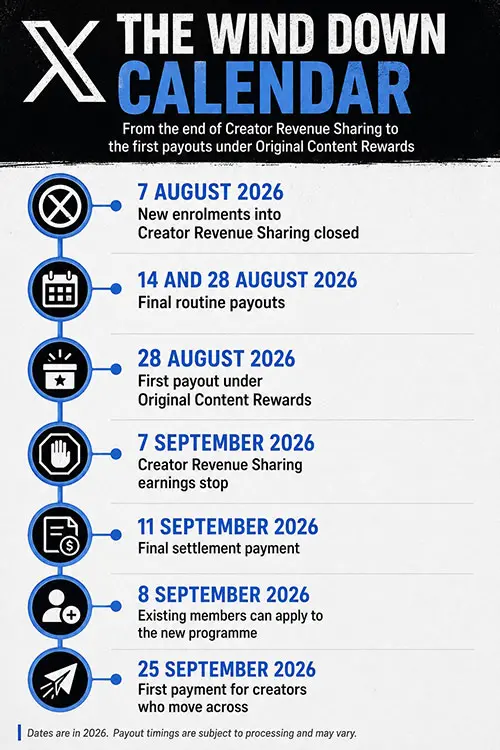
The first payout under the new programme is scheduled for 28 August. Existing Revenue Sharing members can start applying from September 8, with access rolled out gradually, and those who enrol on or after that date receive their first payment on September 25. There is no automatic transfer between the two programmes.
The headline threshold looks ten times easier than the old five million impression bar. It is not. The measurement changed underneath it. Only Premium subscriber views on the “Home Timeline” count, which ties creator income directly to the size of X’s paying subscriber base.
The bot allegation, and what the evidence shows
The sharper accusation levelled at the old programme is that automated networks used scripts to reply, like and repost at scale, inflating the numbers that triggered payouts.
X has effectively conceded the direction of that claim. In October 2025 the platform removed roughly 1.7 million bot accounts in a purge aimed specifically at reply spam.
Bier later revoked API access for so called InfoFi apps that paid users to post on X, saying they had produced a tremendous amount of AI slop and reply spam. Kaito, the best known of those services, dropped about 20% on the news.
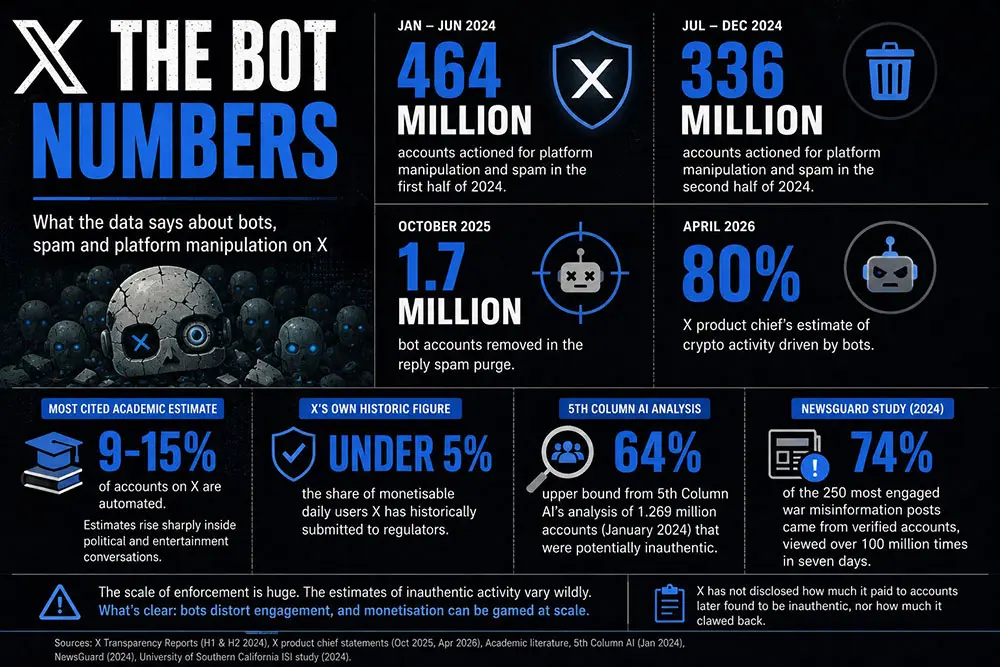
The enforcement numbers are enormous. X’s own transparency reporting listed platform manipulation and spam as by far the largest suspension category, with 464 million accounts actioned in the first half of 2024 and roughly 336 million in the second half.
Independent estimates of how many accounts are automated vary wildly, and that variance matters. The most widely cited academic range puts automated accounts at 9% to 15% of the total, rising sharply inside political and entertainment conversations.
X has historically told regulators the figure is under 5 per cent of monetisable daily users. At the other extreme, a January 2024 analysis of 1.269 million accounts by 5th Column AI concluded as many as 64% were potentially inauthentic.
A 2024 study in PLOS ONE by researchers at the University of Southern California’s Information Sciences Institute found no meaningful reduction in inauthentic activity on X after the takeover, with bot driven cryptocurrency promotion apparently increasing.
Separate work established that monetisation flowed to the platform’s worst actors. NewsGuard found that verified accounts produced 186 of the 250 most engaged posts pushing false claims in the first week of the Israel Hamas war, about 74%, with those posts viewed more than 100 million times in seven days. Because verification was the gateway to revenue sharing, the same accounts sat inside the payout system.
Here is the honest limit. No public dataset quantifies how much of the payout pool automated networks captured. X has never disclosed how much it paid to accounts later found to be inauthentic, nor how much it clawed back.
Third party tallies suggest the programme paid out in the region of USD 45 million to more than 150,000 creators by early 2024, an average of a few hundred dollars each, with 2026 rates estimated at roughly USD 8 to USD 12 per million verified impressions. Against those thin margins, industrial scale farming makes sense only at volume, which is exactly what the scripts provided.
 So the allegation is well supported in direction and poorly quantified in scale. That is a gap X alone can close.
What changes and what may not
The new design attacks the supply side by refusing to pay for copied work, and Jacchia has said detection models will keep improving and the bar will keep rising.
The demand side is harder. Qualified impressions still depend on Premium accounts, and Premium subscriptions can be bought. A network willing to fund subscriptions can still manufacture qualifying views, at a price.