
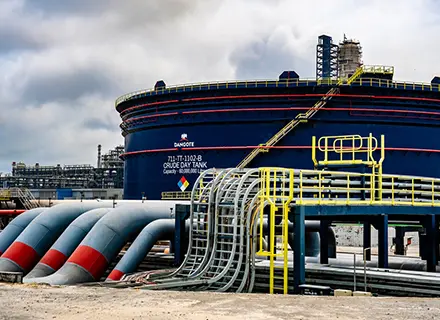

Nigeria’s 650,000-barrel-per-day Dangote refinery has imported two million barrels of crude from the UAE’s ADNOC, marking the venture’s first-ever crude purchase from the Middle Eastern producer.
The purchases come amid more oil shipments transiting the Strait of Hormuz, following the US-Iran ceasefire earlier in June 2026. However, the weak demand in Asia has freed up more Middle Eastern crude supply for other regions.
“Dangote imported one cargo of Umm Lulu crude and another of either Das or Murban crude in June. The refinery receives about five to seven crude cargoes a month from Nigeria’s state-owned NNPC, benefiting from lower shipping costs, but has previously said it requires about 13 to 15 cargoes per month,” reported Reuters.
As per the Kpler data, the Dangote refinery, which has turned into a major exporter of middle distillates to Europe due to fuel shortages linked to disruption of shipping through the Strait of Hormuz, also sourced up to 65,000 bpd of Libyan crude in May.
The two UAE cargoes, confirmed by S&P Global Commodity Insights on June 29, will arrive at Dangote’s Lekki facility in the coming weeks. Since the beginning of its commercial operations in early 2024, the facility has drawn its crude almost exclusively from Nigeria, the United States, and other Atlantic Basin suppliers. In 2025, approximately 70% of its imports originated from Nigeria under the naira-for-crude arrangement the African country’s federal government struck with the Dangote Group. The remaining 30% was split primarily between US grades.
In 2026, the refinery diversified its import options further, receiving cargoes from Angola, Ghana, Libya, and Guyana alongside domestic Nigerian supply. The UAE purchase marks the first time any Middle Eastern crude has been added to that growing roster.
The import by Dangote also serves as a double delight for the UAE’s crude grades, as the development, along with the reopening of the Strait of Hormuz, has brought the commodities back into the global supply picture at competitive prices. Benchmark UAE Murban crude was trading at approximately USD 66.40 per barrel on June 26, nearly USD 6 below pre-Iran war levels, making Middle Eastern grades an increasingly attractive option for a merchant refinery trying to widen the range of crude it can profitably process.
CEO David Bird, who joined Dangote in 2025 after two years running Oman’s Duqm refinery, wants to more than triple the number of crude grades the facility can process from approximately the current capacity of 40 to more than 120 in the coming years. The UAE’s key export grades, including Murban, Das Blend, Umm Lulu, and Upper Zakum, are broadly compatible with the refinery’s distillation unit configuration and would add significant flexibility to a facility currently running at full nameplate capacity of 650,000 barrels per day.
“The naira-for-crude agreement between NNPC and the refinery has guaranteed 13 to 15 cargoes of Nigerian crude monthly, helping to reduce the refinery’s foreign exchange exposure on the bulk of its feedstock. But that arrangement has faced persistent operational headwinds. Inadequate crude availability at export terminals and recurring technical issues at key loading points have compelled the refinery to seek additional crude sources outside Nigeria on a regular basis, a situation that Bird acknowledged had accelerated the timeline for building out the international procurement infrastructure. The UAE cargoes are the most visible expression yet of that imperative,” reported Billionaires Africa.
The Dangote refinery has already confirmed plans to double its processing capacity to approximately 1.4 million barrels per day by 2028, a level that would allow the business to process approximately 80% of Nigeria’s entire daily crude oil production in a single day. However, the drawback with the approach is that, going by things, domestic Nigerian crude supply will become structurally insufficient to feed the expanded facility and international sourcing at scale will become a permanent operational requirement rather than a supplementary buffer.
“The Middle East has historically been one of the primary sources of refined petroleum products imported into West and Central Africa. Saudi Arabia, the UAE, and India together accounted for the majority of the region’s refined fuel imports before the Dangote Refinery began reshaping those trade flows. The refinery is now not only displacing Middle Eastern refined product imports across African markets but also beginning to buy raw crude from those same Middle Eastern producers to process in Nigeria. The direction of the trade is reversing,” Billionaires Africa concluded.