
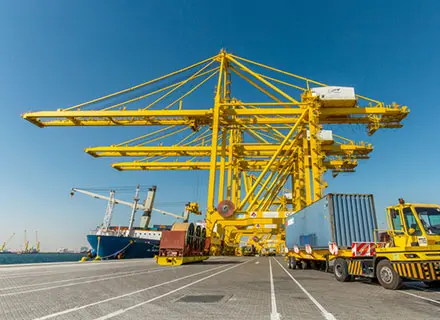

Qatar’s Hamad Port has climbed three places to eighth in the world, apart from being the second among Gulf ports, in the recently published 2025 Container Port Performance Index (CPPI). The ranking will likely help the facility to cement its standing as one of the most efficient maritime gateways on the planet, given the fact that the index, published jointly by the World Bank and S&P Global Market Intelligence, is regarded as one of the most authoritative benchmarks for container-port efficiency worldwide, ranking ports on vessel turnaround times, berth productivity, and the speed of cargo-handling operations.
“Hamad Port’s continued ascent comes despite a period marked by geopolitical tension, shipping disruption, and rising pressure on global transport networks — and underlines Qatar’s growing influence in international logistics and maritime trade,” CPPI noted.
“The achievement reflects years of sustained investment in infrastructure, digitalization, and operational excellence. It also points to the port’s ability to sustain productivity and reliability while many international ports continue to grapple with congestion, delays, and rising operating costs,” it added further.
Since its inauguration in September 2017, Hamad Port has become a cornerstone of Qatar’s economic and trade strategy, serving as the Gulf country’s principal maritime gateway and a key driver of supply-chain resilience.
“More than 95% of Qatar’s seaborne imports now pass through the facility, making it one of the Gulf region’s most strategically significant logistics assets. Hamad Port handles everything from food products and construction materials to industrial equipment and consumer goods, supporting both Qatar’s domestic activity and broader development goals,” reported the Gulf Times.
“The port’s success is closely tied to its advanced infrastructure and substantial capacity. Built to accommodate some of the world’s largest container vessels, it has an annual handling capacity of around 7.5 million twenty-foot equivalent units (TEUs), alongside the capability to process general cargo, livestock, vehicles, and bulk commodities. Its position along major shipping routes further strengthens its appeal as a regional transhipment and distribution hub linking Asia, Europe, Africa, and the Middle East,” CPPI noted.
As per the CPPI, operational efficiency has been central to the improved ranking, with recent indicators pointing to faster vessel turnaround and quicker cargo processing, allowing vessels to spend less time at berth and return to service sooner.
“Faster loading and unloading cut costs for shipping lines and sharpen the competitiveness of supply chains linked to Qatar — an advantage that has grown in importance as operators seek to offset disruption across major trade corridors and maritime chokepoints,” World Bank and S&P Global Market Intelligence noted further.
Qatar has also been investing heavily on the technology front in terms of keeping Hamad Port cutting-edge. Advanced port-management systems, automated processes, and integrated customs and logistics platforms have streamlined cargo clearance and improved coordination among stakeholders, resulting in faster cargo movement, greater transparency, and better service for importers, exporters, and shipping lines.
“The ranking also reflects the port’s resilience amid evolving geopolitical and economic headwinds. Global maritime trade has faced considerable uncertainty in recent years, from regional conflict and supply-chain shocks to inflation and shifting trade patterns. Yet Hamad Port has maintained operational continuity and high service standards, reinforcing confidence among international shipping companies and global logistics operators,” CPPI noted.
The port has continued to advance Qatar’s economic diversification agenda by supporting the expansion of non-hydrocarbon sectors through measures like facilitating trade, attracting investment, and deepening connectivity with global markets. Hamad Port also acts as a catalyst for industrial growth, giving manufacturing and construction sectors, along with export-oriented industries, efficient access to global supply chains.