
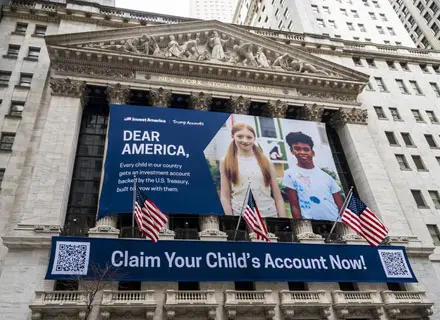

For millions of American parents, a new line has just appeared on the family balance sheet, and it did not exist a year ago.
Trump Accounts, formally called 530A accounts, are the government seeded investment accounts for children, which have gone live under President Donald Trump’s flagship “One Big Beautiful Bill Act,” with babies born between 1 January 2025 and 31 December 2028 in line for a USD 1,000 head start from the Treasury.
More than six million children were signed up within days of the launch, timed deliberately to coincide with America’s 250th anniversary of independence.
The idea is simple on the surface. Every eligible child gets a modest financial head start, invested in the stock market rather than left to sit in a bank account, with the hope that two decades of compounding growth will turn a small seed into a meaningful sum by adulthood.
But the scheme touches on some big questions. Is this a form of social security? What is Trump actually trying to build here? Is the timing, right before the November midterms, a coincidence. And has America tried anything like this before. Each deserves a closer look.
How the accounts actually work?
Any American child under 18 with a valid Social Security number can have a “Trump Account” opened for them by a parent, guardian or other authorised adult. Only those born between January 2025 and December 2028 receive the government’s USD 1,000 seed deposit.
Parents can then add up to USD 5,000 a year, employers can contribute up to USD 2,500 annually on behalf of staff, and charitable donors can top up accounts for defined groups of children.
Money in the account must be invested in low cost, broad based US equity index funds, with fees capped at 0.1%, and cannot be touched until the child turns 18. At that point, the account converts into a traditional individual retirement account, with standard IRA rules on withdrawals and tax.
Several large companies, including Uber, Intel, IBM and Nvidia, have already pledged matching contributions for employees’ newborns.
Billionaire Michael Dell and his wife Susan have pledged USD 6.25 billion to give an additional USD 250 to around 25 million children under ten in lower income postcodes, and hedge fund manager Ray Dalio has made a similar pledge for children in Connecticut.
Is this a social security scheme?
No, and the distinction matters. Social Security is a pooled, government run insurance programme funded through payroll taxes, designed to provide income to retirees, the disabled and survivors regardless of how markets perform. It is a collective safety net.
Trump Accounts are the opposite in structure. Each account belongs to an individual child, the money is invested in equities and can rise or fall with the market, and there is no guarantee attached to the balance.
It behaves far more like a retirement savings product, similar in spirit to an IRA or a 529 college savings plan, than an entitlement programme.
The government’s role is limited to a one time seed deposit and some tax deferral benefits, not an ongoing promise of income.
If anything, the accounts sit closer to personal wealth building tools than to the social insurance model that underpins schemes like Social Security or Medicare.
What is Trump trying to achieve?
The administration has been candid about the bigger goal. Officials, including Treasury Secretary Scott Bessent, have framed the accounts as a way to merge Main Street with Wall Street, giving every child a stake in the American economy from birth rather than leaving stock market wealth concentrated among those who already invest.
Senator Ted Cruz, who helped shape the policy, has argued openly that the accounts are meant to counter growing sympathy for socialism among younger Americans by turning them into capitalists early in life.
There is also a legacy angle. The scheme was deliberately timed to launch on the 250th anniversary of the Declaration of Independence, and the administration has repeatedly described it as one of the defining achievements of Trump’s presidency, a programme intended to outlast him politically.
Encouraging private and corporate money to flow in through the so called “50 State Challenge” also reduces the direct fiscal burden on the government while still allowing the White House to claim credit for a mass participation initiative.
Is this a publicity gimmick ahead of the midterms?
This is where opinion splits sharply, and it is worth laying out both sides fairly. Critics point out that the accounts launched just months before the November midterms, at a time when Trump’s approval ratings have been under pressure over inflation, the Iran conflict and cuts to safety net programmes like Medicaid and food assistance that were passed in the very same bill that created Trump Accounts.
Some commentators argue that a flashy, feel good financial giveaway, complete with celebrity involvement such as rapper Nicki Minaj pledging money for fans’ children, is a convenient distraction from less popular parts of the same legislation.
On the other hand, defenders of the scheme note that the policy was legislated a full year before launch, that the July 4 timing was tied to the nation’s semiquincentennial rather than the election calendar, and that the underlying idea of child savings accounts has genuine bipartisan roots stretching back decades, which undercuts the idea that it was invented purely as election bait.
Some Republican strategists have even complained that Trump has not leaned on the accounts heavily enough in his midterm messaging, focusing instead on foreign policy and other priorities.
The honest answer is that the scheme is both a substantive piece of policy and a useful talking point, and how much weight to give each depends on which side of the political aisle one sits on.
Is the scheme first-of-its-kind in America?
Not entirely, though the design has real quirks that make it distinct. The broader idea, often called baby bonds, was proposed by economists Darrick Hamilton and William Darity in 2010, and Senator Cory Booker introduced federal legislation for such accounts, called the “American Opportunity Accounts Act,” in 2018 and several times since.
Connecticut became the first US state to actually run a baby bonds programme in 2023, giving larger deposits to children from lower income, Medicaid eligible households, while Maine runs a smaller Alfond Grant that puts $500 into a college savings plan for every newborn resident.
Britain tried something similar with its “Child Trust Fund,” which ran for children born between 2002 and 2011 before being discontinued amid concerns that most families never topped up the government’s seed money.
What sets Trump Accounts apart from these earlier baby bonds models is the investment structure. Traditional baby bonds proposals put money into government bonds or a public trust, and deliberately give larger sums to poorer children to narrow the wealth gap.
Trump Accounts instead put every eligible child’s seed money into the same flat USD 1,000, invested directly in the stock market through private brokers, with no adjustment for family income.
Supporters call this simpler and more market friendly. Critics, including some economists who worked on the original baby bonds concept, argue that giving every child the same amount regardless of need does little to close wealth gaps, and may even widen them over time, since wealthier families are far better placed to add the maximum USD 5,000 a year and reap the larger compounding benefit.
The bigger picture
Trump Accounts represent a genuinely new twist on an old idea, borrowing the branding of baby bonds while abandoning much of their progressive design.
Whether they end up as a modest but useful savings habit for millions of American families, or as a well marketed pilot that mostly benefits those who were already financially comfortable, will only become clear over the next eighteen years, as the first cohort of eligible children grows up alongside their accounts.