
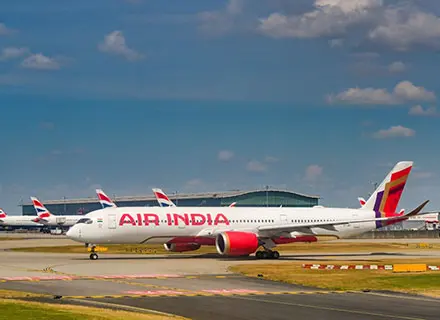

Air India has handed its turnaround to someone who has done this before, with fewer resources and under worse conditions.
On August 5, the Tata Group carrier named Tewolde Gebremariam as chief executive and managing director. He replaces Campbell Wilson, the former Singapore Airlines executive who resigned in April and leaves on 30 September.
An internal Air India document reviewed by Reuters described him as a “change leader” with particular strength in crisis management. That phrasing matters. Air India is not asking him to grow an airline. It is asking him to steady one.
From the cargo desk to Africa’s largest carrier
Gebremariam joined Ethiopian Airlines in 1985 as a traffic officer in the cargo unit in Addis Ababa.
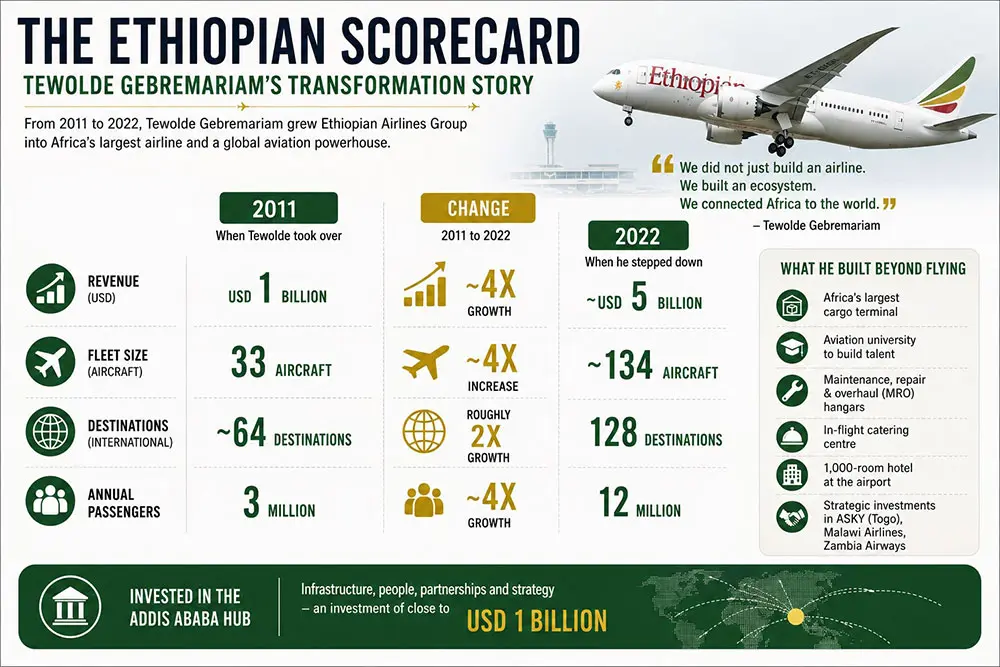
The eleven years that followed produced one of the industry’s better growth stories. Revenue rose roughly fourfold, from about USD 1 billion to about USD 5 billion. The fleet grew from 33 aircraft to around 134.
The international network roughly doubled to 128 destinations and annual passenger numbers went from three million to twelve million.
The number that explains him best, though, is the roughly USD 1 billion he ploughed into the ground rather than the air. Addis Ababa acquired the continent’s largest cargo terminal, an aviation university, maintenance hangars, a catering centre and a 1,000-room hotel.
Ethiopian also took anchor stakes in ASKY Airlines in Togo, Malawi Airlines and Zambia Airways, extending its reach without flying every sector itself. He did not build an airline so much as a hub economy, one that pulled Africa to Asia and Africa to Europe traffic away from Gulf carriers.
Two crises, no bailout
His crisis record is the reason Tata has hired him. In March 2019, Ethiopian Airlines flight 302 went down six minutes after departing Addis Ababa, killing all 157 people on board and helping ground the Boeing 737 MAX worldwide.
Ethiopian sent the recorders to France rather than to the United States, defended its crew publicly and refused to hurry the aircraft back into service.
Then came the cOVID pandemic. Ethiopian took no government bailout, converted passenger aircraft into freighters and let cargo carry the group through the collapse in travel.
The inheritance in Delhi
The parallel with Air India is uncomfortably close.
On 12 June 2025, flight AI171, a Boeing 787-8 bound for London Gatwick, came down about 32 seconds after leaving Ahmedabad and struck a medical college hostel.
In late July 2026 the government told Parliament that detailed testing had found no abnormality in the switch or its locking detents, and that the full thrust control module is still being examined at Boeing’s facility.
The scrutiny has not let up in the meantime. In February this year a 787 was grounded in Bengaluru after a pilot reported that a fuel control switch would not lock into RUN, an episode that triggered a public disagreement with the UK regulator over the decision to operate the sector home.
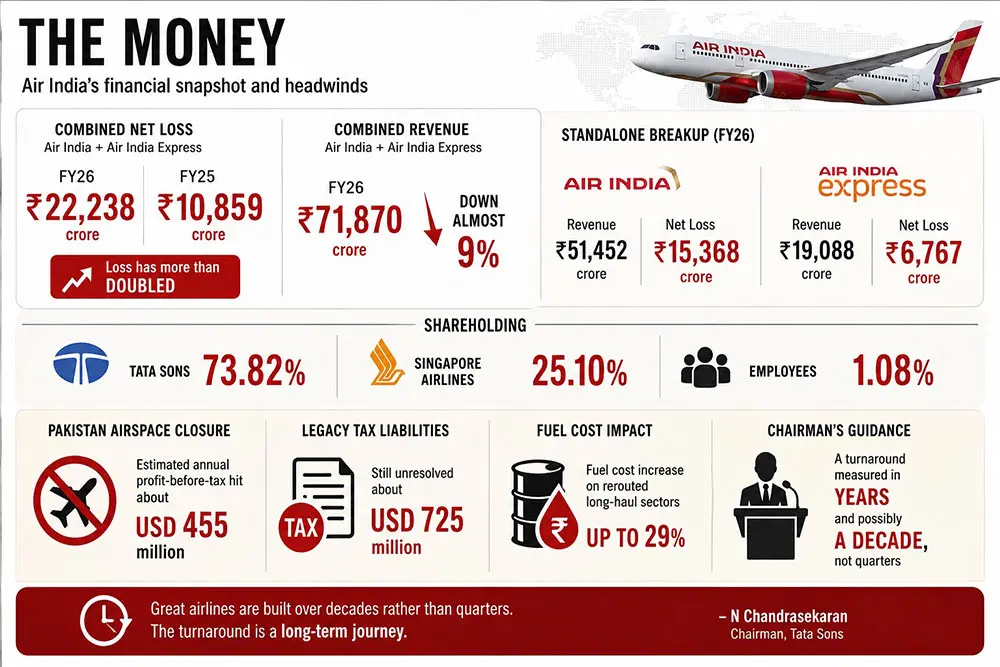
The financial picture is worse. Air India and Air India Express posted a combined net loss of Rs 22,238 crore in FY26, more than double the previous year’s Rs 10,859 crore, on combined revenue of Rs 71,870 crore that fell almost 9%.
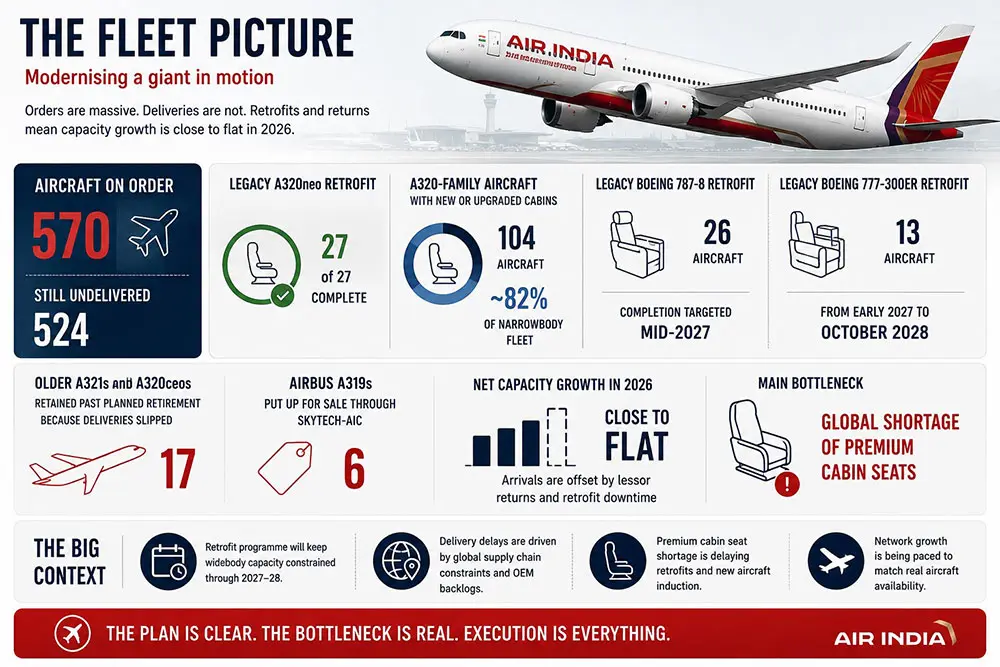
Fleet renewal, the centrepiece of the Wilson era, is running behind the marketing.
Around all of this sits geopolitics. Pakistan has kept its airspace shut to Indian carriers since April 2025, renewing the notice month by month, most recently to August 24.
What he can actually change
Four levers look plausible.
The first is safety credibility, rebuilt slowly and visibly. Ethiopian’s response in 2019 was to be transparent, protect the internal reporting culture and let the evidence run its course. Air India needs the chief executive to be the public face of that, not the communications team.
The second is hub economics, which is his specialism. Delhi as a genuine transfer hub for India to Europe and India to North America traffic is the Addis Ababa idea transplanted, and it is the only structural answer to the Gulf carriers taking Indian passengers through their own hubs.
The third is revenue that does not depend on seats. Cargo, the greenfield maintenance base in Bengaluru and the training academy in Gurugram are already built or building. Ethiopian showed what happens when those units stop being cost centres.
The fourth is network honesty. Routes that cannot pay while the airspace is shut should stay parked, and the retrofitted aircraft should go where premium yields actually are.
The caution is that Ethiopian had a protected home market, state ownership and a low cost base. Air India has none of those, and faces a rival carrying two of every three domestic passengers. Gebremariam cannot reopen Pakistani airspace or speed up Airbus and Boeing. What he can do is decide what this airline is for, and stop it losing money while it works that out.