
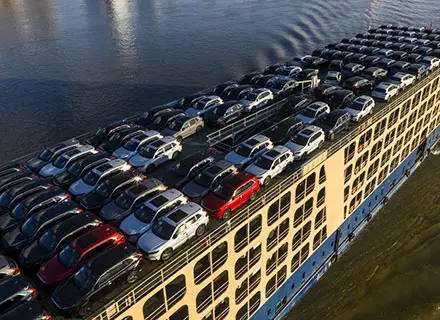

China’s recent agreement with the European Union (EU) has imposed new restrictions on EV manufacturers from the world’s largest auto market by limiting hybrid vehicle exports to the bloc.
The timing of the deal couldn’t have been worse for the Chinese automakers, who have been ramping up hybrid shipments exempt from EU tariffs on Chinese-made EVs, with sales growth slowing at home.
Take the latest China Passenger Car Association data, for example, in which China’s domestic car sales extended their decline for a 12th successive month.
Passenger vehicle sales fell 28.1% from a year earlier to 1.63 million units in September, worsening from a 23.7% decline in August, the association noted.
In that background, exports have remained a key growth driver, with automakers looking overseas to cushion the impact of a sluggish home market.
Some 923,000 vehicles were shipped in September, showing a jump of 73.2% year-on-year, compared to a 77.5% rise in August.
Now what is there in the China-EU deal? As per the European Trade Commissioner Maros Sefcovic, Beijing would cut exports of hybrid cars to the bloc by more than half, with the EU successfully forcing the Xi Jinping administration to address the ballooning trade deficit with the bloc.
In H1 2026, China’s exports of hybrids to the EU tripled to USD 7.5 billion from USD 2.5 billion a year earlier. The figure, published by the China Customs Department, was nearly nine times the USD 845 million exported in all of 2021.
In 2024, the EU imposed additional tariffs on Chinese EVs. Automakers from the world’s second-largest economy, since then, have increasingly turned to plug-in hybrids, which are exempt from the extra duties.
The decision was a masterstroke, as weak charging infrastructure in parts of Europe also supported demand for plug-in hybrids, marketed for their long range and strong fuel economy.
SAIC, BYD, and Chery accounted for more than 90% of Chinese hybrid sales volume in the EU, while hybrids represented more than half of their European sales, according to Jefferies.
While Sefcovic said on Friday the agreement would cut the imports of “several million cars over four years,” Brussels and Beijing have yet to disclose how the arrangement will be implemented.
As per China’s Commerce Ministry, the arrangement will allow continued export growth and guarantee Beijing a quota no smaller than that granted to any other source of imports.
Investors and analysts view the agreement as a de-escalation of trade tensions and a potential indication that tariffs on Chinese hybrids may be temporarily suspended.
“Overall we believe it is a risk-relief rally story…as the implementation rules, volume caps, price floors, and carve-outs are still pending technical negotiation,” Citi analysts said.
The rapid market proliferation of Chinese hybrids has increasingly challenged European manufacturers, including Volkswagen, long the region’s leading plug-in hybrid seller, said Li Yanwei, an analyst at the China Automobile Dealers Association.
BYD, China’s largest hybrid vehicle exporter to Europe, apart from being considered Tesla’s global rival, sold more plug-in hybrids than fully electric models in the first eight months of the year.
As per Li’s calculations, the Seal U SUV emerged as BYD’s best-selling model.
Together with Chery, SAIC, and Geely, the company has narrowed the gap with Volkswagen, which still commanded a 31.8% share of the EU plug-in hybrid market.
Jefferies analysts see the China-EU deal as signaling “tariff risk off, quota risk on,” potentially pushing Chinese automakers towards higher-priced models, increasing pressure on German premium brands, and accelerating plans to build more vehicles in Europe.
What is there in the deal?
Sefcovic said that the “shared understanding” would “moderate” China’s export of hybrids and plug-in hybrids to the EU while also cutting the imports of several million cars over four years, following the two-day talks with the Xi administration.
Sefcovic and Chinese officials, including Commerce Minister Wang Wentao, were involved in intense discussions over the last three months, which came after years of disputes between Beijing and Brussels over soaring Chinese exports, including cars.
EU leaders will discuss the outcome at Brussels this Thursday to determine whether the agreement marks the start of a rebalancing of the bloc’s trade deficit with China, a figure that has swelled to over 1 billion euro (USD 1.12 billion) a day.
Sefcovic called the deal an “excellent result” achieved by the two sides.
However, the agreement is just the beginning. It is a crucial first step—but only a first step—in the process of rebalancing,” he told reporters in Beijing.
Bernd Lange, chair of the European Parliament’s trade committee, told the media that the hybrid deal should be used as a model to extend similar measures to other sectors as well, apart from the necessity of the EU deploying trade defence measures more effectively.
Chinese Commerce Minister Wang told Sefcovic that China was not the root cause of the EU’s problems but a partner in solving them, according to the Chinese ministry.
The two sides also reached an understanding to reduce Chinese import duties on approximately four billion euros worth of EU exports, including car parts, olive oil, and footwear.
The deal also included the smoothening of China’s granting of export licences for rare earths and permanent magnets.
China’s and the EU’s dispute over cheap Chinese EV exports has clouded bilateral ties over the past two years and led to EU tariffs in 2024. China’s retaliatory measures against EU beverages, animal protein, and dairy, as well as restrictions on exports of rare earths and critical minerals, hit the bloc severely.
China and the EU will now continue discussions on price undertakings as an alternative to tariffs.
While German auto industry group VDA welcomed the agreement, it maintained a cautious tune by stating that it was too early to determine if the deal would address unfair competition.
Mercedes-Benz said the deal showed constructive dialogue was the right way to address challenges, and it should provide greater predictability.
Matthias Schmidt, a European autos research analyst, said countries like Germany had thought themselves immune to the threat from Chinese car companies but were waking up and asking Brussels to step in.
“The result is this statement from Sefcovic today,” he said on Friday.
“Now Berlin is asking London to join them, and Brussels, given the UK accounts for 30% of Western Europe’s new Chinese car sales,” Schmidt added further.
As part of Friday’s agreement, China’s commerce ministry said it also would continue facilitating the approval of export licenses for rare earths and permanent magnets through a “green channel” mechanism.
The focus is on the trade imbalance
As per the UN Comtrade data, Chinese exports to the EU totalled USD 560 billion in 2025, up from USD 517 billion in 2024.
Exports to major economies, including Germany, Italy, Spain, and Poland, each rose about 10% from a year earlier, while shipments to Hungary jumped 43%.
China, on the other hand, imported USD 268.3 billion worth of European goods, down from USD 269.4 billion in 2024, led by purchases from Denmark, Ireland, and France.
While Beijing has been using exports aggressively to flood its relatively cheap, state-subsidized goods that its own domestic population can’t absorb, the EU is torn between welcoming those imports to ease living costs and keeping them out to rebuild its own factories.
European Commission President Ursula von der Leyen, in September, warned the European Parliament about the trade gap reaching a “tipping point” and that the 27-member bloc would use all the tools at its disposal to rebalance the relationship.
“China and the EU will keep exploring the possibility of lowering tariffs on certain goods and continue dialogue on market access for medical devices,” the Chinese ministry said.
“Sefcovic and Wang are set to meet again in March 2027, with a video conference call in January,” the department concluded.