
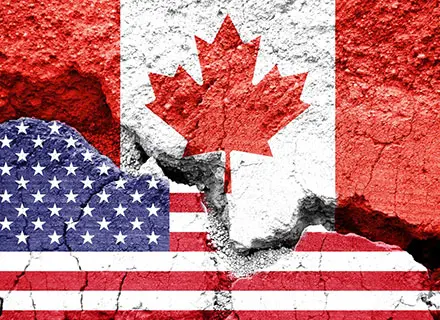

Canada has imposed retaliatory tariffs on about CUSD 27.6 billion (USD 20 billion) of US imports, escalating its trade confrontation with Washington after negotiations between the two countries collapsed and raising fresh doubts over the future of North America’s integrated trading system.
The measures, which took effect just after midnight on Tuesday, cover hundreds of US products and impose duties ranging from 15% to 50%, according to Ottawa.
The targeted goods include steel, furniture, clothing, appliances, electronics, agricultural equipment, and other manufactured products.
Ottawa’s countermeasures match, in broad dollar terms, the latest tranche of tariffs imposed by US President Donald Trump on Canadian goods worth USD 20 billion.
The move represents a significant escalation in an 18-month trade dispute between two economies whose supply chains have been deeply integrated for decades.
Canadian Prime Minister Mark Carney has sought to present the tariffs as a targeted response rather than an attempt to sever commercial ties with Washington.
Ottawa has continued to signal that it is willing to negotiate, but Carney has rejected what he considers unacceptable US demands on Canadian industries and trade policy.
However, on Tuesday, there was a shift in Carney’s tone, with the former central banker now urging a further diversification away from Canada’s biggest trading partner while casting doubt on the viability of the US-Mexico-Canada Agreement (USMCA).
“We have everything we need to pivot and prosper. That pivot will come at a cost. There’s always a cost to action, but it doesn’t come close to the cost of standing still,” Carney said on a video posted on YouTube.
The latest confrontation follows the collapse of bilateral negotiations on August 21. Canadian officials said Washington had introduced demands late in the discussions that Ottawa could not accept, including restrictions affecting Canada’s ability to negotiate trade arrangements with other countries and issues involving Canada’s French-language and cultural protections.
Carney has warned that Canada cannot accept an agreement that undermines its economic sovereignty.
The Canadian government is nevertheless attempting to keep the latest retaliation focused. The new tariffs apply to approximately 6% of US exports to Canada, according to the Associated Press, limiting the immediate scope of the measures even as the political confrontation intensifies.
The US and Canada are each heavily dependent on the other. Canada sends roughly 68% of its exports to the United States, while a large share of manufacturing on both sides of the border relies on components crossing the frontier multiple times before a finished product reaches consumers.
That integration means tariffs can quickly become a cost for businesses on both sides rather than simply a penalty imposed on foreign producers.
Canadian importers could face higher prices for US-made goods, while American manufacturers that rely on Canadian customers may find themselves less competitive. Companies could respond by switching suppliers, passing higher costs to consumers, or relocating portions of their production.
The uncertainty is particularly acute in industries such as automotive manufacturing, where North American production networks have been built around decades of relatively frictionless cross-border trade.
Returning the favour, the United States announced a ban on a broad line-up of Canadian alcoholic beverages, motorcycles, and dairy products from import on Tuesday. The dairy ban covers whey protein, invert molasses, cane molasses, and non-alcoholic beer.
Furthermore, various cheese products were added to a list of products subject to a 50% Trump tariff. Some paper, aluminum, wood, furniture, lighting, and other products were also added to the list.
A US government official told Reuters that the Trade Representative Jamieson Greer had spoken with Dominic LeBlanc, Canada’s minister responsible for bilateral US trade.
While the talks lasted over the past couple of days, the pair were expected to speak again to find a breakthrough.
In a social media post on Tuesday night, while criticising the US measures, LeBlanc confirmed the news, stating that he was in contact with Greer regarding a path forward.
“As has been the case for the last 18 months, our first priority remains on protecting and supporting Canadian workers, farmers, families, and businesses from these unjustified actions,” he wrote.
For financial markets, the central concern is how long the confrontation lasts and whether it spreads to the wider US-Mexico-Canada Agreement (USMCA).
The trade agreement is already under annual review, while Trump has declined to extend its term for another decade. The uncertainty surrounding the pact is creating a difficult environment for businesses planning investment and supply chains across North America.
Michael Harvey, executive director of the Canadian Agri-Food Trade Alliance and a member of Carney’s advisory committee on bilateral US economic relations, warned of the danger of an escalating cycle.
“What we are worried about is an escalatory spiral,” Harvey said.
Agriculture is among the sectors exposed to the dispute. Canada and the US are major trading partners in food and agricultural products, with farmers and processors on both sides dependent on access to the neighbouring market. Retaliatory tariffs can therefore affect not only exporters but also wholesalers, retailers, and consumers.
Canada also faces a difficult economic calculation. The US remains by far its most important trading partner, meaning Ottawa has fewer options to absorb a prolonged breakdown in bilateral commerce than Washington.
While Canada has waged a trade war against an economy 13 times its size, Carney has become massively popular at home, with a new poll from Angus Reid on Tuesday showing that approval of the former central banker’s performance jumped 11 points to 62% from August’s ratio.
Canadian businesses and consumers have increasingly embraced locally produced goods, while provincial governments have taken different approaches to dealing with the confrontation.
Alberta Premier Danielle Smith, for example, has advocated maintaining close engagement with Washington and avoiding measures that could unnecessarily damage the province’s economy.
Saskatchewan Premier Scott Moe has similarly argued against using major exports such as oil and potash as weapons in the dispute.
Canada has been attempting to diversify its commercial relationships, including closer economic ties with Europe and Asian markets.
The worsening US dispute could accelerate those efforts, potentially changing the direction of Canadian trade and investment over the longer term.
For Washington, however, the tariffs also carry risks. American companies exporting into Canada face a substantial consumer market where higher prices could weaken demand. US manufacturers that depend on Canadian raw materials, components, or customers could see their costs rise.
The danger is that tariffs become embedded in business decisions. Companies may start redesigning supply chains not due to cheaper or more efficient alternatives, but to avoid political intervention. redesigning supply chains not because another source is cheaper or more efficient, but because it is less exposed to political intervention.
That could ultimately reduce the efficiency of North America’s manufacturing system and raise costs across the region.
According to Canadian and US government data, the North American nation has shipped almost 68% of total exports to the Uncle Sam this year, out of which roughly 80% moved duty-free due to exemptions under the USMCA pact.
However, the exemption will now be tested, as the latest Trump tariffs do not allow Ottawa to exercise USMCA clauses.