
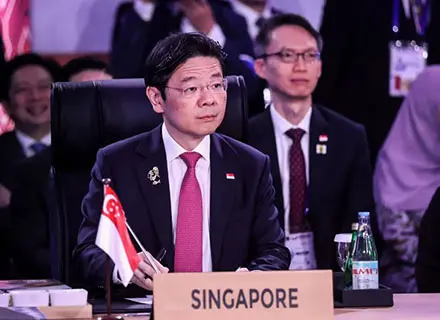

Singapore Prime Minister Lawrence Wong is set for a 64% increase in his annual remuneration to SUSD 3.6 million (USD 2.85 million), cementing his position as the world’s highest-paid head of government, as the city-state approved its first increase in political salaries in 15 years.
Wong’s current annual package is about SUSD 2.2 million. The increase follows an independent review of Singapore’s political salary framework and will take effect under a revised system from October 15.
The government has accepted the review committee’s recommendation to raise the benchmark salary for an entry-level minister, known as the MR4 grade, from SUSD 1.1 million to SUSD 1.8 million. However, ministers will not immediately move to the new benchmark.
Instead, existing political officeholders will receive a one-off adjustment of up to 9%, depending on factors including individual performance, responsibilities, and when their salaries were last adjusted. An MR4 minister currently earning the SUSD 1.1 million reference salary would receive about SUSD 1.2 million after the full adjustment.
Wong told parliament that the government had deliberately chosen not to implement the new benchmark in a single step.
“Restraint cannot become neglect,” Wong said, arguing that political salaries had remained unchanged for 15 years while private-sector and civil-service salaries had risen.
He said the issue was ultimately about ensuring Singapore could continue to attract capable people into politics, particularly from the private sector.
Wong said he had personally approached several senior permanent secretaries and chief executives before the recent general election to persuade them to enter politics. None of those he approached agreed to make the move.
Senior executives in large listed companies can earn several million dollars a year, Wong said, meaning that joining politics can involve a substantial financial sacrifice even after the revised salary framework is taken into account.
“I have not given up,” Wong told Parliament, saying he hoped to persuade more senior professionals to enter politics before the next election.
Coordinating Minister for Public Services Chan Chun Sing also defended the changes, saying the review was aimed at giving Singapore a better chance of building a “first-rate team” of political leaders.
Chan said the revised framework should make it easier to recruit people at different stages of their careers, including younger Singaporeans in their 30s and 40s who may have significant financial commitments.
The government will also widen salary ranges to between 75% and 125% of the reference salary, giving the prime minister greater flexibility to determine pay based on an officeholder’s experience, performance, and responsibilities.
The existing four ministerial grades will be streamlined into three, with the MR2 and MR3 grades merged. Most ministers who remain at MR4 are expected to earn about SUSD 1.35 million by the end of the current term, rather than automatically moving towards the new SUSD 1.8 million benchmark.
Singapore’s political salary system links the MR4 benchmark to the median annual income of the country’s top 1,000 earners, with a 40% discount intended to reflect the ethos of public service. The government says the system is designed to keep political salaries competitive while maintaining transparency and reducing incentives for corruption.
The remuneration package also contains a significant variable component. About 35% of a political officeholder’s reference remuneration is variable, including an individual performance bonus and a national bonus linked to national economic and social outcomes.
Under the revised system, the national bonus will be more tightly linked to unemployment and real income growth for Singaporeans at both the median and lower-income levels. The bonus can range from zero to six months.
Wong, meanwhile, said he would donate the entire increase in his salary for the next five years to suitable charitable causes, assuming he remains prime minister. He stressed that this was a personal decision and that he did not expect other political officeholders to follow suit.
Members of parliament will also receive higher allowances. Their monthly allowance will rise from SUSD 13,750 to SUSD 18,500, while allowances for nominated MPs and non-constituency MPs will also increase. These changes will take effect on October 15.
The changes are likely to remain politically sensitive. Singapore’s political salaries are already among the highest in the world, and the previous framework was introduced after a 36% reduction in 2012 following public criticism.
The government deferred a scheduled review in 2023 because of economic uncertainty. Wong said the latest review was necessary because prolonged restraint had caused political salaries to fall increasingly behind comparable remuneration in the private sector and parts of the public service.
The revised framework will be reviewed independently every five years, while the updated national bonus system will come into effect from January 2027.
Image Credit: Prime Minister’s Office Singapore