
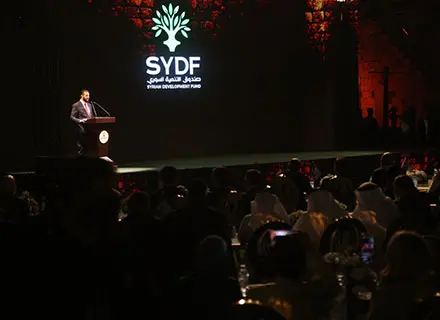

Syria’s new government has channelled assets seized from businesspeople linked to ousted president Bashar al-Assad into a secretive state fund valued at USD 50 billion, creating a powerful vehicle to manage the country’s economic recovery while raising questions about transparency, accountability and the concentration of economic power.
The Syrian Sovereign Fund, established by President Ahmed al-Sharaa in 2025, has taken control of a sprawling portfolio of businesses, factories, shopping centres, real estate and stakes in banks.
The fund’s reported valuation, disclosed by Syria’s finance minister last year, makes it one of the country’s most consequential economic institutions.
The fund says its businesses employ more than 40,000 people. Its influence extends across sectors, giving it a central role in deciding how businesses operate, where foreign capital flows and which development projects receive backing.
Thaer Laham, managing director of the Syrian Business Council, described it as the country’s wealthiest and most economically influential entity at present.
Rebuilding through seized assets
The fund forms part of the government’s effort to rebuild an economy devastated by years of conflict, sanctions, damaged infrastructure and declining investment. Rather than relying solely on public spending, the administration is seeking to use existing assets to attract overseas capital and expertise.
The authorities have taken over businesses associated with notable individuals from the Assad era, including Samer Foz, a businessman whose commercial interests spanned several sectors, and Mohammad and Wassim Qattan, whose assets included a shopping mall in Damascus.
A state committee responsible for recovering illegally acquired wealth has said the fund has been involved in managing 32 entities previously belonging to Foz across trade, services and banking.
The strategy presents a difficult question: how can the government recover assets allegedly accumulated through corruption and political patronage while ensuring that the proceeds benefit the wider population?
The scale of the challenge is considerable. The US State Department previously estimated the Assad family’s net worth at between USD 1 billion and USD 2 billion, while warning that its wealth was difficult to establish because assets were spread across companies, property portfolios, offshore structures and accounts held through intermediaries. The wider network of regime-linked business interests was considerably more extensive.
However, the USD 50 billion attributed to the Syrian Sovereign Fund should not be interpreted as cash available for reconstruction. It represents the reported value of a broad collection of assets, whose individual valuations, liabilities, ownership arrangements and income streams have not been fully disclosed.
Gulf investors see an opportunity
The fund has emerged as a key intermediary in the government’s efforts to attract investors from the Gulf and other international markets.
One of its most prominent initiatives is a USD 7 billion real estate development agreement with Emirati developer Arada. It has also entered into agreements with Turkish agricultural supply-chain company Tiryaki Agro and Saudi manufacturer Riyadh Cables Group to upgrade and manage assets.
The fund has taken a 25% stake in a Syrian company established by Kuwait’s Zain to operate a mobile network under a licence valued at USD 747 million. It has also helped establish businesses in payments, including a venture working with Visa, and domestic vehicle manufacturing.
These arrangements offer international companies access to a market where reconstruction needs are enormous and established commercial infrastructure remains limited. For Syria’s government, partnerships can bring capital, technology and management expertise without requiring the state to finance every project itself.
The opportunity is attracting attention as regional investors look for positions in Syria’s recovery. In February 2026, Syria and Saudi Arabia announced multibillion-dollar investment agreements covering telecommunications, aviation, airport development and water infrastructure.
But the fund’s opaque structure may complicate its efforts to build lasting confidence. Investors need clarity over the ownership of assets, the authority to enter contracts and the treatment of liabilities inherited from former owners.
Transparency and governance concerns
The identity of the fund’s director has become a particular source of scrutiny. Three people who had met him identified him as Ibrahim Succarieh, a Lebanese-Australian citizen who is reportedly under Australian sanctions over alleged links to an al-Qaeda affiliate. The fund has not publicly listed him as its director, and he did not respond to questions sent through the institution.
Syria’s tourism minister chairs the fund, which reports directly to the president. It says it has more than 270 employees and is developing its governance framework progressively, with the stated aim of aligning itself with international sovereign wealth fund practices.
Critics argue that such assurances are insufficient for an institution controlling assets worth tens of billions of dollars. Jihad Yazigi, editor of the Syria Report, has warned that the absence of transparency and the failure to formally identify the fund’s chief executive raise serious questions about its operations.
The lack of public disclosure also raises concerns over whether the fund could reproduce the crony capitalism that characterised parts of the previous regime’s economy. Transferring assets from former insiders to a new state institution does not, by itself, guarantee independent oversight or equitable distribution of economic gains.
A test of Syria’s economic transition
For al-Sharaa’s government, the fund offers a way to consolidate state assets and accelerate investment decisions in a country that urgently needs jobs, infrastructure and functioning public services.
Yet the same concentration of control could weaken competition if access to valuable assets depends on relationships with government officials rather than transparent commercial procedures.
The test will be whether Syria can turn its seized assets into productive investments while establishing credible rules for valuation, disclosure, ownership disputes and the use of profits.
With foreign investors showing interest in real estate, telecommunications and infrastructure, the fund could become a central engine of reconstruction. Without greater transparency, however, its growing influence risks replacing one opaque system of economic patronage with another.