
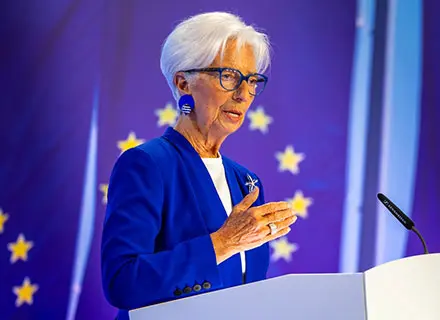

She was a lawyer rather than an economist, a former politician rather than a career central banker, and the first woman to run the institution that sets interest rates for the 21 countries that now share the euro.
Seven years on, she is leaving early, and on her own terms.
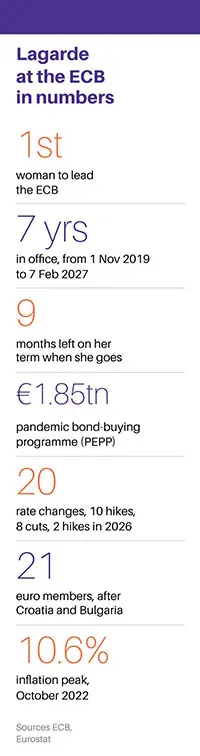
On October 29, after the Governing Council’s two-day policy meeting, Lagarde told her colleagues and European Council President António Costa that she will step down on February 7 2027, around nine months before her eight-year term was due to end.
At the press conference that followed, she explained the decision simply.
“I don’t think that I can remain neutral,” she said.
The timing tells its own story. France votes for a new president in April 2027, and polls make the far-right National Rally’s Marine Le Pen the favourite.
Leaving in February gives today’s leaders, including Emmanuel Macron and Friedrich Merz, time to agree on a successor before that vote.
Lagarde, now 70, is widely expected to chair the World Economic Forum, though she has not confirmed it.
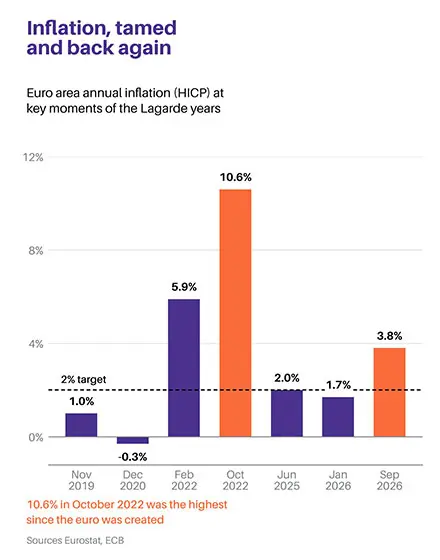
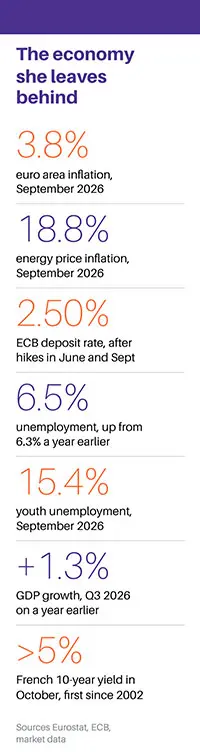
She departs with eurozone inflation at 3.8%, close to double the bank’s 2% target, French borrowing costs at their highest in more than two decades and unemployment creeping up.
That backdrop will shape how her years in Frankfurt are judged.
From Paris to Frankfurt
Born in Paris in 1956, Lagarde rose to chair the law firm Baker McKenzie, served as French finance minister through the global financial crisis and then became the first woman to lead the International Monetary Fund.
 She arrived at the ECB as a proven crisis manager, but with no experience of setting monetary policy.
Her first test came quickly. As Covid-19 shut European economies in March 2020, she said the ECB was “not here to close spreads”, a reference to the gap between Italian and German bond yields.
Markets read the remark as a retreat from Mario Draghi’s 2012 pledge to do whatever it took to save the euro. Italian borrowing costs jumped.
Within a week, the ECB launched the Pandemic Emergency Purchase Programme, a bond-buying scheme that was eventually expanded to 1.85 trillion euro.
It steadied markets and kept borrowing costs low for governments spending heavily to support businesses and households.
Repairing the council
Her less visible achievement was inside the building. Lagarde inherited a Governing Council in which several national governors had openly rebelled against Draghi’s final decisions, including the restart of bond purchases in September 2019.
She opened her tenure with a retreat for policymakers at a spa resort outside Frankfurt and set about rebuilding trust.
Former colleagues credit her with a more open process, in which every governor was heard before a decision was taken.
That consensus style survived the pandemic and the energy crisis that followed Russia’s invasion of Ukraine.
She also led the bank’s first full strategy review in nearly two decades. Completed in July 2021, it replaced the old goal of inflation “below, but close to, 2%” with a symmetric 2% target, meaning the ECB would treat overshoots and undershoots as equally unwelcome.
The review also brought climate change into the bank’s economic analysis and its supervision of lenders.
The inflation test
The biggest mark against her record is the price surge of 2021 and 2022.
Like other major central banks, the ECB first described rising inflation as temporary.
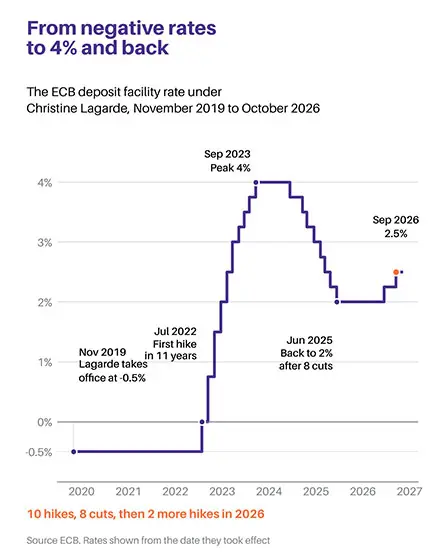
Eurozone inflation was already close to three times the target when Russia invaded Ukraine in February 2022, yet the bank waited until July to raise rates, months after the US Federal Reserve and the Bank of England had started.
 By October 2022, inflation had hit 10.6%, the highest since the single currency was created.
In the same month it began raising rates, the bank created the Transmission Protection Instrument, which allows it to buy the bonds of a member state facing a disorderly rise in borrowing costs that its economic fundamentals do not justify. It has never been used, but its existence calmed markets.
Inflation returned to about 2% by mid-2025, and the ECB cut rates eight times between June 2024 and June 2025, bringing the deposit rate back to 2%.
Emanuel Moench, co-director of the Centre for Central Banking in Frankfurt, has credited the bank with bringing inflation back to target “without triggering a recession”, even as he argues it reacted too late. The Fed has not matched that record.
A wider and more digital euro
The single currency grew on her watch. Croatia adopted the euro in January 2023 and Bulgaria followed in January 2026, taking the eurozone to 21 members.
Lagarde also turned the digital euro from a technical study into a political project. She argued that a central bank digital currency was a matter of European sovereignty, with US card networks and dollar stablecoins dominating payments in the region.
In July 2026, the European Parliament voted by 416 to 169 to open negotiations with member states on the law, and EU institutions aim to finalise it by the end of the year. A pilot is planned for 2027, with a possible launch by 2029.
Her record elsewhere is mixed. Early plans to steer bond buying and lending more firmly towards green investment were scaled back, and her drive to promote women into senior roles at the bank fell short of its own targets.
Her readiness to comment on politics, including criticism of US President Donald Trump, raised eyebrows among colleagues who believe central bankers should keep a lower profile. Her drawn-out exit, after months of speculation about a move to Davos, has also irritated some colleagues.
 A darker backdrop
The economy she leaves looks very different from February, when reports of her early exit surfaced. Inflation was then 1.7%, interest rates sat in neutral territory and growth was close to its potential, a rare combination for any central banker.
Conflict in the Middle East, including fighting between the United States and Iran, has since pushed oil above USD 100 a barrel.
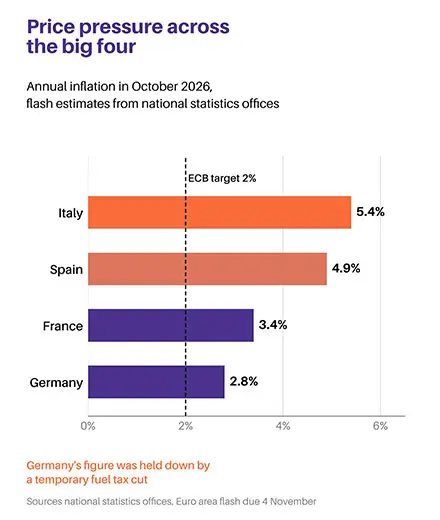
Eurozone inflation rose to 3.8% in September, its highest in three years, with energy prices up 18.8% from a year earlier.
 The ECB, which was cutting rates a year ago, has been forced to reverse course. It raised rates in June and again in September, taking the deposit rate to 2.5%, and held it there on October 29.
Another rise is possible in December.
The jobs market is also softening. Unemployment stood at 6.5% in September, up from 6.3% a year earlier and above the record low of 6.2% reached in late 2024.
Youth unemployment has climbed to 15.4%. Growth has held up better than feared, with GDP rising 0.4% in the third quarter and 1.3% over the year, helped by spending on defence, infrastructure and artificial intelligence (AI).
Germany grew just 0.2% in the quarter, and its recovery leans on exports and state spending while domestic demand stays weak.
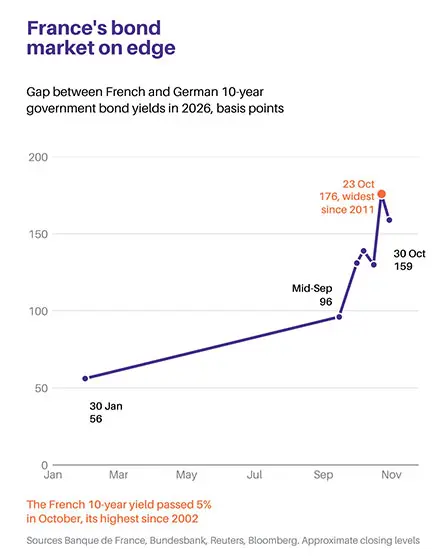
The most immediate danger lies in France. The gap between French and German ten-year borrowing costs, a closely watched gauge of investor nerves, widened from about 56 basis points in January to roughly 176 basis points on October 23, the widest since the eurozone debt crisis of 2011.
Worries over public finances and a possible far-right victory lie behind the sell-off. Asked about France, Lagarde said the bank had instruments ready to respond if trouble spread, a clear reference to the tool she created in 2022.
Both are career central bankers, a contrast with the former finance minister they would replace. Markets barely moved on the news, a sign that the ECB’s standing no longer depends on one person.
Whoever takes over faces a harder task than the one Lagarde inherited, bringing inflation down a second time without choking a fragile recovery, and possibly the first real test of the Transmission Protection Instrument if French bonds slide further.
 The verdict
Lagarde’s legacy will be debated for years. She was slow to spot the inflation surge and stumbled in her first crisis.
But she also restored unity to a divided council, built a tool that changed how the ECB protects the euro, brought prices back under control without a recession and set the single currency on a path into the digital age.
In a video message after her announcement, she said she was leaving with “a sense of good work done and an ECB that is fit for the future”.