

Berkshire Hathaway shares climbed on Monday, August 10, to their highest level since Warren Buffett told shareholders in May 2025 that he would hand over the chief executive’s job.
The trigger was a set of quarterly numbers that beat expectations, and, more importantly for the market, the first clear evidence that his successor Greg Abel is willing to spend.
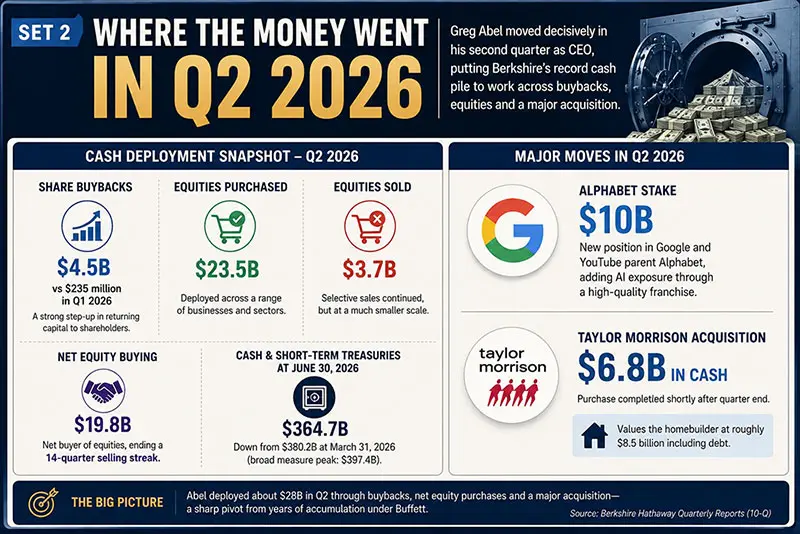
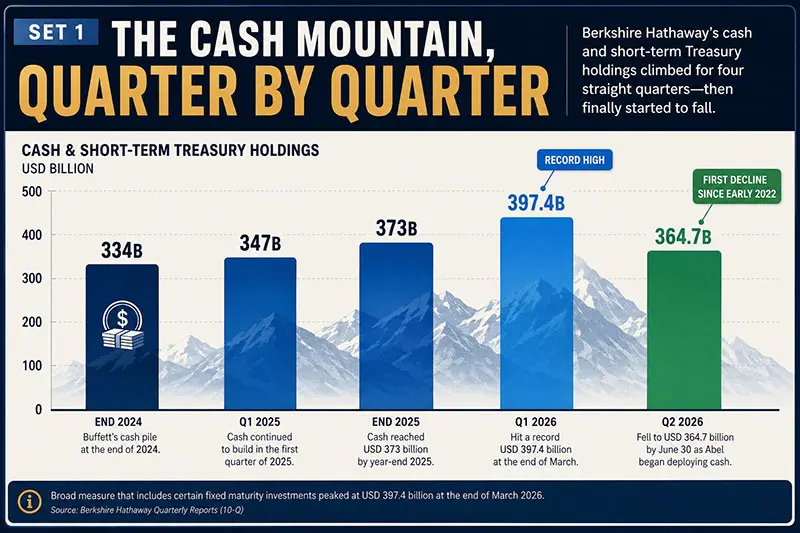
Berkshire’s cash and short-term Treasury holdings fell to USD 364.7 billion on June 30, down from USD 380.2 billion three months earlier.
Set against the USD 235 million of buybacks in Abel’s first quarter in the chair, that is a striking acceleration. Berkshire was also a net buyer of equities to the tune of USD 19.8 billion, ending a streak of 14 consecutive quarters in which it sold more shares than it bought.
Shortly after the quarter closed, Abel completed the USD 6.8 billion purchase of homebuilder Taylor Morrison, valuing the business at roughly USD 8.5 billion including debt.
The operating numbers helped. Operating earnings rose 16% to USD 12.98 billion from USD 11.16 billion a year earlier. Net earnings, flattered by USD 12.7 billion of investment gains, more than doubled to USD 25.67 billion.
Manufacturing, service and retailing profits jumped 24% to USD 4.47 billion, Berkshire Hathaway Energy rose 27% to USD 891 million and railroad BNSF added 6% to USD 1.56 billion. Insurance was the weak spot, with underwriting earnings down 13% and GEICO’s underwriting profit falling 45%.
How Buffett ran the same balance sheet
For most of the past four years, Berkshire’s defining act was inaction. Buffett let the cash build because he could not find businesses he wanted at prices he was willing to pay.
He sold down a large slice of the Apple stake, took profits elsewhere, parked the proceeds in Treasury bills and waited. Cash climbed from USD 334 billion at the end of 2024 to USD 373 billion a year later, and kept climbing into 2026.
His reasoning was never mysterious. Buffett wanted a fortress balance sheet that could absorb a mega-catastrophe in the insurance business without forcing a single asset sale, and he wanted the firepower to act when other people could not.
That is exactly what happened in 2008, when Berkshire wrote cheques to Goldman Sachs and General Electric on terms nobody else could offer. The cash was not idle in his mind. It was an option on somebody else’s panic.
He was also being paid to wait. With short-term rates elevated, a USD 350 billion Treasury bill position threw off serious income at almost no risk. His last significant acquisition before stepping back was the USD 9.7 billion purchase of OxyChem in 2025.
The case for waiting
The strengths of the Buffett approach are easy to list. Nothing gets destroyed. A conglomerate that never overpays never has to write down goodwill, never has to explain a bad deal at the annual meeting and never loses the trust of its shareholders.
The weaknesses are just as clear, and shareholders had begun to say so out loud. A cash position running near 29% of the company’s total size is a drag on returns.
Treasury bills beat losing money, but they do not compound the way a good operating business does, and the income is fully taxed. Berkshire pays no dividend, so investors who wanted their capital working had no way to reclaim it. The longer the pile grew, the more it looked less like patience and more like a shortage of ideas.
The case for spending
Abel’s version is not reckless, whatever the headlines suggest. Spending roughly USD 15 billion out of USD 380 billion is a change of tone rather than a change of religion. But the tone matters.
Buying back stock when the shares trade below what the businesses are worth mechanically lifts value per share for everyone who stays.
The Taylor Morrison deal fits Berkshire’s existing footprint, sitting alongside Clayton Homes, Shaw Industries, MiTek and HomeServices of America, which is the kind of synergy Buffett himself always favoured. Abel has signalled he will buy whole companies rather than only shares, which is the harder and more useful skill for a conglomerate of this size.
The Alphabet position, meanwhile, gives Berkshire exposure to artificial intelligence infrastructure through a business with the cash flows and moat that Berkshire has always liked.
The risks are real too. A homebuilder is a cyclical, rate-sensitive asset bought at a point in the cycle when American housing affordability is stretched. Buybacks executed at higher prices are simply a transfer from continuing shareholders to exiting ones.
A new chief executive under pressure to prove he is not merely a caretaker can feel obliged to act, and deals made to answer critics tend to age badly.
What analysts are saying
Wall Street’s verdict so far is approving but conditional. Analysts have described the mood around Berkshire as a “show me” posture, with shareholders waiting for sustained proof that Abel can allocate capital as well as his predecessor did.
The consensus price target sits almost exactly at the current share price, which is about as neutral as coverage gets. Consensus forecasts also point to earnings drifting lower by roughly 2.4% a year over the next three years, which raises the bar for every deployment decision Abel makes.
The share price tells the same story. Berkshire entered August up about 3% for the year against a roughly 13% advance for the S&P 500, a gap of some ten percentage points that reflects lingering doubt about the transition rather than any weakness in the underlying businesses.
There is warmth in the commentary as well. Gabelli Funds’ Macrae Sykes noted that Berkshire continues to build shareholder net worth in Abel’s first year despite a tougher backdrop in the insurance industry, which is a fair reading of a quarter where the operating engines fired and only underwriting stumbled.
Analysts at Forbes cautioned that insurance headwinds will probably hold full-year operating earnings growth to the low to mid single digits, so the deployment story is doing a lot of the work in the share price at the moment.
Buffett, now chairman, offered his own endorsement at the annual meeting in May, telling shareholders that Greg is doing everything he did and then some. Coming from a man who spent six decades guarding this balance sheet, that is not a small thing to say.
The honest verdict
Neither approach is obviously right, because they are answers to different questions. Buffett was managing a company he had built and could afford to run at his own pace, and his caution was underwritten by 60 years of credibility.
Abel inherited a balance sheet that had drifted into an unusual shape and a shareholder base that wanted to see a plan. Sitting on the pile for another two years would have been the riskier choice for him, not the safer one.
The real test is not how fast the cash goes out but what it buys. Berkshire’s next 13F filing, along with the performance of Taylor Morrison and Alphabet through a full cycle, will say far more about Abel’s judgment than a single quarter of accelerated spending.